Home Blog Page 16

Terri Calvesbert suffered 90 percent burns and survived house blaze against all odds – this is her today

0

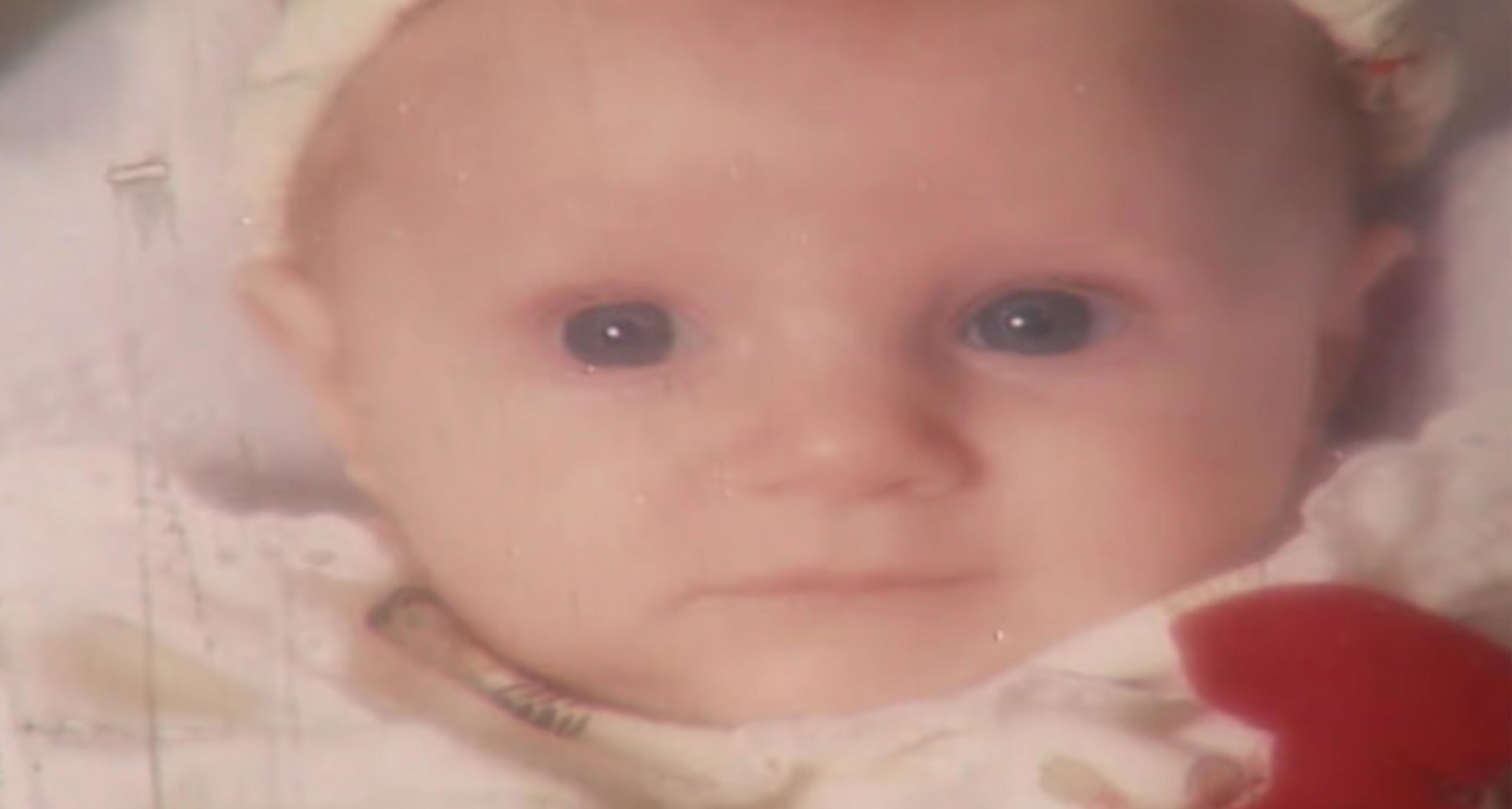
The life of Terri Calvesbert from Ipswich, England, changed forever when she was just an 18-month-old baby. Today, she is considered a fighter who never gave up on her life and her future.

Around the time she turned one and a half, Terri suffered a horrible incident. Her mother, Julie, had a hard time putting the baby to sleep. “She was normally such a brilliant sleeper, so I didn’t understand why she wouldn’t settle,” Julie recalled in an interview with The Sun. Not knowing what to do, Julie decided to let the girl tire herself out and left the room forgetting she placed her burning cigarette there. “I never smoked in the flat, but this one night I did. I don’t know why to this day, I did such a stupid thing.”

Shortly after, Julie heard Terri screaming so she went back to the room. At that point, the entire place was filled with smoke and everything was caught on fire.
Youtube/Realstories

In a state of panic, she immediately called 911.

“I remember running into the kitchen and getting a bowl and filling it with water and throwing it into the bedroom, but it made no difference. So many people have said to me since that I should have gone in there and got her. But I panicked,” Julie recalled of that horrible night.

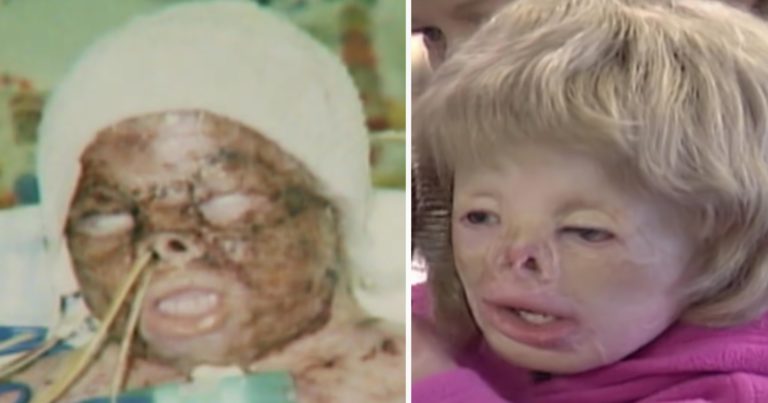
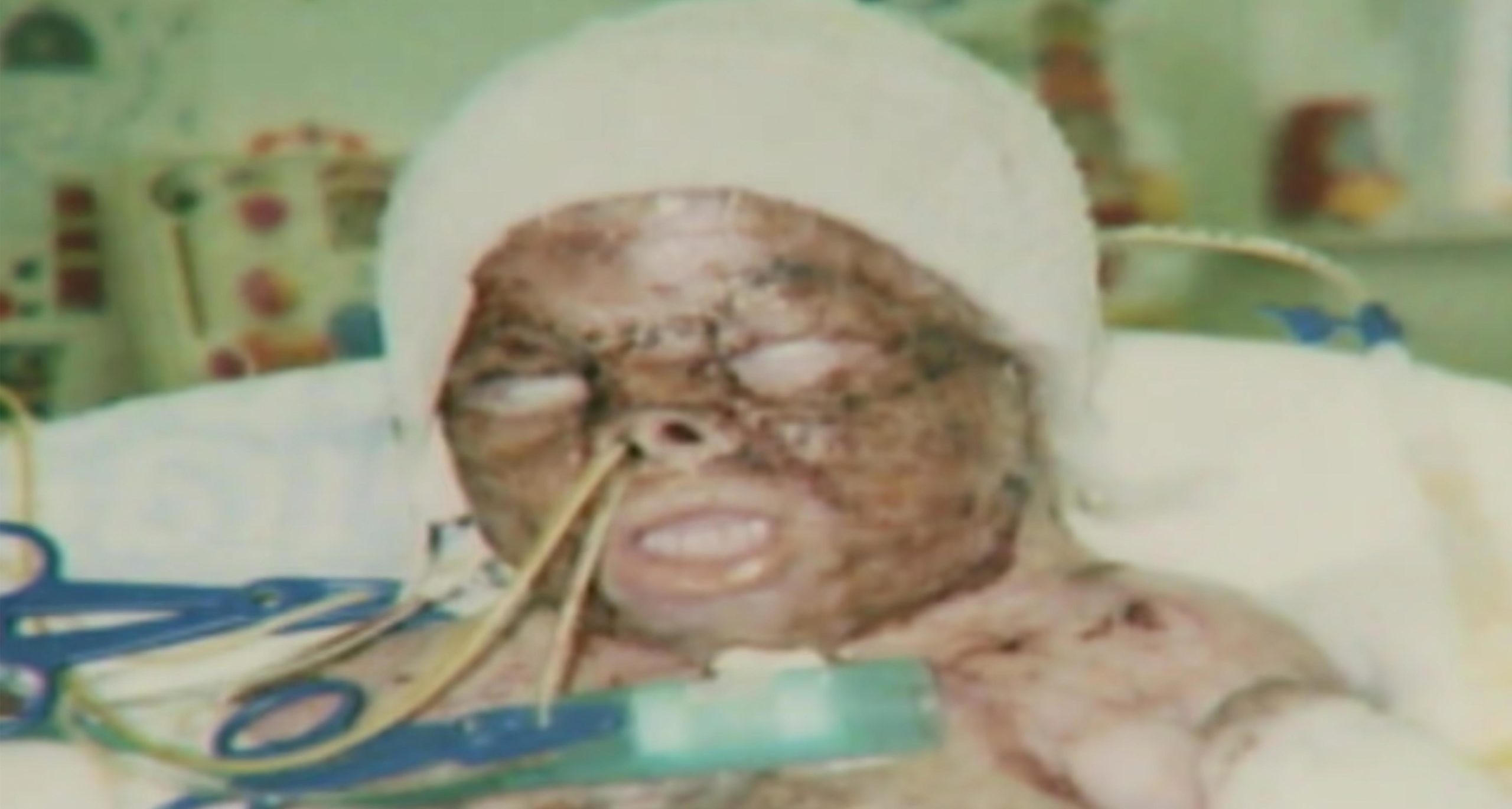
Terri suffered horrific burns on 90 percent of her body and no one believed she would survive.

“I have never seen anybody with extreme burns to that degree,” firefighter Simon Bevan, who saved Terri, said in the Channel 5 documentary, The Girl With 90 Percent Burns. When he spotted her, he thought she was a charred plastic doll.

“She was so badly burnt I could not extend her neck to resuscitate her, and her body was totally rock hard. No one was expecting Terri to survive.”
Youtube/Realstories

Terri spent six months at the St. Andrews hospital in Chelmsford, England, and required more than 40 skin grafts. Until the age of 12, she had undergone 60 surgeries and her survival was dubbed a miracle. Sadly, Terri lost her hair, her nose, her fingers, and one of her feet.

During the time she was fighting for her life, her mother, filled with guilt, left Terri an her father. Luckily, Terri’s dad, Paul, is one of the best and most caring people there are.

“My dad stays with me and takes me down to the operating theatre, but all the operations scare me and they hurt a lot,” Terri said in the past.

“The last operation I had was on my left hand, to open out my fingers, but that was horrible because it got infected and I was really sick. I need eye drops too and because I didn’t have them put in that time, my eyes were sore too,” she added.

Youtube/Realstories

For her bravery and determination to regain her life back, Terri was awarded a Pride of Britain child of courage award by the Duchess of York in 2004.

With the help of her dad, she achieved many things. Terri was able to go to school where she made many friends who never teased her for her appearance but accepted her for who she is.

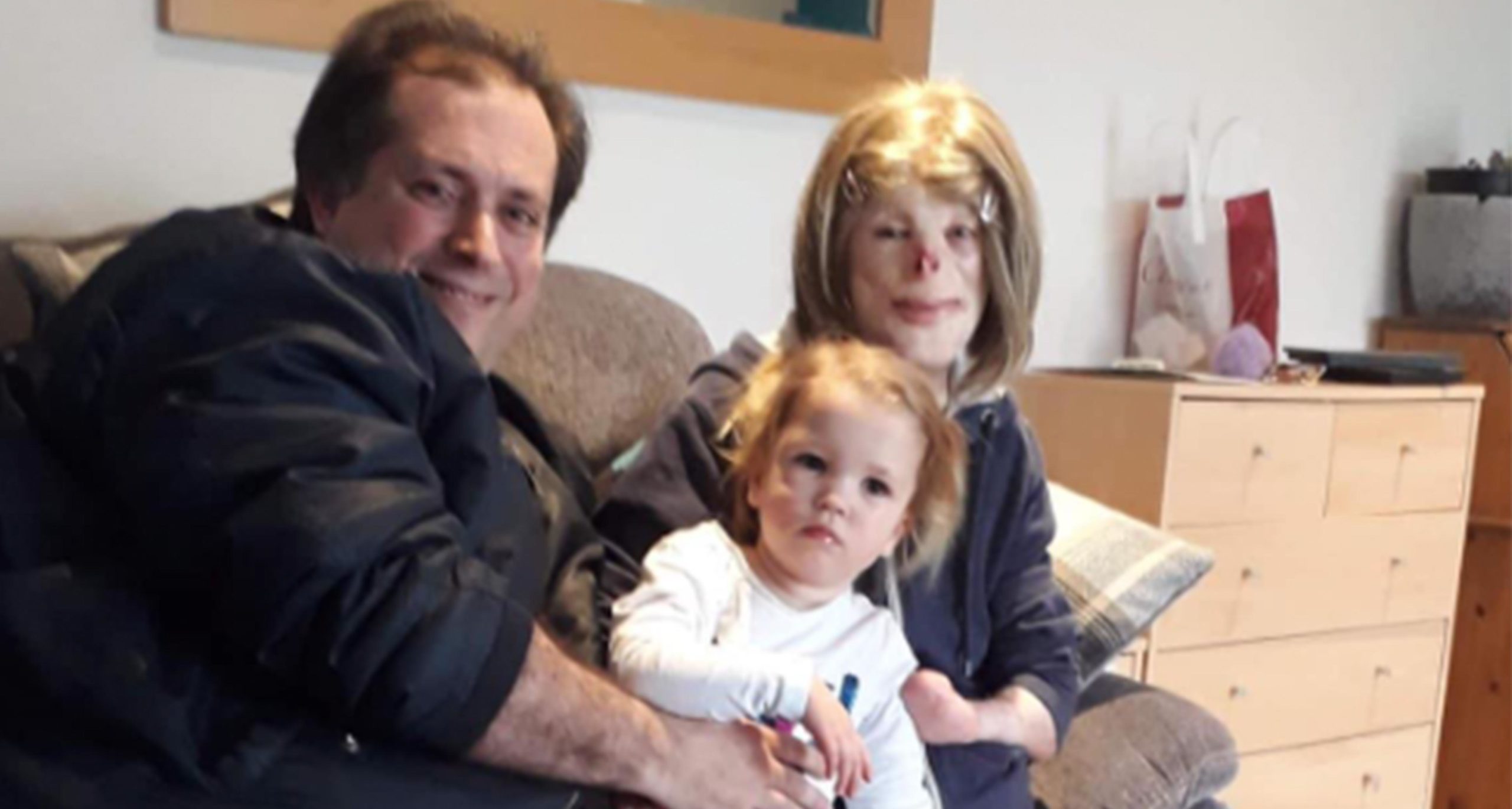
Terri moved on with her life. She even forgave her mother for leaving her. Years after the accident, Julie contacted Terri’s father and asked to see her daughter. Having such a big heart as she does, Terri agreed and the two see each other every now and then even today.
Facebook/TerriCalvesbert

“My mum phoned Dad after she heard he was getting married to his girlfriend Nicky and said she wanted to see me,” Terri recalled when she was 12 years old.

“Now I see her every few weeks at my grandma’s house. It’s not weird at all, it’s just normal. We talk about things like what I’m doing at school. I’m not angry with her about the fire.

“I just think I’m lucky because I see my mum and then there’s Nicky too. It’s like I have two mums instead of one.”
Facebook/TerriCalvesbert

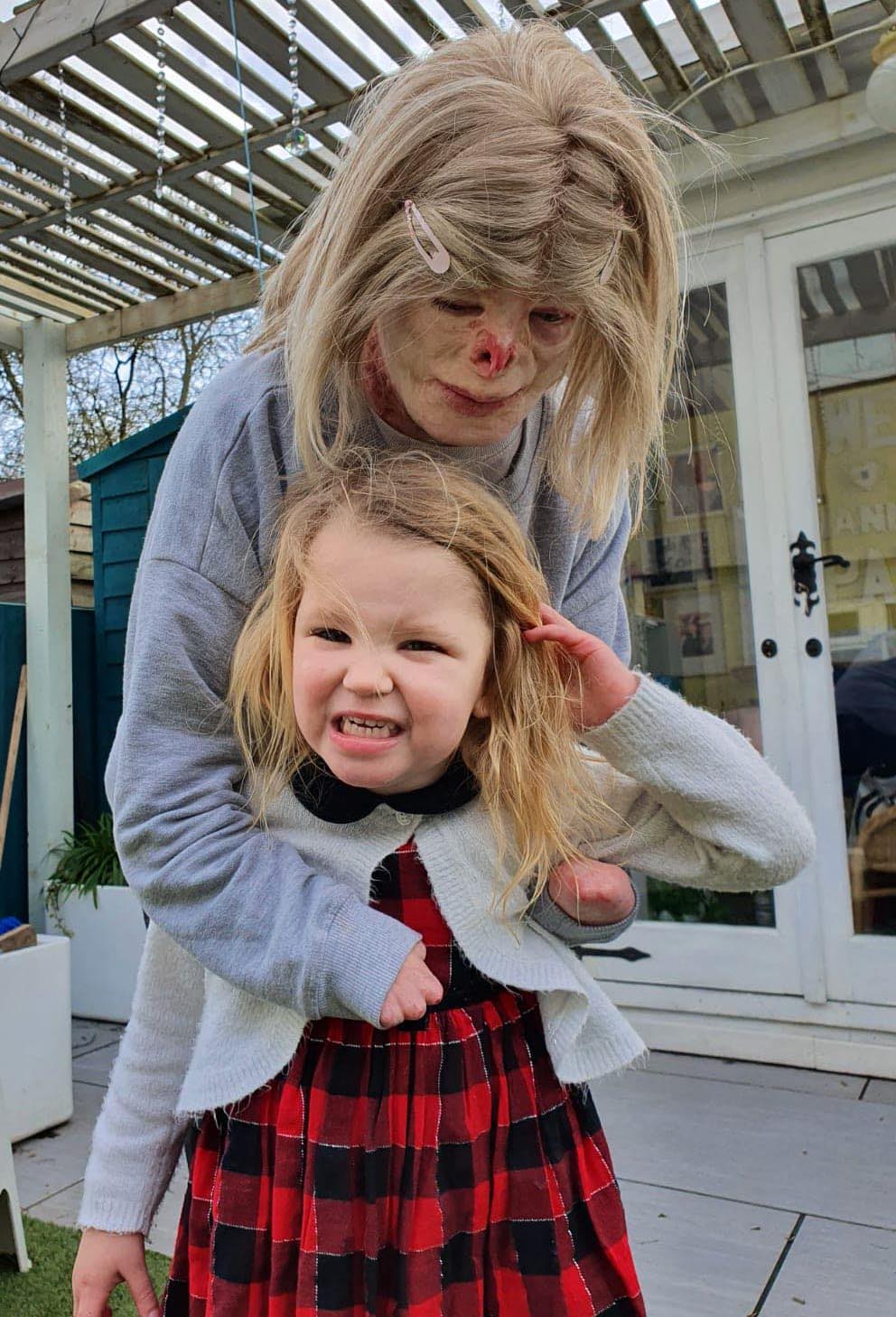
Over the years, Terri received support from those close to her as well as from complete strangers. The fund set up to help her with the expenses helped raise around $500,000 from 1999 to 2012.

“The trust fund has been amazing, I have lost count of how much money people have raised for me,” Terri told Ipswich Star. “I even get messages now on Facebook still, with people from Canada or America, which is crazy. It means so much to me.”
Facebook/TerriCalvesbert

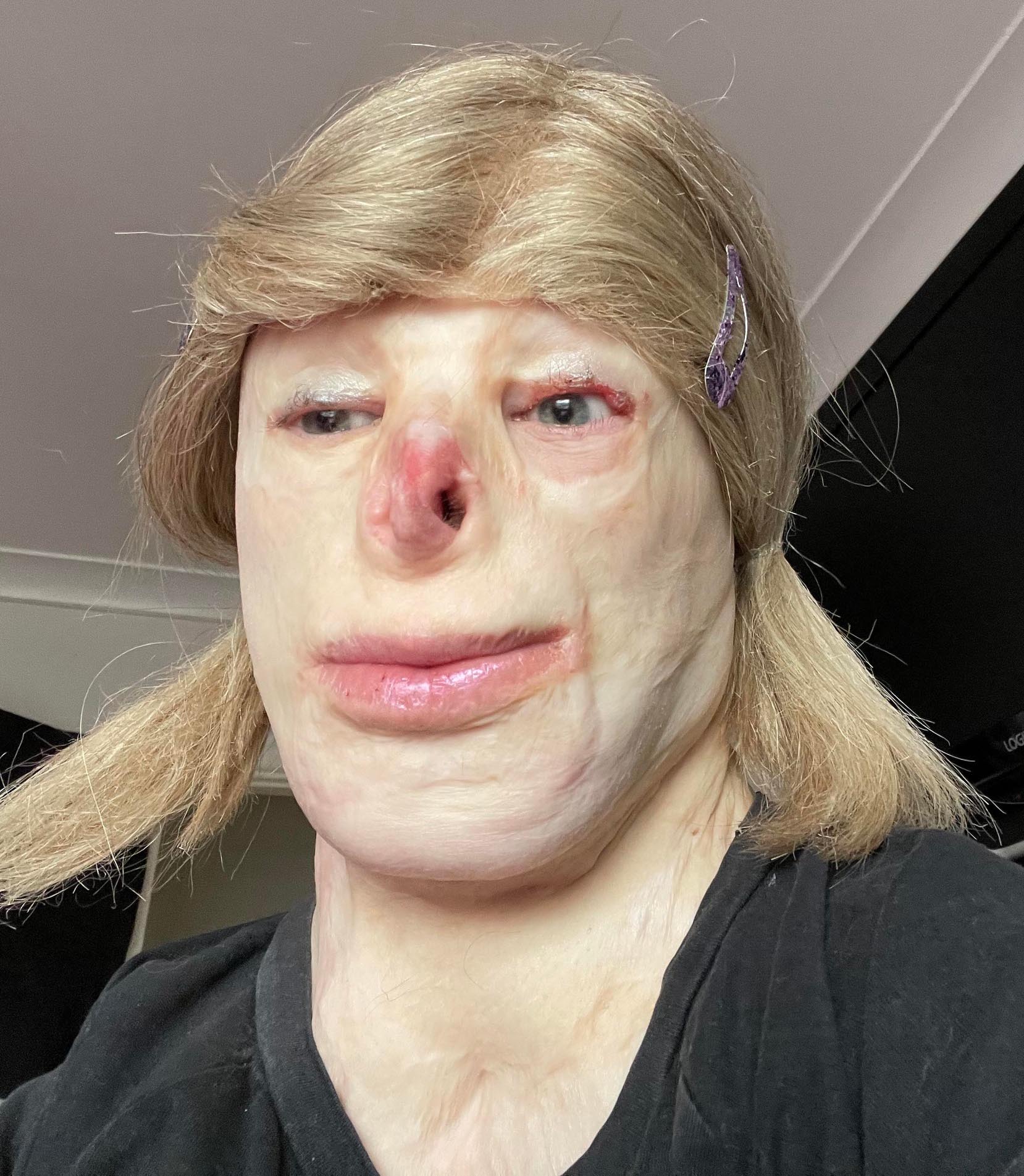
Today, 28-year-old Terri is happily married to her “best friend.” The two met through Facebook some years ago and have been together ever since. Terri is a mom of five-year-old daughter Poppy-Mae.

“It’s scary to be a mum and I never thought I would be able to be one. But it is great and I love it. She’s a good girl,” Terri shared with the Ipswich Star.

She is happy and loves her family to the moon and back. “I wouldn’t take my leg off at first in front of Richard,” Terri shared. “But he made me feel really comfortable very quickly and now I take my wig and my leg off at night. He really does love me.”

After everything she went through, Terri truly deserves the life she has today with her husband and daughter. “There have been difficult times over the years going through so many painful operations, but I’m so proud I’ve got to this point,” this brave woman says.

Please SHARE this article with your family and friends on Facebook.

Bored Daddy

Love and Peace

How this Hollywood star transformed pain and loss into a life filled with love and hope

0

Some would say he’s best know for his voice that has that rich, vibrating quality of a vintage cello played in a grand hall, and it wouldn’t be far from the truth. This Hollywood star, however, is also known as the heart and soul of the greatest sitcoms to have ever graced American television.

Today, at 71, he still stands as one of the most revered figures in the film industry, with six Emmy’s under his belt, and no plan of slowing down any time soon.

Kelsey Grammer was born in 1955 in Saint Thomas, U.S. Virgin Islands. When his parents divorces, which was something he didn’t take easy, he moved to New jersey with his maternal grandparents who raised him.

At the age of just twelve, Grammer lost his grandfather, whom he considered a father-figure and the most important person in his life.

Grammer’s grandfather died of cancer after years of heavy alcohol abuse, and towards the end of his life, he became less patient with Grammer, who once recalled, “And that begun the idea that there was something wrong with me.”

Just a year later, another tragedy struck when Grammer’s father was shot and killed outside their home by a complete stranger who was charged with the killing but was found no guilty by reason of insanity. As expected, this left young Grammer devastated.

During the time Grammer was studying theater at Juilliard in New York, seven years following his father’s murder, he experienced yet another shattering ordeal that changed his life forever.

His younger sister, Karen, was kidnapped by four man, sexually abused, and murdered in Colorado Springs.

For a long time, Grammer blamed himself for the tragedy. Speaking to Vanity Fair, he revealed, “It’s hard to explain. It’s not rational. But it happens anyway. I know a lot of people who’ve lost their siblings and blame themselves.”

One of the men involved in the murder of Karen, Freddie Glenn, was convicted of her murder and of two others. He was initially sentenced to death, but the sentence was later overturned.

Years later, the Emmy-winning star continued speaking out against Glenn’s multiple parole opportunities, writing to the board in 2009.

“I miss her in my bones, I was her big brother. I was supposed to protect her — I could not… It very nearly destroyed me.”

Actor Kelsey Grammer attends T.J. Marteil Foundation Benefit Baseball Game on June 14, 1992 at DeDavex Field in Los Angeles, California. (Photo by Ron Galella, Ltd./Ron Galella Collection via Getty Images)

In 2014, the actor confronted his sister’s murderer via video link, responding with both honesty and grace.

“I accept that you actually live with remorse every day of your life, but I live with tragedy every day of mine… I accept your apology, I forgive you. However, I cannot give your release my endorsement. To give that a blessing would be a betrayal of my sister’s life.”

The staggering losses of his father and sister were followed by another family tragedy in 1980. Grammer’s two half-brothers, Stephen and Billy lost their lives in a scuba-diving accident. After Billy didn’t return to the surface, Stephen returned to rescue him, but suffered a fatal air embolism. Billy’s body was never found.

These dark moments of his life were the reason Grammer turned to substance abuse, something he spoke about openly. In attempt to overcome the overwhelming grief he experienced, he just “kept drinking.”

Speaking to Vanity Fair, the actor said, “That was the time when I could not forgive myself for my sister’s death.”

At the time, he turned away from God, but he now urges others who experience loss not to do the same.

“I would advise people to step away from that. If I could, I would say, rather than turn away from God, turn toward Him in these situations,” the actor told Fox News Digital. ”Because it isn’t like God’s out to get you. But it feels like that sometimes. And that was very hard.”

Shutterstock

Grammer has been sober since 1996, and today, he approaches life’s challenges with a hard-won resilience.

“Every one of us is going to experience some terrible loss. I just got a big dose. For every story you hear that’s tragic, there’s another that’s equally tragic or more so. I think you come to look at it as part of life.”

Kelsey Grammer experienced loss, pain, and hardship, but despite everything, he managed to build a successful Holiday career.

Grammer’s acting career began on the stage in the late 1970s, leading to his Broadway debut in 1981 as Lennox in Macbeth.

By 1984, he landed the career-altering role of Dr. Frasier Cane on Cheers, later starring in the spinoff Frasier. His portrayal of the refined psychiatrist made him a household name and earned him four Emmy awards for his wit and charm.

When it comes to his love life, it’s as cinematic. On a flight to London, Grammer met Kayte Walsh, a flight attendant from England and daughter of football player Alan Walsh. They felt instant connection and soon married at New York’s Plaza Hotel on February 15, 2011, shortly after his third marriage concluded.

It seemed like he finally found the woman of his dreams.

Speaking of Kayte, who is 25 years his junior, Grammer said, “This lovely woman lit up my world and changed my heart, which was a bit calloused and hardened against a lot of things. And we are good, and I feel young and alive.”

In 2025, the couple welcomed their fourth child together, making Grammer the father of eight. He has four other children from previous marriages and relationships.

“I have neglected a couple of the kids in my life, especially the first two,” Grammer once told People. “I’m trying to make up for a little of it now. I’m still their dad, so you can always have [a] chance to show up.”

Kelsey Grammer attends the 2020 Vanity Fair Oscar Party hosted by Radhika Jones at Wallis Annenberg Center for the Performing Arts on February 09, 2020 in Beverly Hills, California. (Photo by Frazer Harrison/Getty Images)

As a father, Grammer makes constant efforts to teach his children not to let anger consume them, a lesson he learned the hard way following his father’s and sister’s murders.

“They say stuff all the time, like, ‘I want to kill [Freddie],’” he explains.

“I tell them, ‘I understand it and respect you for it, but you’re going to want more from life than that.’”

His daughters, Spencer and Greer, have followed into his footsteps as actors, while two of his other children, Mason and Jude, are pursuing film production in college.

Grammer is also a devoted grandfather to his first grandchild Emmett Emmanuel Hesketh, born in 2011 to his daughter Scarlett and her then-husband James Hesketh.

Please SHARE this article with your family and friends on Facebook.

Bored Daddy

Love and Peace

Scientists link gut bacteria to colorectal cancer — here’s how to support a healthy gut

0

In recent years, the number of younger adults diagnosed with early-onset colorectal cancer has increased significantly, which made experts research the possible causes that led particular demographic to face a growing threat of this particular type of cancer.

According to research funded through Cancer Grand Challenges, the reason could be child exposure to to a toxin produced by Escherichia Coli.

While E. Coli is a vital part of a healthy gut microbiome, as explained by Cancer Research UK, some strains of it can produce a toxin called colibactin capable of altering DNA. This toxin, which is also produced by other harmful species of gut bacteria except for E. Coli, can damage cells in the colon, potentially contributing to colorectal cancer, which is currently the second-leading cause of cancer-related deaths in the United States.

“Not every environmental factor or behavior we study leaves a mark on our genome,” Ludmil Alexandrov, a professor at U.C. San Diego and a member of the school’s Moores Cancer Center, said in a statement. “But we’ve found that colibactin is one of those that can. In this case, its genetic imprint appears to be strongly associated with colorectal cancers in young adults.”

According to the American Cancer Society, it is estimated that the number of people diagnosed with colorectal cancer this year would be 158,000. Also, 55,000 deaths are expected.

Experts, however, argue that there are steps that could help prevent colibactin, as per The Independent.

One of those steps is understanding the exact impact colibactin has on the gut. Human digestive system consists of trillions of bacteria that help create a complex eco-system that changes as we age. At infancy, or typically around six months of age, E.Coli is the dominant force in the gut. This, however, shifts as we go into adulthood.

According to research, around 20-30% of the adult population carries E. Coli strains capable of producing colibactin, says Christian Jobin, a microbiome researcher at the University of Florida. However, carrying this bacteria doesn’t always translate into cancer. It is interesting to note that cancers tied to colibactin are less common in Africa and Asia compared to the US and Western Europe.

Researchers are still working to understand the “why” in this disparity. Jobin suggests that the behavior of colibactin-producing E.Coli is influenced by a variety of factors, including our diet, internal inflammation, and even specific medications.

Further, Jobin argues that how people are born, breastfeeding, the use of antibiotics, and whether or not children were fed processed foods, can all be contributing factors.

“All of these factors are known to substantially affect the microbiome and there is some evidence they may impact this [colibactin producing] bacteria, but we really need to investigate each one carefully,” said Jobin.

This perspective shifts the focus from the time of diagnosis to the many decades of “silent” development that preceded it. By the time the tumor is detected, the microbiome in the gut has already changed significantly, often as a result of different exposures early in life.

“It might not be just about what happens in adulthood – cancer could potentially be influenced by events in early life, perhaps even the first few years,” said Alexandrov.

Building a healthy gut in infants is crucial for supporting their immune system, their nervous system, and their digestion. The first few months are critical, according to Chicago’s Children’s Healthcare Associates.

Parents can support this development through breastfeeding, introducing foods packed with beneficial bacteria, or using probiotic-fortified formula. Even simple skin-to-skin contact helps as microbes from the parent’s skin transfer to the baby and help establish a resilient gut microbiome.

It is also very important to avoid antibiotics, unless they are really necsessary.

“Antibiotics can knock out a raging ear infection and cure strep throat, but they can kill off beneficial gut bacteria at the same time. Use these drugs only when needed, not for viral infections like colds, flu, and many ear and sinus infections,” Stanford Medicine says.

When it comes to adults and the health of their gut, the strategies are rather similar.

Even a single serving of probiotic-rich foods – think yoghurt, pickles, sauerkraut, or sourdough – can give the good bacteria a boost. According to the Children’s Hospital of Philadelphia, these foods help lower the count of harmful bacteria by increasing acidity by also tackling the inflammation linked to chronic diseases such as cancer.

Boosting your fiber is just as vital. Foods like bell peppers, bananas, oats, and asparagus serve as prebiotics and fuel the good bacteria present in your system. According to researchers, just three to five grams of prebiotics daily can strengthen the gut health and protect you from harmful bacteria such as E. Coli.

What also plays an important role in keeping your gut healthy are hydration and physical activity. Water is the key ingredient for the mucus that protects the digestive system, while exercise and any form of physical activity helps keep your good bacteria “happy.”

While sedentary life can can limit your microbes, just 150 minutes of moderate activity a week is enough to see improvement. Mayo Clinic suggests that women drink 11.5 eight-ounce cups of water per day, and man have 15.5.

As per the American Cancer Society, colorectal cancer starts in the colon. “Most colorectal cancers start as a growth on the inner lining of the colon or rectum. These growths are called polyps.”

While polyps are quite common and often noncancerous, some can turn into cancer over time.

Dr. Jeremy Kortmansky of Yale School of Medicine explains that colorectal cancer typically exhibits aggressive histological features, which is why it is often diagnosed in later stages.

The symptoms can be rectal bleeding, changes in bowel habits, diarrhea, or constipation. It is very likely these symptoms to be mistaken for less severe issues like hemorrhoids or irritable bowel syndrome.

Of course, as with any other cancer, genetics can play significant role at colorectal cancer.

Obesity increases cancer risk by altering hormones like insulin, promoting cell growth. Chronic inflammation caused by fat tissue also contributes to this risk. A study in JAMA Oncology found that obesity nearly doubles the risk of early-onset colorectal cancer.

Please SHARE this article with your family and friends on Facebook.

Bored Daddy

Love and Peace

Signs your heart is in danger

0

Heart disease and diabetes are two of the most common chronic diseases affecting people worldwide today. What many people fail to grasp, however, is how closely these two chronic conditions are linked. Very often, they come in a pair and affect your body in ways you probably can’t even imagines, and yes, you might be surprised to learn this, but it goes don’t to your feet.

According to the American Diabetes Association (ADA), cardiovascular disease remains a leading cause of death at people diagnosed with diabetes. Living with diabetes increases the chances of facing certain cardiovascular issues, including stroke, compared to those not affected by diabetes.

While most of us link heart issues with chest pain, troubles breathing, and fatigue, the truth is that our body sometimes shows signs in places we are least likely to expect. According to research, some of the very first red flags show up in the feet and the lower legs.

Being aware of the connection between heart disease and diabetes helps in recognizing these early signs, which can help in detecting the problem early on when treatment is most successful, just like with any other disease.

The strong connection between diabetes and cardiovascular disease

In essence, diabetes refers to the way your body processes glucose, or blood sugar. When the glucose levels tend to stay high for too long, they eventually cause blood vessels and nerves throughout our nervous system to wear down.

As explained by the ADA Standards of Care, prolonged high levels of sugar in the blood lead to two specific types of vascular damage.

Microvascular Damage (Small blood vessels)

This type of cardiovascular damage affects the small blood vessels, and when that happens, it easily leads to several conditions, including diabetic neuropathy (nerve damage), diabetic retinopathy (eye damage), and kidney disease.

Nerve damage can affect the feet, and you may start feeling numbness which in turn can prevent you from noticing small injuries. Before long, sadly, something that feels minor initially, can turn into a bigger problem.

Macrovascular Damage (Large arteries)

Macrovascular complications affect the large arteries and are directly tied to heart disease. These include coronary artery disease, stroke, and peripheral artery disease (PAD).

At people with diabetes, the process of atherosclerosis, or the buildup of fatty plaque inside the artery walls, progresses at higher speed. Over time, this buildup leads the arteries to narrow and stiffen, thus affect healthy blood flow.

PAD is a major contributing factor in foot health since it affects circulation in a way it narrows vessels and starves the lower limbs of blood because of the plaque buildup, the American Heart Association explains. Unfortunately, this common condition affects millions of people worldwide, and increases the risk of heart attack, stroke, and even amputation of the low extremities.

Unsplash

A simple reason why the feet are affected the most compared to other parts of the body is because they are farthest from the heart.

It is good circulation that is crucial in maintaining tissues healthy and helping in the healing of wounds. When the circulation is poor, it’s hard for the feet to receive the levels of oxygen and nutrients needed.

At its core, two main biological processes connect the dots between diabetes, heart disease, and the health of your feet. Think of it as a double-hit to the body’s “infrastructure”: one strikes the electrical system (nerves), while the other clogs the plumbing (blood vessels).

Peripheral Neuropathy (Nerve damage in the feet)

One of the most common problems people with diabetes face is peripheral neuropathy, which is one of the main reasons for diabetic foot ulcer.

When blood sugar levels are high, it is like a short circuit in the nerves, and this is a big concern for foot health because, in many cases, this can cause loss of sensation. If you do not feel a pebble in your shoe or a blister developing, a minor irritant can become a serious infected ulcer before you are even aware of it.

Peripheral Artery Disease (Reduced blood flow)

Whereas neuropathy affects feeling, peripheral artery disease affects healing. Since diabetes speeds up the buildup of plaque in the larger arteries, the blood flow to the lower extremities is made more difficult. This lack of steady oxygen supply prevents even the smallest cuts from healing, which seriously increases the risk of infection, according to Pub Med.

Unsplash

When neuropathy and poor circulation occur together

One of the most dangerous aspects of diabetes is that nerve damage and poor circulation can occur at the same time, making it a combination that can easily cause a number of issues. For example, a person develops a small blister on the feet, and they don’t even feel it because of nerve damage caused by diabetes. At the same time, the blister cannot heal easily due to poor circulation. Next, an infection sets in because bacteria found its way to the blister. The problem arises when this infection is not treated on time and it gets deeper into the tissue.

In severe cases, the tissue can die due to poor circulation, a condition known as gangrene.

According to recent cardiovascular guidelines, patients with both diabetes and PAD are at a significantly increased risk for foot ulcers, infections, and complications.

Warning signs in the feet that can reflect heart health

Since both diabetes and cardiovascular disease affect the blood circulation in the body, the feet can sometimes show warning signs of more serious vascular problems.

Doctors advise patients to watch for the following signs and symptoms:

Cold feet

Sometimes, cold feet could mean that the blood flow to the feet is reduced because of narrowed arteries.

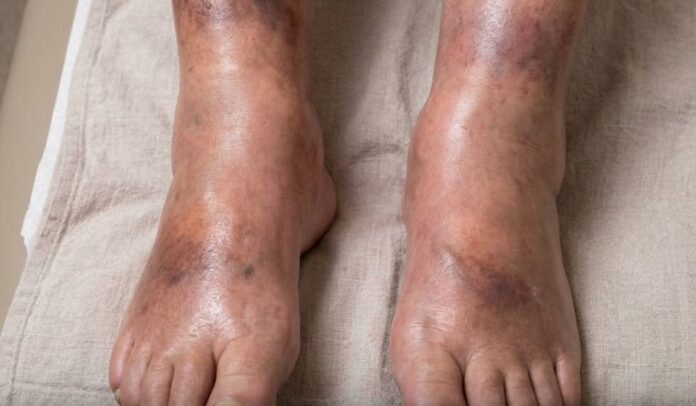
Swelling in the feet or the ankles

Swelling in the feet and ankles, known as edema, could sometimes be linked to heart failure.

Pain when walking

Pain in the legs that occurs when walking and disappears when resting could be a symptom of peripheral artery disease.

Slow-healing wounds

If wounds and cuts do not heal in two weeks, it is always a good idea to consult a doctor.

Changes in skin color

If the feet turn pale, bluish, or reddish, it could be a sign of poor circulation.

Loss of sensation

Numbness, tingling, and burning sensations could mean nerve damage, which is usually associated with diabetes.

Unsplash

Why foot problems can sign signal broader cardiovascular disease

The thing about peripheral artery disease is that doesn’t only stick to the legs. Doctors see PAD as a sign of systemic atherosclerosis, which means the plaque build-up is not limited to the vessels in your legs but is systemic throughout your body.

If the vessels in your legs are compromised and are narrowing, there is a very high chance that the vessels supplying your heart or brain are compromised as well. This is the reason why PAD makes the stakes very high for heart attacks and strokes.

If you are living with diabetes, never ignore the changes you notice in your legs and feet.

New research and advances in treatment

Recent research tend to explore better ways and more effective treatments of treating poor circulation that is present as a result of diabetes.

For instance, a 2025 clinical trial presented at the American Diabetes Association Scientific Sessions found that the drug semaglutide helped improve the ability of people living with diabetes and peripheral artery disease to walk and slowed the progression of the disease.

Other research has tried to understand the ways in which drugs such as metfromin can improve the flow of blood in at patients who experience circulation issues.

Meanwhile, recent guidelines set by the American College of Cardiology and the American Heart Association stress the need for early detection of problems in the circulation system and the need for better collaboration between medical experts such as cardiologists and podiatrists and surgeons.

These developments are meant to prevent severe complications such as chronic limb-threatening ischemia and amputation.

Prevention strategies recommended by experts

Most of the complications related to diabetes and heart disease can be prevented with proper care and monitoring.

Experts from the American Diabetes Association and the American Heart Association advise people with diabetes to have their feet checked by a doctor once a year. However, those at higher risk would need more frequent checkups. In addition, one should check their feet every day for cuts, blisters, swelling or changes in skin color.

Keeping your blood sugar at normal levels will help to slow down nerve and blood vessel damage. Blood pressure and cholesterol level management are also very vital in reducing the risk of atherosclerosis and other heart problems. Physical exercises are also beneficial in maintaining healthy blood flow and blood sugar levels, and smoking should be stopped to protect your blood vessels from any damage and to reduce the risk of peripheral vascular diseases.

You should seek medical attention immediately if you notice severe swelling, infection, discoloration of your feet or toes, leg pain, or chest pain.

*Medical disclaimer: This article is for informational purposes only and does not constitute medical advice. It is not a substitute for professional diagnosis or treatment. Always consult a qualified healthcare provider with any questions about your health. If you think you may have a medical emergency, seek immediate medical attention.

Please SHARE this article with your family and friends on Facebook.

Bored Daddy

Love and Peace

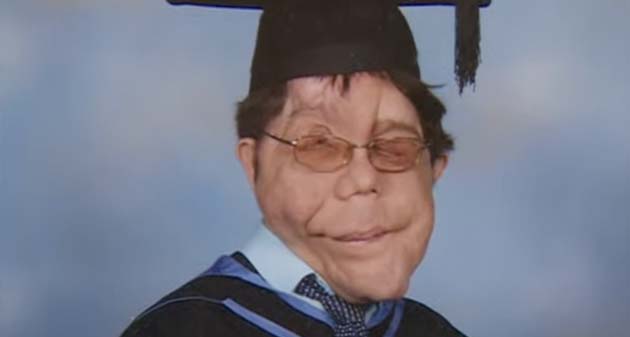
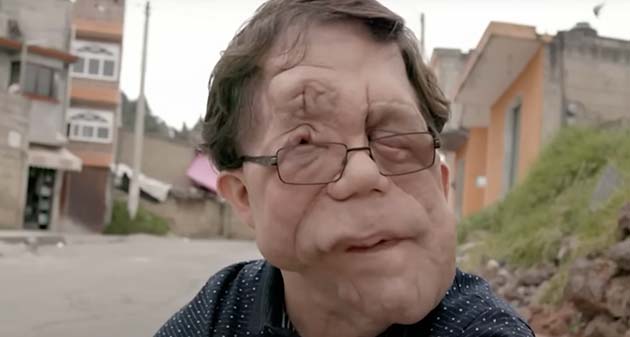
The inspiring journey of Adam Pearson: The actor with a genetic condition who refused to be defined by it

0

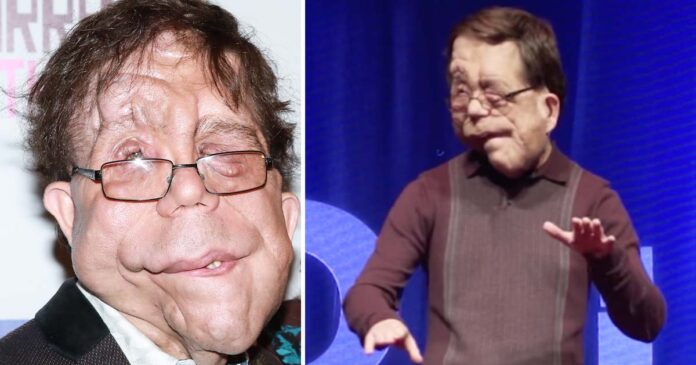
Being different is not a bad thing, but it certainly comes with plenty of challenges and one of the people who know that best is Adam Pearson, the man who never let anything stand in his way to success and happiness.

From being called names such as “Elephant Man” and “Scarface” to starring alongside Scarlet Johansson, Adam has experienced a lot and today he serves as inspiration to many people who live their life with disability.

When he was born, on January 6, 1985, in London, he looked like a completely normal child, but then, when he turned five, his life changed completely. One day, he knocked his head on a windowsill, but the resulting bump on his face never went away. Instead, it triggered the growth of numerous tumors which disfigured his appearance completely. Adam was then diagnosed with neurofibromatosis, a genetic condition that causes tumors to grow along the nerves.

Sadly, he experienced a lot of bullying and considered himself an outsider.

Youtube/OnlyHuman

He recalled a particular incident when speaking to The Guardian. A boy from his class told him that one of the teachers was waiting for him in the next classroom, but when he went there, there was no teacher there but a group of students who made fun of him. “I went home with spit all over my blazer,” he explained. “That was horrific.”

In another interview, he told The Mirror, “I used to stand outside the school gates in the morning, take a massive deep breath and let it happen. I knew what I was in for. It was continuous name-calling – the classic Elephant Man, freak.”

But he knew he needed to find a way to stand for himself.

“Once I started thinking like them, the bullies had won. It’s about the life you have, not the one you don’t. It wasn’t an emotionally productive thing to do,” Adam explained. “For me, it’s all I’ve ever known. It’s very much a part of me. It would have been like asking: ‘Why am I this tall?’”

Youtube/RealStories

Over the years, Adam had undergone numerous surgeries. During a regular visit to Great Ormond Street Hospital, a children’s hospital in London, Adam saw a poster about the organization Changing Faces, he would later became an ambassador of. The organization is “UK’s leading charity for everyone with a scar, mark or condition on their face or body.”

Upon graduating from Brighton University where he studies business management, Adam landed several jobs, including at Channel 4 and the BBC, and appeared in The Undateables and Beauty and the Beast, both of which deal with how society views disabilities in all forms.

NEW YORK, NY – JUNE 20: Adam Pearson and Jess Weixler during the 10th Annual BAMcinemaFest Opening Night Premiere Of “Sorry To Bother You” at BAM Harvey Theater on June 20, 2018 in New York City. (Photo by Gonzalo Marroquin/Patrick McMullan via Getty Images)

It wasn’t until 2011, however, that more people learned of him and his life changed drastically. Changing Faces contacted him one day and told him that producers were looking for a male character for the film Under the Skin, starring Scarlet Johansson. Adam was quick to land on a role in the film which turned out to be a great success.

“One of the main reasons for taking the role was because it was so moving and honest,” Adam said.

“For me, the film is about what the world looks like without knowledge and without prejudice. It’s about seeing the world through alien eyes, I guess.”

Youtube/RealStories

Working alongside Johansson was a dream come true. Speaking of her, Adam described her as exceptional, not only as an actress but as a human being. The two even had to film a nude scene together.

“They just said ‘action’ and you do it,” he said. “I didn’t really think about it, I didn’t broadcast the information [that he was in the film] until quite near the release. I didn’t tell some people at all and just took them to see the film, I mean, my friend Heidi hasn’t made eye contact with me for a week.

“[Scarlett Johansson was] brilliant. She’s really nice, charming, funny and intelligent once you get over the feeling of ‘Oh my God, this is Scarlett Johansson!’”

Adam didn’t see the film as his personal success only because he believed that being part of it was a way to show the world that people with disabilities have a lot to offer.

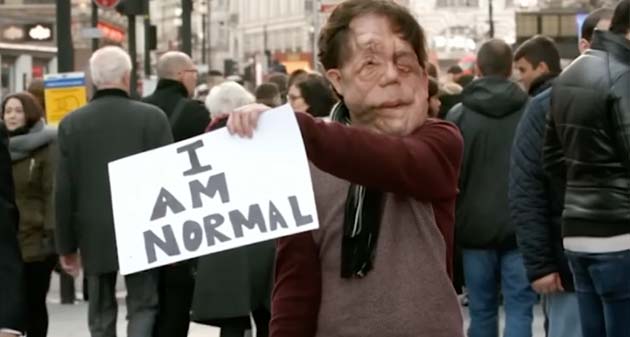
He wanted to be seen as a proof that nothing is impossible, even if you are different than what societies consider ‘normal.’

“There’s a lot of fear around the unknown. If I can try to be as normal as possible and show there’s nothing to fear – either on film or day to day, going round the corner to go shopping for milk – then the more people see it in wider society, the less stigma there is. If I just sit at home and mope, hugging the dog and crying, nothing’s going to change.”

Youtube/RealStories

Following Under the Skin, Adam starred in other productions as well, including DRIB, in which he played himself, Chained for Life, and A Different Man among the rest. The New York Times described him as “an actor of great charm.”

Having been working hard to break down the stigma surrounding his disability, Adam has been serving as a motivational speaker at different events such as the World Health Innovation Summit. He has also been given multiple TED talks. Adam won a RADAR Award and a Diana Award for his work and is serving as an ambassador for The Prince’s Trust, Changing Faces, and Us In A Bus. His influence in the fight against the stigma surrounding people with disabilities is immense. In 2022, he was included in the list of UK’S 100 most influential people with disabilities.

“Often with minority talent, and particularly disabled talent, they get pigeonholed into only doing massive air quotes here, disability thing,” he told Metro. “I’ve got no idea what disability things are, so if someone could let me know and I could start doing them, that would be great! But no, it was something that existed outside of that realm, and it seemed like a real opportunity to sort of step out of that bubble.”

Adam is single and doesn’t have children. In case he does, there is 50% chance they will inherit his condition. “My kids will be genetically awesome anyway,” he proclaimed.

Adam Pearson is a fascinating man who has become a role model for many.

We wish him even more success in the years to come.

Please SHARE this man’s life story with your family and friends on Facebook.

Bored Daddy

Love and Peace

Melania Trump warned people behind leaked Barron photo would face ‘immediate consequences’

0

First Lady Melania Trump has been known as someone who doesn’t want to be under the spotlight, and she wants the same for her son, Barron Trump.

That Melania has been overly protective of Barron isn’t something new. She’s heavily involved in his life, and even split her time between Washington DC, Florida, and New York, where Barron stayed during his freshmen year.

A source close to the family spoke to People, describing the First Lady as “very protective” of her only child.

“Melania’s friends are her family members. She is a doting mother to Barron and very protective of him. This is nothing new,” the source said, adding that Barron always has been a “first priority.”

“She has carte blanche – she can be as active in the East Wing or as inactive as she cares to be,” Kate Bennett, author of Free, Melania, told CNN.

Bennett added that unlike other first ladies, Melania didn’t use the period of the last four years to build hew own platform and brand.

“The missed opportunity of this period between her tenure in the White House has been the lack of a continuing platform or policy agenda that most first ladies build on.”

Getty Images North America/Chip Somodevilla

However, no matter how much she tried to protect him and keep him out of the spotlight, being the son of the president of the country make people interested in Barron’s private life.

Around Christmas of 2025, a photo of Barron during a private moment with his father was taken and then leaked, which made the Trumps furious.

As Melania is doing everything in her power to provide Barron with as much normal life as possible, the leakage of the photo upset her, and according to a source who spoke to journalist Rob Shuter, she wanted the person who took the photo to face consequences for violating her son’s privacy.

“Melania made it very clear that Barron’s privacy is non-negotiable,” a source confirms, according to Radar Online. “Anyone caught filming or taking pictures would face immediate consequences, including potential banning from the club.”

Another source said the message was that certain moments are off-limits. “The message was clear: no cameras, no leaks. Private family moments stay private,” the source added.

According to a political insider, Melania Trump’s main concern is to ensure that her son Barron Trump is not harassed or photographed without consent.

“Melania watches Barron constantly in an effort to be sure nobody messes with him or bullies him,” the source told People last summer. “She always knows where he is and what he’s doing.”

According to Rob Shuter, members who took the photo of Barron were threatened with having their membership revoked.

Speaking of the incident, an insider told Shuter, “Barron was solemnly following his father through the dining room. He was quiet, very reserved, wearing his usual blue suit, almost mirroring Donald.”

Barron is currently attending New York University (NYU), unlike his father and his siblings who all attended the University of Pennsylvania.

Speaking of his son’s choice of university, Trump said, “It’s a very high-quality place. He liked it. He liked the school.

“We liked NYU. I’ve known NYU for a long time, but it’s one of the highest-rated schools.

“I went to Wharton, and that was certainly one that we were considering. We didn’t do that,” Trump continued. “We went for Stern. He’s a very high-aptitude child, but he’s no longer a child.”

Barron Trump attends the inauguration of U.S. President-elect Donald Trump in the Rotunda of the U.S. Capitol on January 20, 2025. REUTERS/Kevin Lamarque/Poolâ€_â€_

Although he’s the son of a business mogul and president of the country, Barron, just like his mother, tends to stay out of the spotlight. Sources say he acts just like any other student put there. According to a TikTok user, Barron carries an $88 backpack, which shows just how down-to-earth he really is.

“As Trump’s son, and the future heir, Barron is worth hundreds of millions of dollars, but he always carries an inexpensive black school bag. Barron lived a life of luxury from childhood. He was raised by Melania, and had a life of ease and plenty since he was a child;” the user wrote, per Express.

“However, no one would believe that under Trump’s guidance, Barron is very thrifty in private. Since he entered college, he has been carrying an $88 black school bag, which makes Barron look more like an ordinary student.

“It enables him to keep a low profile, and be more approachable in public, and allows him to participate in various activities more comfortably. In addition, since Trump became President, he has been opposed to extravagance and waste and has even donated his own money to charity at times.”

The user on TikTok concluded: “In order to follow in Trump’s footsteps, Barron has always kept a low profile. Even at the age of 18, he has never bought luxury goods. To some extent, this can also better shape Barron’s positive image, prepare him for being the heir in the future and play a positive role in the overall image of the Trump family.”

Eva Marie Uzcategui/Bloomberg/Getty

After he completed his first year, students around campus noticed that Barron was nowhere to be seen at the start of the fall semester. This sparked speculations, with the public wondering where the youngest Trump could be.

However, People later revealed that his absence was due to the fact that he was no longer based at NYU’s main site.

“One officer explained that he’s actually spending this semester at another NYU campus,” the outlet noted.

Ahead of his sophomore year, Barron transferred his studies to Washington, D.C. and is staying at the White House with his parents, according to People.

Please SHARE this article with your family and friends on Facebook.

Bored Daddy

Love and Peace

Father and daughter found deceased after FB Marketplace meetup

0

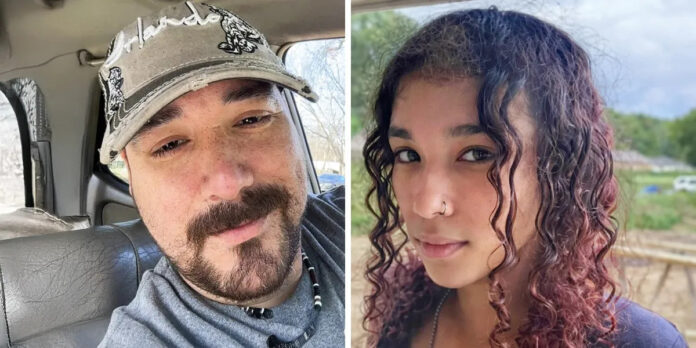
Father and daughter left their Mississippi home on February 28, 2026, to meet someone they contacted through Facebook Marketplace, but the trip turned deadly after they were both shot and killed.

The bodies of the father and daughter were discovered inside their work van off a rural road in Sardis, a town around 50 miles south of Memphis, Tennessee, after the police responded to what initially appeared as a single-vehicle crash.

According to their family, Victor Gonzalez, 42, and his daughter Serenity Gonzalez, 19, were about to purchase a gaming console on the day they were killed. The police said the tracks left by their vehicle suggest that the two tried to flee before the tragedy took place.

Jessie Waterman, 15, the son of Victor and the brother of Serenity, spoke to several media outlets and said he didn’t know exactly whom his father and sister were meeting regarding the Play Station 5 they were planning to purchase. Speaking to WREG, Jessie said he believes his father and sister fell victims of a setup.

In an interview with Memphis-based ABC affiliate WATN, Jessie explained that “something must’ve happened with the transaction,” suggesting it may have been “a scam.” Regarding the location where his loved ones were discovered, he said he believes “they were trying to flee based on the tracks on the road and the mud on the side of the van.”

According to investigators, the killings took place either Saturday, February 28, 2026, or Sunday, March 1, 2026.

Residents of the place where the shooting happened explain that River Road, where the father-daughter vehicle was located, is far from busy and would only be used if people already know it exists.

“It’s got houses up that end and houses up the other end, but very few in between,” neighbor Connie Donahou said. “It’s not a real busy road, but if you live around here, you know about this road. You pretty much have to live around here to know about this road.”

Victor worked as an electrician and his daughter worked alongside him. According to Jessie, they were both hardworking and mainly took jobs in the Memphis area.

Their tragic deaths left their family wonder why someone would want to hurt them.

“If I was to ask a question it would be, why? All of this, it doesn’t make any sense [sic],” Jessie said, according to WREG News.

“Everybody is in shock and disbelief. But we’re also grieving at the same time because it all happened all of the sudden [sic],” he added.

Panola County Sheriff Shane Phelps confirmed he spoke to the victims’ family but refused to provide any details about what could be possibly going on before the shooting took place. He added that they are actively working on the case.

So far, little information has been revealed about who the possible suspect could be, and no motive has been identified.

For now, all that can be done is wait and hope that someone comes forward with information that will shed light on how a simple online purchase can become a deadly crime.

The tragedy in Mississippi may not be an isolated incident. Hundreds of miles away, another investigation is taking place which can point to a disturbing pattern linked to meetups arranged through online marketplaces.

On Sunday night, otherwise quiet residential street in Colombia, Missouri, turned into a crime scene after a shooting incident that left a man in critical condition. The investigation revealed similarities to other violent encounters connected to online marketplace transactions.

Police were called to the 1400 block of Ridgemont Court shortly after 8 p.m. on January 18, 2026, after reports of gunshots in the area. Upon arriving at the scene, they found a 42-year-old man with gunshots wounds. He was transported to the hospital where he later died.

The man was later identified as Michael Ryan Burke, a Columbia resident and Marine Corps veteran.

Getty Images

A couple of days following the tragic shooting, the police arrested four suspects, two men, a woman, and a juvenile. The adult suspects were identified as 18-year-old Alexis Baumann of Hallsville, 18-year-old Kobe Aust of Columbia, and 18-year-old Joseph Crane of Columbia. Police say that both Baumann and Aust were arrested on suspicion of second-degree murder, first-degree robbery, and first-degree burglary. Crane is being charged with the same crimes as well as additional charges of armed criminal action and the unlawful use of weapons. The juvenile has been arrested on similar charges.

According to People, the shooting was linked to a planned Facebook Marketplace deal involving a cellphone.

Authorities revealed that Michael was arranging to sell his iPhone 15 Pro for $585 on Facebook Marketplace. After he shared his home address with the potential buyer, he received a text message around 8 p.m. saying, “I’m here.”

Not long after, the police answered a call about shooting and found Michael injured inside his home. Despite his injuries, he was still able to call for help. During his final moments, he sent a text message to his mother and sister, telling them goodbye.

“He texted them saying that, ‘hey, I’m dying and I love you,'” said Jerry Reifeiss, who knew Michael for more than two decades. “That was just Ryan. He always put people in front of him and wanted to make sure people knew how he felt.”

In the days before Michael’s death, the suspects attempted two other iPhone robberies involving Facebook Marketplace.

Please SHARE this article with your family and friends on Facebook.

Bored Daddy

Love and Peace

The silent signal: What your swollen legs may reveal about pancreatic cancer

0

Not rarely, the human body tends to communicate signs of internal distress through symptoms that are seemingly unrelated to the original source of the disease. Many serious conditions such as cancers initiate in a silent manner and only develop slight symptoms before more obvious symptoms develop.

The pancreas is an organ located in the abdominal cavity, behind the stomach, and plays a vital role in digestion and blood sugar control. Because of its location in the body, pancreatic disorders tend to progress without any visible symptoms during the early stages of the disorder. This is the reason why pancreatic cancer in particular is usually detected at an advance stage.

However, recent scientific studies reveal that the body may signal early signs of certain diseases in unforeseen ways. One of these warning signs is the swelling of the lower extremities. Usually, swollen legs, or edema, are a sign of kidney problems, heart problems, or poor blood circulation.

However, recent clinical studies reveal that swollen legs could also be a sign of more serious health issues such as pancreatic cancer, according to a study published in the National Library of Medicine.

While edema itself isn’t something uncommon, the reasons under which it occurs could be crucial in identifying the real problem. When the swelling appears suddenly, when it’s more pronounced in one of the legs than the other, or when it is prolonged and happens without any apparent causes, it may suggest that underlying systemic changes occur at the body’s internal level.

Nowadays, more people are aware that pancreatic cancer can affect the chemistry, the circulation, and the proteins in the blood, which can become noticeable through the legs.

Being aware of these symptoms may help in early diagnosis of the disease.

The Primary Culprit: Deep Vein Thrombosis (DVT)

The most direct and most serious link between swollen legs and pancreatic cancer is the development of blood clots, specifically Deep Vein Thrombosis (DVT). This happens when a blood clot forms deep inside the vein, usually in the leg, and prevents blood flow. The result is usually swelling, warmth, pain, or even color change in that particular limb, the Mayo Clinic explains.

Of all cancers, one type stands out in its aggressive relationship with these clots: pancreatic ductal adenocarcinoma (PDAC). In fact, this cancer is so closely related to these clots that doctors actually refer to it as a “procoagulant,” which is a fancy way of saying this cancer actually makes your blood thicken and clot far faster than it should.

This is not simply a consequence of being sick, but a very real biological consequence of how the cancer operates within the body.

The Biochemistry of Trousseau’s Sign

Medical professionals have long been aware that hidden cancers and unexplained blood clots often go hand in hand. Back in the 1800s, a French doctor named Armand Trousseau noticed that some of his patients developed recurring clots well before any underlying cancer was actually detected. This specific medical red flag is now known as Trousseau syndrome.

Today, we have a much clearer picture of why this happens. Modern molecular research has pinpointed several specific biological “triggers” that pancreatic tumors use to hijack the body’s clotting system and turn it against itself.

Tissue Factor (TF) Overexpression

Pancreatic tumor cells release high levels of protein known as Tissue Factor into the bloodstream. You can think of it as the body’s first “emergency switch” to blood clotting. It is the primary initiator of the coagulation cascade, which is the complex chain reaction that leads to blood clot formation.

In addition, cancer cells also release microscopic particles into the bloodstream that contain Tissue Factor. These particles travel through the entire bloodstream, spreading the clotting signals to parts of the body away from where the tumor is, most often ending up in the legs.

Adenocarcinoma Mucins

Another contributing factor involves mucins—large, sugar-coated proteins produced by many pancreatic tumors. When these mucins leak into the bloodstream, they act like a magnetic bridge, latching onto platelets and white blood cells. This interaction activates them in a way that aggressively promotes the formation of clots, as explained in a study published in the Journal of Mind and Medical Science.

Together, these different triggers create what physicians sometimes describe as “sticky blood.” It is a state where the body’s natural clotting system is stuck in the “on” position, continuously activated and ready to form a blockage at any moment.

Why the Legs Are Affected

As described in a study published in the National Library of Medicine, blood naturally circulates more slowly in the deep veins of the legs compared to other parts of the body because of gravity and because it is so far from the heart, so this area is especially susceptible to clots forming.

As these abnormal clotting signals are carried throughout the body, one of the most common places for the blockage to occur are the legs. When the clot starts to form, it prevents blood flow and causes immediate swelling and inflammation at this part of the body. While some patients can experience pain, warmth, and redness, at most patients the swelling is the only obvious symptom that something isn’t right.

Statistical Risks: The Khorana Score

Clinical data is consistent in proving the link between pancreatic cancer and clotting disorders. Among all types of cancer, pancreatic cancer ranks second in terms of the risk of developing venous thromboembolism (VTE), which encompasses both DVT and pulmonary embolism.

Recent estimates from 2024 and 2025 indicate that between 20% and 40% of patients with advanced pancreatic cancer will at some time during their disease course experience a clotting disorder. This is among the most common complications experienced with pancreatic cancer.

The Khorana Risk Score

To help identify which cancer patients are most likely to develop clots, clinicians use a predictive model known as the Khorana Risk Score. This scoring system evaluates several factors, including the specific type of cancer, platelet counts, hemoglobin levels, and body mass index.

Different cancers receive different baseline scores depending on their known clotting risk. Pancreatic cancer is automatically assigned two points, which immediately places patients into the high-risk category before any other factors are even considered.

Prognosis Signifficance

For patients with pancreatic cancer, blood clots aren’t just a complication from the disease but also a factor than can help in determining the severity of the disease. Research linked to the COMPASS trial in 2025 suggest that when blood clots appear early on, they could be tied to more aggressive tumor sybtypes.

When a patient experiences a venous thromboembolism during the first three months of their diagnosis often have tumors with biological features that lead to faster growth and more difficult survival outcomes. Because of this link, medical professionals consider unusual and sudden leg swelling a potential indicator of how the disease would progress.

Protein Deficiencies and Systemic Edema

Not all swelling related to pancreatic disease is a result of blood clots. In some instances, both legs can swell as a result of a condition known as systematic edema, which happens when the body’s balance of fluids is disrupted, as per the Mayo Clinic.

A protein in the body produced by the liver, known as albumin, is responsible for keeping fluids within your blood vessels. When albumin levels are too low, fluids leak out of your blood vessels and into your tissues, causing swelling.

Pancreatic tumors have also been known to disrupt this system because they prevent the release of vital enzymes needed in the body. As a result, the body is not in a position to absorb proteins from food, thus leading to a condition known as hypoalbuminemia in advanced stages. In some instances, the tumor may also disrupt functions in the liver and lead to widespread inflammation in the body, thus lowering albumin levels in the body.

This form of swelling often manifests as pitting edema, which is most visible in the ankles and in the feet. You can test if you have pitting edema by pressing the swollen area with your finger and see if it leaves a temporary indentation. Unlike the swelling from the DVT, which usually affects one of the legs, this type affects both legs and develops gradually over time.

Diagnostic Pathways: When Swelling Leads to Discovery

For some, the swelling in the legs can actually be the first sign of pancreatic cancer. As a result, guidelines, such as those published by ESMO in 2025, now strongly advise a very careful evaluation in case the swelling appears without an obvious cause. This is especially important if the patient is over the age of 50 or has other risk factors, such as a history of smoking or recent weight loss without an apparent cause.

The investigation into whether or not a patient has pancreatic disease will normally commence with some initial tests. In most cases, doctors will initially opt to perform a blood test to check for the presence of D-dimers, as these are specific proteins that are present when the body is attempting to dissolve a blood clot. Research published by Seitz and colleagues in 2024 found that although high levels on this test indicated that a clot is present, they cannot be used to diagnose the disease alone.

However, once doctors suspect DVT, the next course of action is imaging studies. As noted by the Mayo Clinic, the first method is the use of duplex ultrasound, where the doctor is physically able to see if the flow of blood has been blocked or has slowed down significantly.

Finally, there is the important aspect of detecting underlying cancers. When the DVT is unprovoked, meaning it has no underlying causes such as surgery or long flights, the National Cancer Institute, as of 2025, notes that this may lead the doctor to order abdominal CT or MRI scans, which are then used to check for underlying cancers such as pancreatic cancer. By investigating such clotting, it is possible to identify the underlying cancers at an earlier stage than would otherwise be possible.

Management and Emerging Treatment Strategies (2025–2026)

When leg swelling is present because of pancreatic cancer, doctors treat both the swelling itself and the cause.

Anticoagulation Therapy

Once the clot is detected, doctors usually prescribe anticoagulant medications, such as Direct Oral Anticoagulants (DOACs) and Low-Molecular-Weight Heparins (LMWH), which prevent the clot from growing bigger and others from forming. These drugs greatly reduce the chances of serious complications like pulmonary embolisms.

Preventative Strategies

Recent research published by ASCO Post reveals that at the time of diagnosis, high-risk patients may benefit from “blood thinners” to prevent blood clots from forming.

Supportive Care

According to the Mayo Clinic, some simple steps that can help alleviate discomfort and prevent fluid accumulation are:

  • Wearing “compression stockings” to assist with blood flow.
  • Elevating the legs while resting.
  • Engaging in physical activity, such as walking.

Conclusion: Recognizing the Body’s Warning Signs

While often minor, swollen legs can sometimes signal serious internal issues. In certain cases, this swelling is a direct link to pancreatic cancer through blood clots or protein imbalances.

This does not mean every instance of swelling is a cause for alarm. However, persistent, painful, or one-sided swelling should always be evaluated by a professional. As the National Cancer Institute suggests, simple blood work or an ultrasound can identify the cause early, when treatment is most effective. Paying attention to these quiet signals can truly save lives.

*Disclaimer: This article is intended for informational purposes only and should not be considered medical advice. If you experience symptoms such as unexplained swelling, consult a qualified healthcare professional.

Please SHARE this article with your family and friends on Facebook.

Bored Daddy

Love and Peace

List of items you should be stockpiling as WWIII fears grow

0

It’s fair to say that humanity is living through a time of uncertainty. The rising tensions between countries has led many to believe that WWIII is around the corner.

And it’s not just ordinary humans who fear this scenario, but world leaders, former and current, too.

Dmitry Medvedev, the former president of Russia, said World War III “will undoubtedly begin “if [President Donald] Trump continues his insane course of criminally changing political regimes.”

“And any event could be the trigger. Any event,” Medvedev, who served as Russia’s president from 2008 to 2012 and prime minister from 2012 to 2020, warned.

During an interview with Russian media on March 3, the deputy chairman of Russia’s Security Council argued that “Trump made a grave mistake” by launching a large-scale attack on Iran, calling the country “an ancient civilization” that understands “how to wait,” according to The Express Tribune.

“With his decision, he put all Americans under potential threat,” he said, describing the move as “a war by the US and its allies to preserve global dominance.”

Anadolu Agency

The comments followed after The United States of America and Israel launched joint strikes on Iran on Feb. 28, killing the country’s Supreme Leader, Ayatollah Ali Khamenei.

“Now he is also a martyr. You can imagine the rest. And now there is no doubt that Iran will pursue the creation of nuclear weapons with redoubled energy,” Medvedev said.

According to President Donald Trump, the attack served the purpose of preventing Iran from obtaining nuclear weapon.

Iran didn’t stay silent. In response, they launched missiles and drones across the region, striking US assets and allied nations including Israel, Bahrain, Kuwait, Qatar, Jordan, and the United Arab Emirates.

With the global stability getting shaky, governments are calling on citizens to think ahead. They are not trying to cause panic, but to ensure that in case of conflict or disaster, households can be self-sufficient for a while.

We saw a clear example of this last year when the European Commission advised that households across the European Union have a 72-hour kit. This means stocking up on essentials such as water, food, and meds, along with items such as flashlights, batteries, and important paperwork.

These guidelines are a key piece of the Preparedness Union Strategy, a wide-reaching plan to toughen up the EU’s crisis response. Whether it’s a sudden cyber-outage or a natural disaster, the goal is for people and governments to pivot quickly. By making sure households are self-sufficient for a short window, authorities can focus on the heavy lifting—like repairing infrastructure and coordinating large-scale relief—without the immediate system-wide panic.

According to leaders, this is part of what they refer to as “culture of preparedness,” where knowing what to do in cases of emergency becomes second nature. Since the first three days following a disaster are most chaotic, being able to look after yourself during that period allows governments to get organized and reach the hardest-hit areas first without letting the entire system to collapse.

According to EuroNews, this plan also pushes to better teamwork across EU borders. By improving coordination between member states and beefing up early-warning tech, the EU is trying to stay ahead of the curve. Leaders say that if COVID19 taught us something is that crisis rarely happen one at a time, so we need a system that would allow us to juggle multiple crisis simultaneously.

“In the EU we must think different because the threats are different, we must think bigger because the threats are bigger too,” Hadja Lahbib, the Commissioner for humanitarian aid and crisis management, told reporters.

Roxana Mînzatu, the Commission for preparedness, speaking alongside her, added that the bloc is “not starting from scratch.”

Further, Lahbib posted on X, “Ready for anything – this must be our new European way of life.”

European Commission President Ursula von der Leyen also emphasized the importance of stronger preparedness measures.

“New realities require a new level of preparedness in Europe. Our citizens, our Member States, and our businesses need the right tools to act both to prevent crises and to react swiftly when a disaster hits,” von der Layen said in a statement.

While officials state that these guidelines weren’t issued in response to the crisis at the Middle East, they are relevant during times when global tensions rise.

According to an emergency preparedness plan by the Committee on Security and Defence drafted Feb. 25, 2026, large-scale crises – including armed aggression – could lead to “shortages and supply chain disruptions.”

The document states: “The Union should be prepared for large-scale, cross-sectoral incidents and crises, including the potential for armed aggression affecting one or more Member States.”

The plan continues, “In the event of armed aggression and hybrid warfare, military forces would need civilian assistance, including to ensure the continuous functioning of the state and society.”

In the video she posted on X, Lahbib highlighted some of the must-haves for a home emergency kit. Basically, she pointed to the items you need in order to survive on your own for several days in case emergency can’t reach to you right away in times of crisis.

While the emergency preparedness list can vary depending on the location, most include the same core essentials designed to provide food, water, safety, and communication.

Experts recommend stockpiling the following:

  • ID in waterproof casing
  • Canned food and energy bars
  • Bottled water
  • Matches
  • First-aid kit
  • Flashlight and extra batteries
  • Swiss army knife
  • Cash
  • Playing cards
  • Medication

These emergency supplies are meant to help households stay safe and self-sufficient during the initial phase of a crisis, when access to essential services such electricity, transport, or grocery stores may be disrupted. These items can help families cope independently while governments try to restore normal conditions.

While global tensions have people on edge about possible political conflicts, experts and leaders are quick to point out that being prepared shouldn’t be misunderstood as panicking. The goal isn’t to spread fear, but to build common-sense habits that would allow communities hdle a curveball without spiraling.

Keeping a stash of water, non-perishable food, meds, and batteries just ensures your family stays safe and comfortable during those first confusing hours of a blackout or emergency.

The hope is that households will never have to use these emergency kits, but having it means that if a disaster does strike, you will be ready to handle it calmly and won’t be caught off guard.

Please SHARE this article with your family and friends on Facebook.

Bored Daddy

Love and Peace

Risk of prostate cancer increases by 45% in men due to a common practice

0

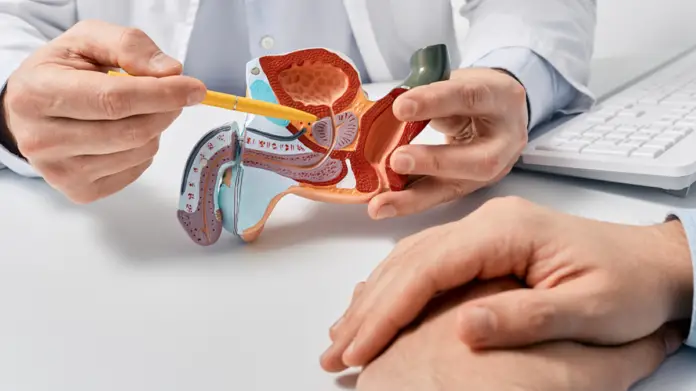
In its early stage, prostate cancer typically causes no symptoms in the vast majority of men. The reason why is because this type of cancer tends to move slow and remains confined to the prostate for years, meaning it can progress quite a bit while being practically invisible to the person who has it. Sadly, this is a bit of a biological trick because you can feel 100% healthy while the cancer is already present.

This is the reason why doctors emphasize the importance of screening for prostate cancer, which could help catch the “silent” phase before it turns into a bigger problem.

Eventually, symptoms may appear, and they are mainly related to the person’s bathroom habits. You may notice a weaker flow, troubles getting started or stopping, or getting up multiple times during the night to use the bathroom. However, even if you are experiencing these symptoms, take a deep breath, because they don’t necessarily mean you are affected by prostate cancer.

More often than not, these symptoms are also related to Benign Prostatic Hyperplasia (BPH), which is just a fancy way of saying that your prostate got enlarged with age. This is a non-cancerous and non-life-threatening part of getting older. However, although BHP is not life-threatening, it’s still worth getting out checked by a professional.

It’s important to remember that urinary changes can be a result of a whole range of issues, including simple urinary tract infection (UTI), to bladder issues or even prostatitis (an inflamed prostate).

Since many different conditions mimic one another, when you experience symptoms like the ones described above, it’s best to consult a medical professional instead of trying to diagnose yourself. In case you notice persistent changes when it comes to your bathroom habits, the worst thing you can do is to ignore them and hope they would go away on their own.

Even when there is a perfectly harmless explanations for the symptoms, it’s always smart to grab a quick appointment with your doctor.

Health professionals can run tests, sort through the symptoms you have been experiencing, and rule out anything serious as prostate cancer. When you get medical advice early, it leads to two major things: it gives you a piece of mind if the cause is benign, and it ensures that if the condition is more serious, you caught it in its early stage when the chances of fighting against it are highest.

According to the American Cancer Society, the numbers tell a pretty sobering story, that one in eight men will be diagnosed with prostate cancer at some point in their life. While the good news is that most cases of prostate cancer are highly treatable, the disease is still a major health hurdle. In fact, prostate cancer is the second-leading cause of cancer death in men, following lung cancer. This statistic should serve as a reminder that being proactive isn’t just a suggestion but a necessity.

Lately, researchers have noticed a worrying trend. Recent studies show that the likelihood of a diagnosis has jumped by nearly 45% in some populations, and the main reason is because many men either delay or entirely skip their screening appointments. When you avoid these tests, you also avoid the opportunity to catch the disease early and increase your chances of fighting against it successfully.

This is why medical experts and professionals urge men, especially those over 50 and those with a family history of prostate cancer, to stay on top of their screenings.

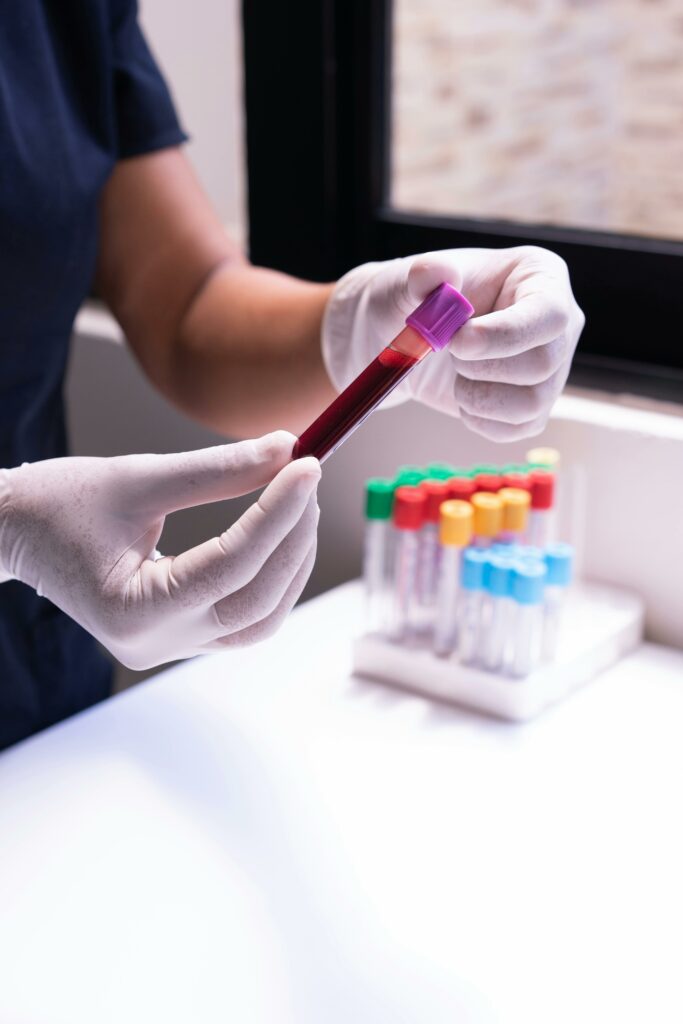
The doctor’s appointment usually starts with a simple PSA blood test that looks for prostate-specific antigens. If your levels are high, it could point to a group of health issues, including prostate cancer. Of course, these high levels don’t always mean a definite “yes” to a prostate cancer diagnosis, but they do tell doctors where to look next.

Medical professionals argue that a structured, nationwide approach to screening could help drastically improve how early we detect prostate cancer. When it’s caught early, it doesn’t only increase the survival rate, but also provide the patient with more options when it comes to treatment. It’s the most effective way to “bottleneck” the disease, preventing it from migrating beyond the prostate to other organs, according to Zero Cancer.

The confidence doctors have in the process of screening comes from massive, long-term research. The ERSPC study is the gold standard here. By tracking men for two decades across seven different countries, this study provided the long-term perspective needed to understand the true impact of screening. As one of the largest studies in medical history, its findings continue to shape how doctors approach prostate health today.

The results show that detecting prostate cancer in its early stage is the single most important factor in survival. Men whose cancer was detected early through screening had a much higher success rate for treatment and recovery than those who detected it in the later stages.

Early detection doesn’t only mean surviving. It also means you can skip aggressive and expensive treatments that are needed once the cancer spreads.

When you look at the bigger picture, the data suggests that regular screening can reduce the risk of dying from prostate cancer by about 20%.

While screening isn’t a preventative measure in a sense that it stops cancer from forming, it is the most effective tool doctors have for catching it when treatment works best.

This is why the medical community is so focused on encouraging men to stay on top of their check-ups and have honest conversations with their doctors about their personal health history

Getty Stock Image

The research was led by the scientists from Erasmus MC Cancer Institute at the University Medical Centre in the Netherlands. It included 72,460 men.

The results showed that around one in six men never attended their regular screening appointments. Those who did had a 23% lower chance of dying from prostate cancer.

“It may be that men who opted not to attend a screening appointment are care avoiders, meaning they’re less likely to engage in healthy behaviours and preventative care in general. This is the opposite behaviour of people who are perhaps more health conscious and are more likely to attend a screening appointment,” lead study author, Renée Leenen, M.D., Ph.D. explained.

“Our study identifies that men who were invited for screening, but do not attend screening appointments are at significantly higher risk of dying from prostate cancer compared to men who were not offered screening or accepted an invitation for screening.

“We need to better understand who these men are, why they choose not to attend appointments, and how to motivate them. This will help us to design population-based prostate cancer screening programmes that encourage higher rates of informed participation.

“Tackling attendance rates in this way could be a big factor in the long-term success of a national prostate screening programme.”

She emphasized the need to get to the reasons why men avoid these screenings.

Many European nations are now coordinating their population-wide prostate cancer screening programmes to boost attendance.

The new analysis also indicates that the overall benefits of prostate cancer screening may be greater than previously believed, with Dr Tobias Nordström, a Clinical Urologist at the Karolinska Institute in Sweden and a member of the EAU Scientific Congress Office, explaining:

“For countries around Europe that are planning to introduce a national prostate screening programme, this analysis focusing on attendance shows that men who participate in screening have a much-improved long-term benefit than what we’ve seen from previous studies.

“But it highlights a group of men who need our attention, as they’re more at risk of developing advanced prostate cancer and dying from it.

“We need to better understand why these men might actively choose not to participate in screening, despite being invited to attend, and how this behaviour is linked to worse outcomes when they get a diagnosis.”

Please SHARE this article with your family and friends on Facebook.

Bored Daddy

Love and Peace

Sudden confusion or difficulty speaking: when it’s more than just fatigue

0

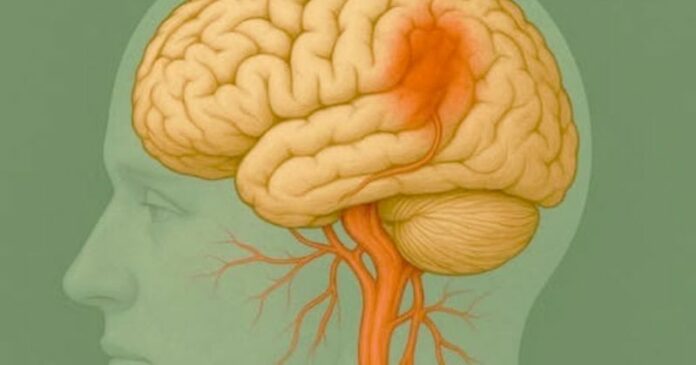
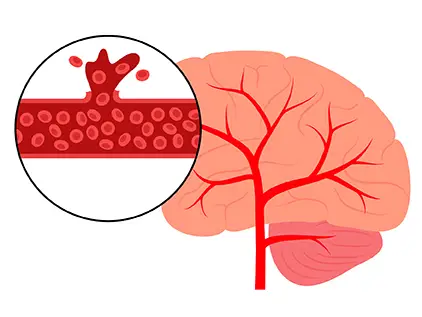
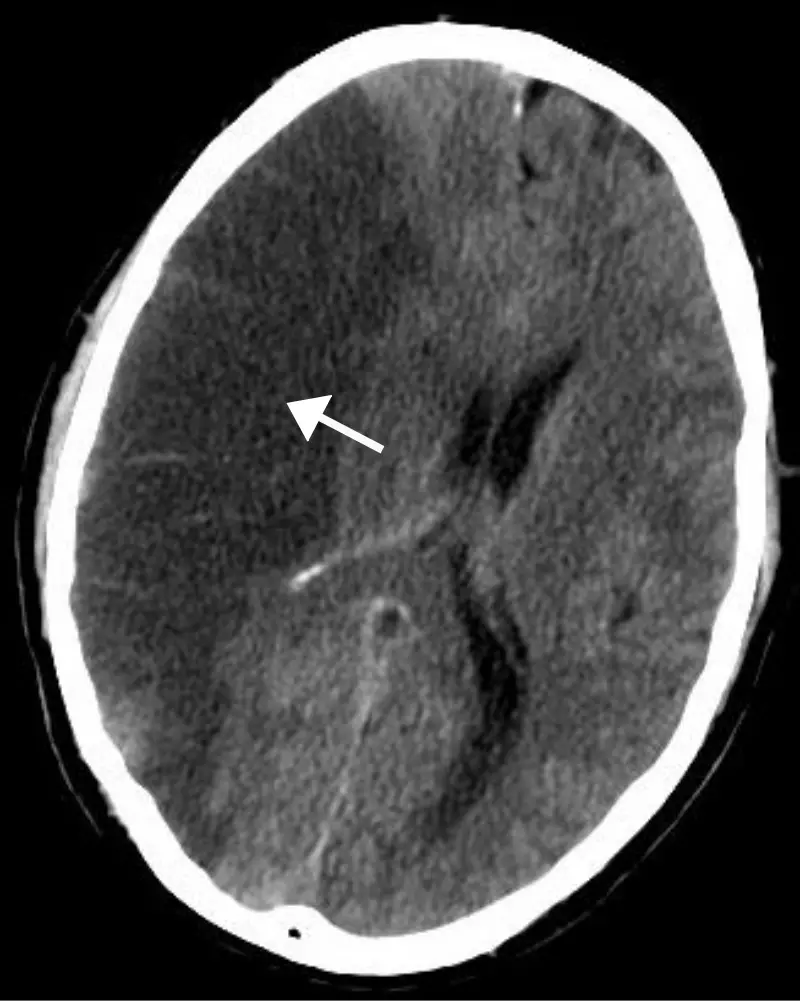
A stroke occurs without warning. It happens “when blood flow to the brain stops, and brain cells in the area begin to die,” as per Healthline.

When a stroke happens, the clock is your worse enemy. It’s a situation when the blood flow to the brain is either abruptly cut or severely restricted, which basically starves the brain cells of oxygen and nutrients they need in order to survive. Since the cells start dying in mere minutes, one of the most important things to do in case of a stroke is to seek medical help as soon as possible. The faster you get treatment, the better the chances of preventing brain damage and actually making a full recovery. When it comes to strokes, there is no “wait and see” period, and time and speed are the only things that matter.

According to the guidelines for the Early Management of Patients With Acute Ischemic Stroke published by the American Heart Association (AHA) and American Stroke Association (ASA) in 2018, people treated with “a blood clot-dissolving drug within 4.5 hours of symptoms have a greater chance of recovering without major disability.”

In order to be able to act quickly in case you or someone else experiences stroke, you need to know what you are looking for. You need to recognize the red flags before they start happening.

As per the Stroke Association, some of those signs are:

Face Weakness: Check if the person can smile and whether their face and eyes drop.

Arm Weakness: Can the person raise both their arms and keep them in that position?

Speech Problems: Is their speech slurred? Do they speak clearly and understand what you say to them?

Time to call 999: If you notice any of this signs, seek medical help.

This test is known as FAST.

Although there are no warning signs that may indicate a stroke will happen, a 2020 study published in The Journal of Headache and Pain suggests that around 15% of 550 adult participants who had suffered an ischemic stroke experienced sentinel headache before.

Transient ischemic attack (TIA), often called a “mini-stroke” occurs when blood flow to the brain is temporarily blocked, causing stroke-like symptoms that typically last for a few minutes or hours. TIAs should never be ignored.

As per the research, these headaches started within seven days of a stroke and lasted until the stroke happened.

One-third of individuals who have experienced TIA will suffer a more serious stroke in the future.

Although a TIA can be considered a warning sign for a stroke, the number of people who suffer an acute stroke within 90 days after a TIA has decreased in recent years, as per a recent research published in Jama Network. This may be an indicator that the actions taken after a TIA help in reducing the risks.

Other symptoms that can help determine if a person had a stoke are:

Sudden Numbness or Weakness

One of the most telling signs that someone is experiencing a stroke is when one side of the body suddenly stops cooperating. This usually affects an arm, a leg, or the face. You might notice the person’s smile looks lopsided or one side of their face is dropping. When the person tries to lift their arms, one may feel heavy like lead, and just drifts back down. This happens because the stroke is “starving” the specific part of the brain that sends “move” signals to the muscles. In simple words, what happens is a localized power outage in the nervous system.

Confusion or Difficulty Speaking

Since the brain is the center that controls communication, a stroke can make language feel like a foreign territory. A person may suddenly start slurring their words in a way people do when they are intoxicated. They may also experience a situation where the words they use are real but their sentences don’t make any sense. Also, they may experience trouble to understand you, looking completely blank and puzzled at even the most simple questions. What happens is a disconnection between what they try to say and what their brain allows them to process.

Vision Problems

The fact that vision problems are a huge red flag is something that people often overlook, thinking that it is simply an issue with their eyes or that it is simply a migraine. However, a sudden “gray out,” blurred vision, or double vision in one or both eyes, is often an indication that something is going on with the brain’s visual center. It is not an issue with their eyes; it is an issue with their brain being unable to process what it is seeing. If an individual suddenly does not recognize someone they know or is unable to read what is on a screen in front of them, it is a major warning sign.

Difficulty Walking

Lastly, pay attention to sudden clumsiness or a loss of balance. A person having a stroke may experience dizziness, vertigo, or difficulty coordinating movements, which can make walking suddenly difficult. They may stumble, sway, or need to hold onto nearby objects to remain upright. If someone who was walking normally moments earlier suddenly cannot maintain their balance, it may indicate that the brain regions responsible for coordination and movement have been affected.

Why Immediate Action Matters

Recognizing these symptoms is the first step. Stroke is a medical emergency and once the symptoms appear, every second counts, so the prompt action that follows is crucial for saving the life of the person who has experienced a stroke. The sooner a patient is given medical attention, the better the chances of limiting the damage to the brain and preventing long-term disability.

Health experts often use the phrase “time is brain” to highlight the urgency. Since the interrupted blood flow to the brain leads to brain cells dying due to the lack of oxygen and nutrients, the more the treatment is delayed, the greater the risk of permanent damage of brain areas responsible for speech, movement, memory, and other essential functions.

Prompt medical treatment enables medical professionals to identify the type of stroke and immediately begin the appropriate treatment. In some types of stroke, medication can dissolve the blood clot responsible for the stroke and re-establish blood flow to the brain. In other types, medical procedures may be necessary to relieve the blockage and prevent further brain damage.

That is why health experts recommend that people should not take any stroke symptoms lightly and should not delay seeking medical attention, even if the symptoms seem minor and disappear within a short time. They may be indicative of a serious problem that needs urgent attention.

Making an emergency call immediately provides medical personnel with the best opportunity to act promptly. Quick treatment not only saves life but also increases the prospects of full recovery and return to normal life.

Conclusion

Understanding your risk factors and being prepared ensures you’re ready to handle an emergency.

Please SHARE this article with your friends and family on Facebook!

Bored Daddy

Love and Peace

*Disclaimer: Please fact-check with your doctor before acting on any of the information provided.

*This post is an update to a previous one, as some of the information shared earlier was found to be misleading such as the writing that the body sends signals of a stoke a month before it happens.

Actor James Ransone dies of suicide aged 46 as police release new heartbreaking details

0

James Ransone, best known for playing Ziggy Sobotka in The Wire, one of the most acclaimed series of all time, has died aged 46.

According to the Los Angeles Medical Examiner, James Ransone died of suicide.

Ransone also appeared in a number of films and series, including Prom Night, The Black Phone, Law & Order and CSI: Crime Scene Investigation, the 2008 miniseries Generation Kill, 2019’s It Chapter Two, and Poker Face among the rest. He was married to Jamie McPhee with whom he had two children.

McPhee took to Instagram to honor her husband. She posted a photo of her and Ransone captioned, “I told you I have loved you 1000 times before and I know I will love you again. You told me – I need to be more like you and you need to be more like me – and you were so right.

The post added: “Thank you for giving me the greatest gifts – you, Jack and Violet. We are forever.”

Mario Anzuoni/Reuters

McPhee also shared a link to a GoFundMe page for the National Alliance on Mental Illness.

During his life, he spoke openly of the sexual abuse he suffered from a tutor while growing up in Maryland. In an Instagram post from 2021, he wrote of the abuse and said it led to “a lifetime of shame and embarrassment.” According to the actor, the incident triggered his addictions to alcohol and heroin, according to the BBC.

Fans and friends honored Ransone on the social media.

Wendell Pierce posted on X, “Sorry I couldn’t be there for you, brother. Rest in Peace James Ransone.”

Director Spike Lee shared a photo of them together and wrote on Instagram: “Rest In Peace To My Dear Brother, MR. JAMES RANSONE. We Rocked Together On RED HOOK SUMMER And INSIDE MAN.”

Sean Baker, the Oscar-winning director of Anora who worked with Ransone on the films Starlet (2012) and Tangerine (2015), wrote, “I’ll miss you dearly my friend.”

Patrick McMullan/Avalon

Madeleine McGraw, who starred with Ransone in The Black Phone and its sequel, remembered Ransone as “such a beautiful soul” and “so genuinely supportive.”

“I’m struggling to put into words the profound emptiness I’m feeling since learning of James Ransone’s passing,” she wrote on her Instagram story. “My heart is absolutely shattered.”

Natasha Lyonne, who starred alongside Ransone in Poker Face, wrote, “Love you with everything I got and holding our beloved brilliant peejo with grace gratitude and cosmic peace into this life and the next – family forever.”

A GoFundMe has been established to assist Ransone’s wife and two children.

Rest in peace, James Ransone.

Please SHARE this article with your family and friends on Facebook.

Bored Daddy

Love and Peace

Kicked out of home at 14, teen bought a rundown house for $5 and refused to be defeated

0

The teenage years are supposed to be one of the best years in a person’s life. Aren’t those the times when we should be carefree, make friends, hang out with those we love, and simply enjoy life the best we can? In theory, yes. But in reality? Teenage years can be extremely difficult for some people, and I’m sure most of us are well-aware of that. The reasons are various. The inability to make friends, to be accepted by the peers, or simply being part of a dysfunctional family.

For a fourteen-year-old teen named Tommy Reed, it was the later.

The moment he reached this milestone, his stepfather decided he no longer belonged in the home. Not only there was no birthday cake, no celebration, no family or friends invited, but he was also delivered the news that changed his life forever. His stepdad told he he needed to move out, right there and then.

The worst part was that Tommy never deserved to be treated like that. He was an incredible young man who did chores around the house, had good grades, and was well-behaved. But because of some reason, sometimes a minor thing like a broken plate, his stepfather despised him. And now that he reached 14, his stepdad believed he could do alone in life, because he was old enough to figure his life out all by himself.

And just like that, Tommy Reed found himself standing behind a slammed door on a cold night in a tiny town in Ohio.

Tommy looked to his mother and prayed for a miracle, a last-minute intervention from the woman who gave birth to him. But she didn’t say anything, not even a single word. And at that moment, her silence hurt him more than his stepfather’s shouting.

Was it even possible for a mother to let her child be treated that way?

What Tommy was left with that night was his backpack, a small flashlight, and $12.63 in his pocket.

He was scared, alone, and had nowhere to go.

He wandered through the streets of the small town for hours.

He walked past the humming gas stations where weary night-shift workers manned the counters. He walked past empty parking lots and the skeletal remains of old factories.

Out of the blue, he was homeless.

Tommy reached the outskirts of his hometown where streetlights became less frequent and weeds began to sprout through the cracked sidewalks.

And that’s when he saw it.

A small house sat by itself at the end of a street no one walked through. The house looked as though it had been abandoned for years. Its roof was sagging in the middle in a rather dangerous way, and the porch itself appeared to lean forward.

All of the windows were already boarded up, and the yard looked like it hadn’t been touched in years.

But something caught Tommy’s eye.

In the yard, there was this piece of wood that said the house was city property, condemned, and the the fee was just $5.

Tommy read that more than once, because he thought it was a joke. How can a house cost just $5?

Well, it turned out it wasn’t a joke after all.

Apparently, the city had this program to try to get rid of houses that are abandoned or whatever. If you’re “insane” enough to take one on and fix it up, you can transfer it for five bucks.

I guess most people would have seen that sign and thought it was like a disaster waiting to happen.

But Tommy didn’t. All this teenager saw at that point was a roof, and more importantly, a place he couldn’t get kicked out of.

Tommy walked into City Hall the first thing in the morning.

He waited in line, and when he reached the front of the line, he took out $5 from his pocket and said, “I want that house.”

The woman behind the counter laughed, and she probably waited for a punchline, but Tommy was dead serious.

She starred at him for a while and then went through the forms of the government program. She read the papers over and over again, and it didn’t say that the person who wanted to buy the place needed to be of certain age as long as they signed the liability waiver.

She then started making phone calls, a bunch of them, and then other people working in the City Hall came. They all went through the forms once again. Some of them questioned if a 14-year-old could in fact buy that house, but others seemed to be relieved someone was even willing to take that old ruin off the city’s hands.

And just like that, Tommy got himself a house. If you could even call it that.

He was excited, but what he didn’t know was that this purchase won’t fix his problems, at least not right away.

When he returned to the house, he started realizing that it was called a house just on paper, since it definitely didn’t resemble one. At least not one suitable for a human to live in.

The roof leaked, and when it rained, it filled with water, so Tommy had buckets all over the place.

The only place that wasn’t wet was a tiny corner, so Tommy slept there during the night.

The thing about Tommy, however, was that he knew how to fix things. And it wasn’t because he wanted to know it, but because he was the one who did it back home. So, the first thing he did was to try and fix the windows with the scrap wood that was all over the room.

He became obsessed with fixing the place as much as he could.

But then there was another problem. He didn’t attend school during the time, so when the school noticed he was missing, a truant officer came to the house with the school counselor, Mrs. Patterson.

Mrs. Patterson probably believed that she would be dealing with a runaway kid from a bad neighborhood.

What she got, however, was a skinny fourteen-year-old kid doing his best to fix up a house.

There were stacks of salvageable wood, tools that he apparently borrowed from somewhere, and scuff marks on the walls.

Once she realized what was going on, Mrs. Patterson sat down and talked with Tommy instead of contacting child services right away.

Before she knew it, she got him into a vocational work-study program.

He would go to school in the mornings, and then he would be able to learn from real-life wood workers.

Being as bright and as determined as he was, Tommy said yes, and it wasn’t long before he learned a bunch of skills, including carpentry, plumbing, and even some basic electric work. He was willing to learn everything as long as there was someone to teach him.

It did take some time, but things finally started to change for the better. Tommy tried and failed, because he wasn’t that skillful yet, but he did manage to fix some of the basics in the house.

Out of nowhere, the people who lived nearby and knew that house existed but never did anything about it, wanted to help Tommy.

One day, an older man, Mr. Jenkins, approached Tommy. He was carrying a toolbox and said he worked as a carpenter in the past. When he learned about Tommy from a neighbor, he wanted to see it himself how a teenage boy was trying to fix a house on his own.

Mr. Jenkins started visiting Tommy almost daily, and helped him with the work.

For the next four years, Tommy’s place resembled more like a construction site than a real home. There were always tools around, and always something to be fixed. But for Tommy, it was the only place in the world where he felt safe.

Little by little, things fell into place. By the time he was sixteen, he’d managed to get the plumbing working well enough to have running water in the house. A year later, he figured out the electrical system, and the lights stayed on for the first time in his life.

When he graduated from high school at the age of eighteen, he surprised many people by graduating at the top of his class. In his valedictorian speech, he said something that everyone in the room remembered: some people were given a future, but some people had to build one for themselves.

When the city inspectors came in, for who knows which time, they finally gave Tommy thumbs-up. Some of them couldn’t even believe it was the same house they had written off.

Tommy didn’t stop there. Over time, he became one of the youngest licensed foster parents in the state.

Over the years, dozens of teenage boys came and went in that house. Many of them had nowhere else to turn, but Tommy gave them a place to stay. Why? Because he knew firsthand what it was like to be homeless and not loved.

Please SHARE this story with your family and friends on Facebook.

Bored Daddy

Love and Peace

Jim Carrey addresses conspiracy theory he was replaced by a ‘clone’ after a man claimed to impersonate him

0

When it comes to the world of celebrities, it’s safe to say it’s filled with glamour, luxury, and… plenty of rumors and conspiracy theories.

Most recently, a wild clone conspiracy theory has been circulating around the social media and it involves Jim Carrey and his recent appearance at the 51st César Awards in Paris. Carrey received an honorary award for his contributions to the film and television industry and gave his acceptance speech entirely in French. He also thanked his partner, Min Ah, in a rare joint appearance.

However, while many found the moment adorable, others claimed it wasn’t Carrey himself who accepted the award, but a clone.

People were quick to share their opinion and many did agree that the actor didn’t resemble himself, sharing side-by-side photos of him from the ceremony and his older days.

One fan wrote on X: “Yeah… umm NO! This is NOT Jim Carrey! Jim Carrey has dark brown eyes for one… this copycat/clone creature has light eyes.”

Another person said he believed that the actor was actually cloned years ago. “I’ve been talking about human cloning for a long time and I’m glad to see it finally gain some traction,” they wrote. “Jim Carrey was cloned years ago. Something has changed behind the scenes to allow us to see unfinished and malfunctioning clones.”

Someone, who also agreed that the Mask star didn’t resemble himself, said it could be just a stunt for an upcoming movie. “That’s not Jim Carrey and its all a publicity stunt for a movie he’s in soon or a documentary.”

The conspiracy theory spread like a wildfire, and I’m sure you’ve stumbled upon it, because it was practically all over the Internet, that it triggered a reaction from the actor himself.

Speaking to Variety, Gregory Caulier, the general delegate of France’s César Awards, said, “Jim Carrey’s visit has been planned since this summer. From the outset, he was extremely touched by the Academy’s invitation.”

Caulier added: “Eight months of ongoing, constructive discussions. He worked on his speech in French for months, asking me about the exact pronunciation of certain words. He came with his partner, his daughter, his grandson and 12 close friends and family members. His longtime publicist accompanied him. His old friend Michel Gondry, who has made a film and two series with him, was there, and they were delighted to see each other again.”

Addressing Carrey’s physical appearance, Caulier said, “For me, it’s a non-issue. Just remember his generosity, his kindness, his benevolence, his elegance.”

Carrey’s representative also confirmed that the actor attended the ceremony in person. In a statement to People, they wrote, “Jim Carrey attended the César Awards, where he accepted his Honorary César Award.”

Jane Erin Carrey, Jim Carrey, Min Ah and Riley Jackson at the César Awards on Feb. 26, 2026. Credit: Francois Durand/Getty

What triggered the rumors in the first place, according to the netizens, was the lighter color of his eyes, and the fact he signed autographs with his right hand, although he’s reportedly left-handed.

What added fuel to the fire was drag queen Alexis Stone, known for celebrity impersonations.

The British makeup artist, whose real name is Elliot Rentz, has carried out many similar stunts over the years, famously attending fashion week events disguised as some of Hollywood’s most beloved stars.

In an Instagram post on Sunday, Alexis claimed to have been at the Cesars, sharing a photo of Jim with the caption: “Alexis Stone as Jim Carrey in Paris,” the Mail reported.

Stone also posted an image of a prosthetic face mask and false teeth which, although seemingly AI-generated, managed to fool many celebrities.

A number of celebs commented on Alexi’s post. Meghan Fox wrote, “I can’t handle any more stress right now I need to know if this is real.”

Lisa Rinna wrote: “You blow me away.”

Fans of Stone also commented on the post he shared about impersonating Jim Carrey at the awards.

“We demand proof of life from Jim Carrey !!!!” one person wrote.

Other people weren’t buying it. “Are you telling me that the Cesar Awards gave Jim Carrey a Honorífic Award, and The person who went to receive it was a some random Guy, no offense, that’s bull… That’s disrespectful and i Don’t believe it as the truth…” another person wrote.

Carrey attended the ceremony with his daughter Jane, 38, her teenage son Jackson, and his companion, Min Ah. He mentioned each of them in his acceptance speech.

“Thank you to my wonderful family, my daughter Jane, and my grandson Jackson. I love you now and forever. Thank you to my sublime companion, Min Ah,” he said, as his daughter, his grandson, and his partner received standing ovations. “I love you, Min Ah. And finally, thank you to the funniest man I have ever known: my father, Percy Joseph Carrey who taught me the value of love, generosity, and laughter.”

Please SHARE this article with your family and friends on Facebook.

Bored Daddy

Love and Peace

I lost one of my twin sons during childbirth – and then one day, my son saw a boy who looked exactly like him

0

Maybe I’m just biased because I’m a mother myself, but I believe it’s true when people say that there is no greater joy in life of that of becoming a parent. The little bundle of you you welcome into your life simply changes it forever, and it’s always for the best. yes, there are sleepless night, dealing with tantrums… and then come the moody teenagers. But at the end of the day, it’s all worth it.

When I learned I was pregnant, I felt like the happiest person alive. Then came the news that I was carrying twins, and just like that, the happiness doubled. However, my joy didn’t last long.

Only one of the babies survived during childbirth, and although I became a mother and it was supposed to be the happiest day in my life, my heart was aching at the same time.

There were people who tried to console me by saying that my son was still a baby, and that I didn’t even get the chance to hold him, but what they didn’t know was that it didn’t make my pain any easier to bear.

For five long years I went to sleep wondering how my son would look like. Was he going to be identical to Stefan? They were twins, so I guess he would, but I somehow learnt to leave with the thought that I would never learn that.

Whenever I had Stefan in my arms, I somehow tried to make piece with the absence of my other child. But I simply got used to mothering around the missing piece. You’d be surprised at what the human heart can get used to, because grief, when it doesn’t have another choice, turns into routine.

And then, on an ordinary Sunday at the local playground we visited each week, everything I thought I knew unraveled.

The Day They Told Me

My pregnancy was complicated from the start. By the time I was twenty-eight weeks pregnant, my blood pressure was so high that my doctor advised bed rest. I mostly spent my days lying on my side and talking to my unborn babies. I somehow knew they could sense me and hear my words.

“Hold on, boys. Mommy’s right here.”

I wanted them to know that despite everything, I was fighting for them.

I had my boys three weeks premature in what felt like whirlwind of white lights and doctors running around me. At that moment, I felt like I was part of some medical drama, because honestly, the experience was far less peaceful than I had ever imagined. The nurses were rushing, and there was a doctor who told me how to breath and another one who told me not to push yet.

Then out of the blue, I heard one of the doctors say, “We’re losing one.”

After that, everything dissolved.

When I opened my eyes, the room was silent. My body was hurting, but I didn’t care. I was quick to look at the bassinets and noticed there was only one child.

Dr. Perry was in the room, and from what his face looked like, I knew he was going to deliver devastating news. Sadly, I was right. He said that everything moved too fast and they did everything to save my son, but they failed.

I remembered I started crying, and then my family entered the room one by one. I don’t think there was a single person who didn’t try to comfort me, but you don’t comfort a mother who had just lost a baby.

I never saw my other son. In those moments, I am not even sure if they offered me to see him. I just signed some paperwork, and that was it. I don’t know why, maybe because I was confused and affected by the loss, but I never questioned anything. I simply trusted them when they said my boy was gone.

Stefan became the center of my world and I did my best not to raise him in the shadow of the brother he never met. It was hard, but I never let Stefan notice I was still grieving.

Learning to Live With Half

Raising Stefan was both joy and ache. He was a curious little boy who loved trucks and dinosaurs, and whenever he played with some, I wondered if my other child would love those same toys, or maybe he would be into something entirely different.

Whenever Stefan’s birthday rolled around and I saw him blow out the candles, I couldn’t stop thinking that there were supposed to be two children celebrating. I knew that imagining those scenarios was making my life even harder, but it wasn’t something I could fight against easily.

What I tried to convince myself was that in order to finally heal, I shouldn’t have looked back.

The Playground

One Sunday morning, I took Stefan to the nearby playground. We visited it often, since it was always filled with kids his age he could make friends with and have some fun. Honestly, nothing seemed out of the ordinary, but it turned out everything about that day was all but ordinary.

At one point, Stefan was on the swing, laughing and having a blast, when his little face turned serious all of a sudden. He looked at a boy around his age at the opposite side of the playground.

“He was in your belly with me,” Stefan said.

I knew kids say funny things sometimes since their imagination is running wild, but he never knew I was carrying twins. He was just too young to understand that. But, something about Stefan’s excitement over that boy made me look.

The boy had curls, just like Stefan’s, but many children do. But there was also a slight arch on his right eyebrow that felt too familiar. And just like Stefan, this boy kept biting his lower lip. However, it wasn’t until he turned fully to us that my heart dropped.

The boy had a crescent-shaped birthmark curved along his collarbone, identical to the one Stefan had.

There were too many similarities between these boys to think it was just accidental.

Was my mind going crazy because even five years after his death I couldn’t come to terms with the loss?

The boys stood next to each other, looked at one another, and then started laughing all of a sudden. To me, no matter how crazy it sounded, it felt like they recognized each other.

In the meantime, a woman in her forties, who was with the other boy, was watching from the bench. I started walking towards her, and then it hit me. I’d seen that woman before.

“You worked at St. Matthew’s,” I said as I approached her. “I delivered twins there. Five years ago.”

And then, a long, long silence between us two.

“My son had a twin,” I said. “They told me he died.”

After a few moments that felt like an eternity to me, the woman looked straight into my eyes and said, “He wasn’t stillborn. He survived.”

The world didn’t end as anyone would assume it would. No explosion, no dizziness, just the plain truth.

For five long years I was grieving for a child who was alive. He and his brother lived in the same city, and unaware of each other.

It was strange to me that the woman spilled the truth just like that, but maybe, just maybe, she knew there was no way to hide it.

“I want a DNA test,” I said, and to my surprise, she nodded.

What Was Stolen

From that moment on, everything felt surreal, and why wouldn’t it.

We hired a lawyer who requested hospital record to be reopened. There were plenty of questions, and I felt guilty of not asking them when I should have. Authorities started an investigation, which is still ongoing, and in the meantime, the DNA results came, and as I knew already, they just confirmed that Eli was my son.

I felt mix of emotions. I don’t think there are words that can ever describe that feeling of having your child returned to you after years of believing he was dead. At the same time, I was angry about the years they stole from me and him.

The system failed us. What we received as an answer was a bunch of legal jargon, something about gaps in the hospital procedures, and a lot of phrases used to make the unthinkable sound scientific and clinical.

The next time I saw Eli was in a small room. I didn’t hold him, because there were lawyers there, explaining things to me, and a social worker who sat at the back of the room and just watched. I wasn’t certain what was to be seen. The truth was there, and those legal things bothered me.

Even when I found my son, nothing was as simple as I thought it would be. To me, he was my lost son, but to him, I wasn’t his mother. He spent the first five years around another woman he called mom. We all went through long therapy sessions, court sessions, and custody arrangements that lasted like forever.

It did take some time, but we finally took Eli home.

When I think about it, I realize that the encounter at the playground was pure serendipity. And no, my story isn’t about loss, but about the ways life works, and most times, those ways are simply incredible.

Please SHARE this article with your family and friends on Facebook.

Bored Daddy

Love and Peace

The father who wouldn’t let go: Love and loss in the Vargas tragedy of 1999

0

It was in December of 1999 when the Vargas State (today La Guaira), Venezuela, witnessed a catastrophic tragedy that claimed the lives of tens of thousands of people, destroyed thousands of homes, and led to the complete collapse of the state’s infrastructure.

Between December 14th and 16th, the entire area experienced heavy rainfall. It mainly affected the north-central coast of Venezuela, especially the state of Vargas. Experts argued that more than 911 millimeters of rain fell during this period, which is more than the usual annual rainfall for the region.

Unfortunately, this led the to the already unstable slopes of the coastal mountains to become saturated. This also included the Sierra de Avila. The area had already been known to be highly prone to landslides because of the steep mountains and the unstable clay soil. Since the heavy rains wouldn’t stop for 48 hours, they soaked the ground and it gave way for thousands of small slides to quickly turn into fast-moving rivers of mud, rocks, trees, and massive boulders, according to reports from the tragic day.

Vargas state in Venezuela seen devastated by a landslide in December 1999, from a video posted on August 2, 2022 | Source: YouTube/Journeyman Pictures

The first major flows were recorded on the night of December 15. Through the night and into the morning, there was a series of waves of mud and floodwater surged towards the sea. Entire hillsides liquefied. Rivers overflowed, carving new channels several meters deep into the alluvial fan deltas along the coastline and covering them with thick layers of sediment. Later, less dense floodwaters inundated the region, cutting even deeper into the newly created flood deposits. In fact, geologists later calculated that some of these floodwaters traveled at the speed of up to 14.5 meters per second.

Leidy Crespo, a survivor from the Llano Adentro neighborhood, recalled the morning of December 16. “It was like being in a movie. I’ll never forget it,” she said of the massive waves of mud and debris that swept everything away.

The aftermath was dead bodies buried under the mud. “You would be walking, and a buried body would appear. I can still remember the cries of people looking for their family members,” she recounted.

In the aftermath of the Vargas tragedy, thousands of people were left homeless, from a video posted on August 2, 2022 | Source: YouTube/Journeyman Pictures

One story from this horrific event broke the hearts of millions of people worldwide.

Rescue operations started immediately, but the conditions were overwhelming. Communication network was down, the roads were all covered in mud, and a number of places couldn’t be reached at all. Firefighters, soldiers, volunteers, and local residents did all in their power to save as many people as possible with the limited resources they had. Many recalled using only their bare hands to dig through the mud, which was still highly unstable, in desperate attempts to spot any signs of life.

Among the survivors was a desperate father buried in the mud almost up to his neck. When rescuers rushed to assist him, he refused to be safe. According to the firefighter who rushed to his rescue, the father said, “Don’t take me out.”

He then uttered something heartbreaking: “It’s just that I’m holding my two daughters by the hands.” 

His daughters were dead under the mud, and he just couldn’t let go of them, although he knew they were gone.

@bbcnewsmundo

“El día que la montaña se tragó al mar…” 🇻🇪 Hace 25 años Venezuela vivió una de las peores catástrofes de su historia. Luego de un período prolongado de lluvias torrenciales, una serie de aludes arrasó con poblaciones enteras en el estado costero de La Guaira (antes estado Vargas) a finales de 1999. Hubo más de 240 mil afectados y el número oficial de fallecidos nunca llegó a conocerse. El país quedó profundamente marcado por este suceso que además coincide con el aniversario de la fundación de la República Bolivariana de Venezuela. #BBCMundo #Venezuela #Vargas #LaGuaira #TragediadeVargas

♬ sonido original – BBC News Mundo

His story touched the hearts of many, and reminded everyone that father’s love is greater than life.

Eventually, the father was taken out to safety, but his story serves as a reminder of the sacrifice a parent is willing to do for their children.

The National Housing Council (Conavi) reported that rebuilding costs reached $830 million, though some official sources suggest the true figure may be nearly double. The financial damage was huge, and today, nearly 26 years after the tragedy took place, residents of Vargas state still live with the emotional aftermath.

The documentary Cuando El Cerro Se Vino Abajo (“When the Hill Came Down”), by photographer Daril Jiménez, who directed it, honors the survivors. During filming, he captured moving stories, including that of a man who lost his wife and son, and Crespo, still a resident of Vargas, who reflected, “We had to start over from scratch, but we’re still here.”

What happened in Vargas was a wake-up call. It reminded many, especially governments, that extreme weather and vulnerable landscapes make a deadly combination. Without proper planning, monitoring, an preparedness, natural hazards can turn catastrophic in the blink of an eye.

Please SHARE this article with your family and friends on Facebook.

Bored Daddy

Love and Peace

Choose one drink to give up, and it will reveal your true self

0

Coffee, water, juice, tea, matcha, and smoothies! Who doesn’t enjoy these drinks? Now imagine that you need to give up one of them for life. And when I say for life, I mean it, like no compromises, no “just an occasional treat,” or “let’s have one over the weekend.” You quit one of these drinks for good and make do with the rest. So, what would it be?

Your first pick might be a random drink, because why not, it’s just one drink after all. However, it turns out the choice isn’t as simple as it seems, and the reason why is because what you choose to give up can reveal plenty about your true self.

It may show what you rely mostly on when you need quick energy boost, or whether you are a kind of person who prioritizes comfort over health. It can also reveal the level of sacrifice you are willing to make for the sake of the small pleasures.

Even something as trivial as the drinks you enjoy can say a lot about your personality. So, let’s get to the quiz and see what you’ll choose to give up.

1. Coffee

Not many people would give up coffee simply because they can’t imagine to start their day without a cup. I know this, because I’m definitely one of them. But if you aren’t among the millions of coffee lovers and you would gladly remove this beverage from the list, you probably believe that the real energy comes from within you, not from a cup of coffee. You probably don’t rely on rituals or caffeine to jumpstart your day because you rely on your personal drive. To you, the mornings are not about the aroma of coffee or that first sip, but about what you bring into your own day.

Being willing to give up coffee, and I must say you are probably among the few ones to do so, it shows independence and self-sufficiency. You are confident in your ability to keep yourself energized without leaning on external crutches.

This choice doesn’t mean you hate coffee, it just means it’s not the center of your life. At the same time, your willingness to give up this drink speaks volumes about self-discipline, calmness, and the belief that motivation comes from within.

2. Water

Imagine having to give up water! Yes, that same thing that helps you stay alive. If this is the one you’d let go of first, hypothetically, of course, since you can’t live without it, that reveals something rather surprising about you.

You are driven by experience, novelty, and curiosity more than anything else. You are not a firm believer in following rules or setting up routines. On the contrary, you love taking risks and exploring life beyond the basics.

Giving up something like water shows that you are oriented towards an adventurous, exiting, and varied life rather than stick to simplicity and minimalism. You simply have a different outlook on life, one that is more oriented around what makes life interesting than about what is just necessary.

When it comes to your personality, it’s definitely bold and unconventional. What this means is that you don’t always follow a predefined path, but challenge the norms and decide what’s necessary for yourself.

3. Juice

Think what your life would be if you are to never drink juice again, that bright and refreshing drink that brings joy to so many people. If you can in fact imagine not having juice, like ever, you are someone who values stability and calmness over adventure. You simply don’t feel like every aspect of your life should be bright and colorful at all times, and that’s fine.

If your first choice was the juice, it means you are grounded. And while you might enjoy comfortable things, you are not someone who enjoys indulging in them just because they are exciting and new. Instead, you enjoy what works and what provides stability and balance to your life.

In a way, giving up drinking juice reveals that you are someone who values steadiness and reliability over excitement and adventure. You probably make thoughtful choices and follow what you know works best for you. Your life, for sure, is about being consistent, and you find joy and contentment in routines that offer you the utmost comfort. Your life is about balance, not about the thrill of the moment.

4. Tea

Tea, that slow, warming ritual in a cup, is more than just a drink. It’s a little pause, a time to collect your thoughts, and reset. Still, if giving up the tea out of the six drinks was your first choice, you are definitely a go-getter and someone who prefers action over quiet time.

The fact that you’re willing to give up your tea so quickly says a lot about your personality. You are a practical, decisive, and action-oriented individual. You don’t seek quiet time to find inner peace. Instead, you seek inner energy through action and want to see life keep moving.

You prefer to be within the flow of life rather than standing on the sidelines, and you prefer to be the one who takes the first step rather than the last. You are simply the one who makes things happen rather than wait for things to happen. This drive also motivates the people around you to achieve their goals, and to keep their projects and ideas move forward. You simply thrive in dynamic situations, and your focus is always on progress and visible results.

5. Matcha

Over the years, matcha has become a symbol of wellness and mindful living. For a number of people, matcha isn’t just a drink, but a statement: it represents an intersection of bold and sophisticated, trendy yet grounded in centuries of tradition.

However, if the matcha is the drink you are willing to let go of first, you are probably a kind of person who prefers familiarity over experimentation, and comfort before novelty. While the matcha enthusiast enjoys the nuances, the effort, and the benefits, you probably find your satisfaction and joy with the familiar, the tried-and-tested, and the reliable.

Choosing to let matcha go suggests that you are practical and grounded, and someone who places value on consistency rather than trends or complexity. You are comfortable with routine and may prioritize simplicity and predictability over exploring new experiences or following the latest health craze. At the same time, you are confident when making decisions based on what works for you, rather than what looks impressive or modern.

6. Smoothies

Smoothies, the colorful and layered drinks that bring together flavors, textures, and nutrients in a delicious and healthy package. Smoothies, for some, represent more than just a healthy snack or a quick pick-me-up; they represent balance between work, wellness, and life. But if you are willing to give up smoothies just like that, it says a lot about your personality. Smoothie enthusiasts love combining different elements and handling multiple things all at once, while you thrive in a simple and uncomplicated world.

Giving up your smoothies reveals that you have a personality that values efficiency, minimalism, and practicality. You don’t need your life layered and complicated, and you focus more on what works and what makes sense. You’re a solution-oriented person, organized, and able to prioritize without overcomplicating things.

In essence, giving up your smoothies reveals a personality that prefers clear and simple paths, and that you thrive in a world that is unlayered and uncomplicated, unlike the world of smoothies that combines and blends different things together.

Conclusion

What your final choice really says isn’t just about coffee, tea, or smoothies, but about your values and priorities in life. The drink you decide to give up reveals how you approach life, even more than the one you’d cling to. Do you prioritize energy or calm? Simplicity or flavor? Ritual or flexibility? Essentials or experiences? These choices hint at what grounds you and what you consider expendable.

What you refuse to live without often reflects the things that stabilize you emotionally. It shows the habits, routines, or comforts that give you a sense of balance and security. On the other hand, the drink you’re willing to give up—even hypothetically—reveals what you see as negotiable. Maybe you’re someone who thrives on action over reflection, practicality over novelty, or stability over spontaneity. Or perhaps you value experiences, experimentation, and variety more than predictable routines.

So take a moment and consider: if you truly had to give up one drink forever, which would it be? That choice can offer surprising insight into your personality, your priorities, and even the small ways you navigate the world.

Please SHARE this article with your family and friends on Facebook.

Bored Daddy

Love and Peace

I haven’t been sick in 43 years—here are the 5 foods I eat daily

0

With age, people start to experience certain symptoms, most commonly back pain, joint stiffness, and reduced mobility. However, this isn’t a universal rule, because younger people also suffer from similar conditions, while there are elderly people who aren’t affected at all.

Whether it is due to genetics or lifestyle, I’ve met a number of elderly people who’s health haven’t been affected due old age. And honestly, I never kept wondering how to achieve the same.

Well, a woman named Margarita might have the answer to this question. She has recently shared that despite being 90, she feels young both in heart and physically. In fact, she claims she hasn’t been sick in 43 years and believes that’s a result of certain habits related to her diet.

Margarita says she doesn’t have diabetes nor suffers from high blood pressure, something really uncommon for someone who’s nearing 100 years. She also says she’s not taking any pills, makes her own food, wakes up without issues, takes short walks, still reads without her glasses on, and what’s most important of all, she remembers everything she’s supposed to remember.

This lovely elderly lady says the people around her claim she’s healthy simply because she’s lucky, but she doesn’t really agree with that. Why? Because with age, she learnt what to put and what not to put on her plate.

Margarita also says that she sees people her age taking a bunch of pills and have a hard time getting out of bed. She believes the reason for that isn’t age but a result of what they have been feeding their body over the decades. So what if she’s right? What if we can extend our life and its quality by simply minding our diet? The truth is that a number of experts have claimed that food plays crucial role in how healthy we are, so I guess Margarita is just the perfect example of that.

The good thing is that even if you are 60, 70, or even 80, you can still make a change in your diet and possibly reverse the damage that has been done over the years.

According to Margarita, these are the 5 foods that let her stay youthful even at the age of 90.

1. Aronia or black berry (chokeberry): small but mighty

Margarita recalled she had started consuming aronia some 30 years ago when a woman living nearby told her, “If you want to maintain young blood vessels, eat this berry regularly.”

Once she included these small but mighty berries in her diet, she started experience changes almost immediately. The heaviness in her head was gone, and her hands were never cold ever again, not even during the cold winter days. Also, this helped her stabile her blood pressure, so she was never subscribed any medications for this condition, unlike most people her age.

According to a study published in the Journal of Functional Foods, “Diets rich in red berries have been linked to a lower risk of chronic diseases such as type 2 diabetes mellitus (T2DM) and cardiovascular disease (CVD), while also offering preventive effects against serious diseases including cancer.”

Aronia berries are rich in antioxidants, such as polyphenols, flavonoids (such as carotenes, lutein, anthocyanin, about 1,480 mg per 100 grams of fresh berries), and proanthocyanidins (664 mg per 100 grams), according to Medicine Net. They are also source of vitamins and essential nutrients, such as vitamin C, A, and E, beta-carotene, folate, and minerals (such as potassium, iron, and manganese). 100 grams of fresh aronia berries contain 35 percent of daily recommended levels of vitamin C.

Aronia berries help in reducing inflammation and combat oxidative stress. They can be added into unsweetened compotes, oatmeal, and other simple dishes.

One simple recipe Margarita shares includes a handful of dried aronia berries soaked in hot water. They should be left like that for a couple of hours after which the infusion can be consumed. Margarita advises on half a cup a day.

2. Willowherb Tea: Calming for the Nervous System

Willowherb tea was once a staple in many households, and being part of an older generation herself, Margarita started consuming it decades ago, and she hasn’t stopped ever since. The reason why is because it offers a plethora of health benefits. She says she consumes it in the afternoon or in the evening, but it has definitely became an important part of her daily rituals.

Since she started consuming willowherb tea, Margarita says it helps her calm her nerves, especially after a long day. Also, it helps her sleep better and not wake up during the night. According to Margarita, the tea facilitates the process of digestion, especially after a heavier meal, and helps fight inflammation. What’s more, it eliminates water retention, so she rarely feels bloated.

So, how does she prepare it? One teaspoon of the dried herb is mixed with 300 milliliters of hot water, which is then covered and left to steep for ten to fifteen minutes. It is best consumed when it is warm, particularly after meals or in the evening.

Unlike coffee or black tea, willowherb tea doesn’t overstimulate the body and doesn’t cause addiction.

According to Vita Library this tea helps with urinary tract discomfort, supports prostate health, and helps with inflamed skin. Willowherb boasts an impressive lineup of active compounds, including flavonoids, tannins, and mucilage.

3. Buckwheat: Stable Energy and Balanced Sugar

If there is one thing that has remained a constant in Margarita’s diet, then that’s buckwheat.

Buckwheat is not only inexpensive, but also simple and nutrient-rich. Margarita says that it was around the age of 40 something that she started feeling her body reacted differently to the food she had been consuming until then. All of a sudden, her blood sugar levels started going up and down, and she felt tired most of the time, especially after a meal. So, she just knew she needed to make change, and she started with the bread which she then replaced with buckwheat.

It wasn’t long after that she started feeling more energetic. Her blood sugar levels stabilized, and she felt full but without that usual heaviness she felt after consuming bread.

According to Nutrition Advance, while classed as a whole grain, buckwheat is botanically a type of seed. It is a rich source of dietary fiber, bioactive compounds, and key essential minerals like magnesium.

If you want to incorporate it into your diet, just like Margarita did years ago, cook one cup of buckwheat with two cups of water over low heat for about fifteen to twenty minutes, without frying, butter, or excess salt. Once it’s cooked, you can also add a tablespoon of flaxseed oil to enhance the taste.

4. Seaweed (kelp or laminaria): Thyroid support

Unsplash

At her forties, Margarita struggled with low energy levels and cold hands, and that’s when she was first introduced with seaweed. After she visited a doctor who ran blood tests, it was determined she lacked iodine because she wasn’t consuming enough of it, which led to issues with her thyroid.

Once she started consuming seaweed, Margarita realized her body no longer struggled to adapt to temperature changes.

Seaweed is a healthy source of natural iodine, as well as other healthy ingredients, including B vitamins, iron, and magnesium, all of which are necessary to maintain a healthy metabolism, cholesterol levels, and natural detoxification of the body, particularly in the liver.

It’s highly versatile and can be incorporated into a wide range of dishes, such as sushi rolls, soups and stews, salads, dietary supplements, and even smoothies.

It’s important to mention that you should choose quality seaweed and avoid it canned because it contains vinegar, sugar, and other additives. Instead, opt for dried seaweed that’s been rehydrated or plain frozen kelp since it’s a cleaner option.

5. Sauerkraut or fermented cabbage: living gut health

Unsplash

Fermented cabbage has been something Margarita remembers eating since her childhood days. However, during those days, it was just food. It was only during her later years that she came to realize the true value of the food. It is one of the best natural probiotics.

This traditional food is beneficial for the health of the digestive system. It has the capability to boost the immune system. It is also a natural source of vitamin C, and vitamin B6, which is beneficial for the nervous system and the balance of the body.

Having some fermented cabbage before or during meals can help with the digestive system, making it easier for the body to assimilate the nutrients present in the foods we eat. It’s a good remedy after a round of antibiotics, which can wreak havoc on the digestive system, or when experiencing a little gastrointestinal distress. One of the best remedies for the digestive system, fermented cabbage is simple, natural, and time-tested.

Conclusion

When it comes to longevity, there isn’t a magic pill. What you can do to boost your health, however, is cut out processed foods, especially those containing added sugar, artificial vinegar, or preservatives. Drink plenty of water to make sure you are hydrated, and make a conscious effort to move your body every day, because even a quick 20-30 minute walk can make a huge difference.

Eat natural foods instead of taking any supplement or vitamin, and make sure to get plenty of sleep and try to maintain a consistent sleep schedule. Listen to what your body is telling you, and remember to make healthy choices consistently over many years so you can live a strong and healthy life as you age.

*Disclaimer: This content is for informational purposes only and is not a substitute for professional medical advice, diagnosis, or treatment. Always consult a qualified healthcare provider before making changes to your diet, exercise routine, or supplement use, especially if you have existing health conditions or concerns.

Please SHARE this article with your family and friends on Facebook.

Bored Daddy

Love and Peace

Many know her as Robert F. Kennedy Jr.’s wife – but she’s a famous Hollywood actress

0

Cheryl Hines is one of those actresses who age like a fine vine. Best known for portraying the role of Larry David’s wife, Cheryl, on HBO’s Curb Your Enthusiasm, Hines got herself a place under the Hollywood sky.

However, nothing was ever given to her on a plate, but she fought hard to get to where she is today.

Hines’ family was middle-class, yet she and her siblings were all expected to attend college.

Her charm and whit helped her land some minor roles which later led to greater things.

David McNew/Getty Images

Cheryl Hines was born on September 21, 1965, in Miami Beach, Florida, but was raised in Tallahassee in a Catholic household. From an early age, Cheryl found that she had a passion for acting and got involved with the Young Actors Theatre during her high school days. Looking back, Cheryl says that her sense of humor and style of comedy were influenced by her father, James Hines.

“He was definitely my first exposure to comedy, and what it meant to be funny. He was quick-witted with his own set of phrases and made us laugh until the end,” Cheryl said after her father’s passing in 2015. 

Once she graduated from university, Hines decided to purse acting career so she soon found herself in Los Angeles. As she tried to make a name for herself, the Tallahassee-raised actress completed an unpaid intern going through headshots.

Sadly, she soon realized that the place where dreams are made, Hollywood, wasn’t what she expected it to be. Hines recalled that a female boss once told her that she needed to go under the knife and get bigger boobs if she wanted to succeed, but Hines wasn’t ready to pay that price for the sake of landing roles.

“At that time, I hadn’t even thought about it — and it did not seem like it was necessary,” she said. “I went home and started thinking about all the actresses that I really admired and whether breast size had anything to do with it. Like: ‘Goldie Hawn doesn’t have big ones,’” Cheryl told Yahoo.

She, however, decided not to go under the knife because she wasn’t ”dying to be on Baywatch.”

Before landing her breakthrough role, Hines wasn’t a famous name. At that point, she only did some minor roles and made guest appearances, but then Larry David wanted someone “unknown” to be his TV wife and Hines fit just perfectly although at the time she had no idea who David was.

”I said well how old is that guy? Isn’t he … old?” she recalled before meeting David.

The audition itself turned out to be chaotic. Before Cheryl even stepped into the room, the casting director gave her a rather strange warning.

“Don’t touch Larry. He doesn’t like for people to touch him,” the casting director explained and went on to explain how the show was supposed to feel like a documentary: “So if at any point it feels fake … the audition will be over.’ And … here’s Larry.”

Well, Cheryl did great, and according to Larry himself, she nailed the audition and was the perfect choice for the role.

“When the show first came out people from Tallahassee thought, ‘Well, maybe Cheryl got married’,” Cheryl recalled, and that was just another evidence of how good she was.

Cheryl appeared in over 100 episodes of Curb Your Enthusiasm. However, her character broke up with Larry at the end of season 8. After the breakup, Cheryl started a relationship with Larry’s friend, Ted Danson.

Cheryl has been part of a number of films and shows, including the road comedy RV where she starred opposite late Robin Williams whom, like many of us, she loved for his generosity and kindness.

RV marked Cheryl’s first major film role, in which she plays a stressed-out mom forced to survive a family vacation crammed inside a chaotic camper.

Cheryl has been married twice. She and her first husband, Paul Young, married in 2002 but split around seven something years later. They share a daughter together.

Today, she is married to environmental lawyer and author Robert F. Kennedy Jr., late President Kennedy’s nephew. Since 2025, Robert F. Kennedy Jr. serves as the 26th United States secretary of health and human services.

“Larry David was my first husband because when I started doing ‘Curb Your Enthusiasm,’ I was single and had never been married before,” she joked in an interview with Fox News.

“Then I married Paul Young, and then I married Robert F. Kennedy Jr.”

Hines and Kennedy were introduced to each other by Larry David.

”He introduced us — just because we were at the same event,” Hines said in a podcast and continued,”But then later Larry was like, ‘That’s a terrible idea. No, no, no — don’t get involved.’ Cut to we’ve been married for eight years.”

Speaking of her husband, Cheryl said, “We share the same values. Family first. We like to have a good time and work hard.”

Since meeting and falling in love, Cheryl has shared how her life has transformed for the better. She’s been amazed by the wide-reaching influence of Kennedy and his renowned family.

“Someone will come up to Bobby basically in tears and say, ‘What you and your family have done for our country and human rights and democracy has been so important to me and my family,’” Cheryl shared.

In 2011, Cheryl Hines joined the cast of the ABC sitcom Suburgatory. Already an acclaimed and respected actress, she brought strong talent to the show, which, however, lasted only three seasons.

Cheryl starred as Dallas Royce, a “110% upper middle-class suburban mother” with tanning solution, fake nails, tight clothing, dead hair, silicone rubber, and Red Bull.

She is considered one of the kindest actors in Hollywood. It is not clear if she has ever used any beauty procedure such as Botox injections, a facelift, nose surgery, breast implants, and cheek implants. However, her role in Suburgatory provided a comical view of how she would look with excessive beauty procedures. During an episode of the show, her character Dallas Royce used too much Botox for comedic purposes, and Cheryl wore silicone on her forehead, cheeks, and lips, giving her an almost scary look. Fortunately, she was able to go back to her natural look after the episode ended.

She earned Emmy Award nominations for Outstanding Supporting Actress in a Comedy Series in 2003 and 2006 for her role on Curb Your Enthusiasm and was honored with a star on the Hollywood Walk of Fame in 2014.

Cheryl Hines, 60, has also tried herself as a director with the Artificial Fruit episode of Curb Your Enthusiasm’s 10th season in 2020. Right now, she is a panelist on the musical game show I Can See Your Voice.

She is both successful and beautiful, a perfect combination.

Please SHARE this article with your family and friends on Facebook.

Bored Daddy

Love and Peace

Why You’re Waking Up in the Middle of the Night and How to Fix It

0

Waking up in the middle of the night can be incredibly frustrating. If you are waking up in the middle of the night and struggling to fall back asleep, you’re not alone. A Sleep Medicine study found that about one-third of American adults experience this at least three times a week, with many suffering from “sleep maintenance insomnia.” Understanding the reasons for this disruption is the first step toward fixing it. Here are eight common causes and actionable tips to ensure uninterrupted sleep.

Source: Freepik

1. Your Room is Too Hot, Cold, Noisy, or Bright

The reason why a number of people wake up during the night is that their environment isn’t sleep-friendly enough. So what does this mean? Well, light, the temperature in the bedroom, and the noise, among the rest, all contribute to this and can easily disturb the sleeping cycle. Sleep experts recommend a cool, dark, quiet bedroom to avoid disruptions and enhance sleep quality. Some practical tips they offer are using blackout curtains to block the light from the street light, if there are any nearby, white-noise machines that help block sounds, and keeping the room cool, at around 18-21°C, to help your body maintain its natural sleep rhythm. These adjustments are all part of something called “sleeping hygiene” that experts recommend for the sake of reducing waking during the night and improving sleep quality in general.

2. Anxiety is Keeping You Awake

Source: Freepik

What many people aren’t aware of is that anxiety can also play part in sleep disturbances. According to Dr. Nesochi Okeke-Igbokwe, anxiety can lead to symptoms such as a racing heart, shallow breathing, and unexpected surges of fear, which can make you wake up abruptly in the middle of the night. In some cases, these symptoms can be referred to as nocturnal panic attacks, which can be more frightening as they come unexpectedly and can interrupt the body’s normal sleep cycle.

Sadly, if anxiety isn’t addressed, it can lead to fatigue and irritability. If you are one of those people whose sleep is affected because of anxiety, you should talk to your doctor and ask for professional help instead of trying to solve the issue yourself. The professional help that is available includes therapy to help deal with anxiety, as well as taking anxiety medications or relaxation techniques such as meditation or deep breathing. When anxiety is treated, it can also result in better sleep quality.

3. Frequent Trips to the Bathroom

Have you ever heard of nocturia? If you wake up during the night multiple times in order to use the bathroom then you are probably suffering from this condition. This usually happens when you consume too many liquids shortly before going to sleep, and that includes water, tea, juices, and any other fluids.

However, urinating during the night is not only attributed to habits. It can also be cause by other underlying medical conditions such as diabetes, urinary tract infections, or hormonal imbalances that might interfere with the regulation of fluids in the body. As a result, sleep is significantly impaired, and it might be difficult to concentrate during the day.

Some of the things you can do to fight nocturia is to limit the intake of fluids a few hours before going to bed. If you still wake up during the night to use the bathroom after limiting fluids before bedtime, then maybe it would be for the best to consult a doctor in order to discover the cause. When nocturia is no longer an issue, you sleeping would be better, too.

4. Alcohol Consumption Before Bedtime

Source: Freepik

Maybe you’ve noticed that when you have a glass of two of alcohol, it helps you fall asleep faster. However, having alcohol before going to bed will affect the quality of your sleep since it increases the percentage of sleep stage 1, which is the lightest stage of sleep. This means you’ll be more likely to wake up more often during the night.

Alcohol consumption before bedtime can also cause throat muscles to relax, which may worsen snoring and sleep-breathing problems, and increase the need to visit the bathroom during the night. To prevent frequent waking up during the night, make sure you have your glass of alcohol at least three hours before sleeping in order to give your body the time to process it.

5. Sleep Apnea Could Be the Culprit

According to NHS, sleep apnoea happens “when your breathing stops and starts while you sleep. The most common type is called obstructive sleep apnoea (OSA). Sleep apnoea needs to be treated because it can lead to more serious problems.”

People who suffer from this condition sometimes wake up during the night gasping for air, which can be a rather uncomfortable experience.

If left untreated, it can cause more serious issues such as high blood pressure, heart problems, chronic fatigue, headaches, and difficulty concentrating.

In case you are among those people who experience symptoms such as loud snoring, choking, and daytime sleepiness, seek professional help. In the case of sleep apnea, the breathing pattern can be normalized with the use of CPAP machines, which can considerably improve the quality of life.

6. Overactive Thyroid Gland

Did you know that hyperthyroidism, or an overactive thyroid, can also affect the quality of sleep? This happens because when the thyroid hormone levels get high, they tend to speed up the metabolism, which results in racing or irregular heartbeat, increased anxiety, and night sweats. These symptoms not only make it hard to fall asleep, but they also affect the quality of sleep and lead to waking up during the night.

So, if you have troubles sleeping through the night and everything seems just fine, maybe it is the thyroid that causes the problem. This can be easily checked through blood tests, so it’s best to consult a doctor who may recommend medications or other treatment to regulate the production of hormones. Managing hyperthyroidism won’t only help you sleep better, but it would offer a better quality of life in general.

7. Eating Too Late or Skipping Meals

Here comes the eating part. As we are all already aware, the food we consume affects our health, and with that, the quality of our sleep. Experts recommend that you do not eat a lot of food before you go to sleep because it might cause a lot of discomfort, and you might wake up in the middle of the night with a burning sensation in your chest, which is mainly caused by too much acid in your stomach. On the other hand, it is recommended that you eat enough food during the day so that your blood sugar levels do not drop when you go to sleep, which might cause you discomfort and wake you up in the middle of the night. By developing healthy eating habits, you will be able to sleep better and wake up feeling refreshed and ready for the next day.

8. Restless Legs Syndrome (RLS)

Restless legs syndrome (RLS) is a condition “where you have a strong urge to move your legs, usually when resting at night,” according to NHS. These sensations may feel like tingling, pulling, crawling, or aching, and are often accompanied by difficulty sleeping or falling asleep.

When you experience this, you can try moving the legs, stretching, and walking. However, the issue is that the symptoms return just after you get back to bed and try to fall asleep.

It is recommended that if you experience these symptoms, you visit a doctor for proper examination. The doctor can use blood tests to check the iron levels in the blood, as iron is the most common cause of RLS. The doctor can prescribe iron supplements or medication that can help improve nerve signals and muscle functions, ensuring you have an uninterrupted sleep.

Conclusion

Waking up during the night can be caused by many reasons, such as the ones described above, and even more. They range from lifestyle habits such as drinking alcohol and eating late meals to medical conditions such as anxiety, sleep apnea, thyroid problems, and restless legs syndrome.

It is important to recognize the patterns of the symptoms and make changes to daily habits in order to improve the quality of your sleep.

*Disclaimer: This content is for informational purposes only and is not intended as medical advice. It should not replace consultation with a qualified healthcare professional. Always seek the advice of your doctor or another licensed medical provider regarding any sleep concerns, symptoms, or treatment options.

Please SHARE this article with your friends and family on Facebook.

Bored Daddy

Love and Peace

Stepmom gave me 36 hours to leave after my father’s funeral – but she got what she deserved

0

As humans, we always imagine how our lives would be, and the sad reality is that things don’t always turn out as we expect. No matter how many plans we make, life has it’s way to remind us that there are things that are simply out of our control. But still, we manage, because humans are resilient beings. We don’t quit easily and do our best even when everything falls apart.

And I? I have always known my life would be a beautiful one. Well, I least I started realizing that when I met Ethan. Somehow, with him, everything felt right. He was my person, and I was his. We never had much, but at least, we had each other and our tiny apartment.

And then I learnt I was carrying twins. Honestly, we both knew raising two babies would be hard, but we never said it out loud.

Life wasn’t perfect, but it was peaceful. At least until everything fell apart.

Ethan worked as a mechanic and there were times when he’d spent long hours at the shop, but that evening, he simply didn’t return.

In the morning, I got a call from the police. Ethan was involved in a car crash. He lost his life, and at that point, I felt like I lost mine too.

The weeks that followed were a real struggle. I could barely function and had a hard time eating, sleeping, or talking to anyone. I hated the world, and I kept asking, “Why me?” I’ve never done anything bad to anyone. On the contrary, I’ve always been the hand lender, so why did I deserve to go through such pain and loss.

The stress affected my pregnancy, and the doctor advised me to rest. I needed daily support because I couldn’t help myself to move on. Living all by myself was no longer an option. But who should I have turned to?

My mother passed away when I was still just a teenager and my father remarried shortly after. With Ethan’s parents in Arizona, my dad was my last sanctuary. However, his place was no longer only his. His wife Veronica was in the picture, and she was the kind of woman who moved through life like it was a stage play and everybody else was simply background.

When I arrived at my dad’s place, he embraced me. His eyes could tell he was glad I was there. He touched my face with the back of his hand – the way I had touched his hand when I was still the little girl clinging to him during storms. “This is your home, sweetheart.”

For a brief moment after weeks of loneliness, I felt like things could be all right. But boy, I was wrong.

Veronica was a different story altogether. She’d smile at me every now and then and that was pretty much the interaction between the two of us. I don’t know why, but I felt like that smile was reserved for people who annoyed her and she didn’t really liked. Was I wrong about my gut feeling? Honestly, during those times of grief, I just hoped I was, because I didn’t have the strength to deal with her.

Whenever she was around, she would mumble something vague about timing before she left the place. I did my best to be invisible for her. I stayed in the guest room and tried not to get out unless I really needed something. Although I needed to rest, I cleaned after myself, and thanked her profoundly for every meal she prepared for me. But despite my efforts, I could feel I bothered her because of something, and although she never really said anything, her gestures were tying to send a message that I wasn’t welcome there.

Dad, however, loved me around. He would sit beside my bed and massage my swollen feet, tell stories of when I was a baby, and tease me. I felt secure with him by my side, and for a short time, I dared, just dared, to think that everything was going to be just fine.

Then dad got sick.

Unsplash

It was sudden. One day he was reading next to me, and the following day he was gone. Just like that. Gone. No goodbye, no last words, just silence. I lost my father when I needed him the most.

Two days after the funeral, Veronica showed her true colors. I was still in pajamas, trying to get down a piece of toast, when she entered the kitchen. She was so dressed up I though she was getting ready for a wedding.

She did not ask how I was or offered any consolation or condolences.

“You should start packing,” she said, like she was reporting the weather instead of condemning me to the streets.

I was taken aback. “What?” I asked.

“You have 36 hours,” Veronica said, like it was no big deal, like she was pouring herself a glass of mid-morning wine. “This place is mine now. I don’t want you here. I don’t want your…bastards here.”

My stomach dropped. “Veronica, I’m due in two weeks. What am I supposed to do?”

“Motel? Shelter? Not my problem. You’re not squatting in my house. You’re not raising those babies in my house.”

I barely stood on my feet. “Dad would have never allowed this!”

She smiled as cruelly as she could. “Well, dad’s not here, is he?”

She then took her phone out and called someone named Mike. “Hey, Mike. Be quick, we have a problem.”

Unsplash

Who the hell was Mike?

Well, it didn’t take long before that Mike guy stormed into the house like he owned the place. It turned out he was Veronica’s boyfriend. Yes, she was seeing Mike while being married to my father.

I got scared and got into the guest room, but I could hear Veronica telling Mike to break the door, screaming how I didn’t belong there, that I was an intruder. Imagine, an intruder in my own father’s home.

Once alone, I called the police and told them how my stepmother wanted me out of the house and on the streets. I explained I was 38 weeks pregnant and frightened.

The police arrived quickly and stopped Mike from hurting me, but the reality was harsh. I couldn’t stay there, I had no job, no savings, and nowhere to go.

I packed what I could as quickly as possible. Despite being desperate, I didn’t think of my stuff, I just grabbed some of my dad’s most valuable belongings because I knew Veronica would get rid of them right there and then. I also took my suitcase, some of my clothes, my phone, and I left my dad’s place.

When I got to the shelter, I nearly fainted of exhaustion. I barely dragged my things, and if it wasn’t enough, my suitcase opened and everything fell off. With tears in my eyes, I started collecting the things when I spotted the envelope my dad gave me the month before, while the two of us stayed at the porch and had tea together. I recalled what he said when he gave me that envelope; to open it only after he was gone.

Unsplash

I hid it between my things afraid Veronica could see it and get mad at whatever my dad written. But then, in those moments of desperation, I found the strength to open that envelope, unaware that my life would change yet again. Inside were official documents with my name at the top.

It was a deed to the house and it said it was mine.

The papers were signed, notarized, filed, and irrevocable.

Dad had thought of everything. Even in death, he had cared for me. He had ensured that no matter how cruel Veronica might be to me, I would not suffer poverty, not when I was about to give life to his grandchildren.

I cried and laughed at the same time. “Thank you, Dad. Thank you for never letting go.”

The next morning, I walked into the house. Veronica was there, wearing her silk pajamas. She raised an eyebrow when I placed the deed right in front of her.

“What’s this?” she yelled at me.

“It’s mine,” I said. “This house is mine. My dad left it to me because he probably knew what kind of woman he was marrying.”

“T-This isn’t… you can’t… that’s not fair!”

“Oh, it’s fair,” I said, trying to stay calm. “You tried to throw me and Dad’s grandchildren into the street. But this house isn’t yours to ruin.”

“You think a piece of paper means you win?” Veronica snapped.

“Not just the paper,” I said quietly. “The officers outside agree.”

Unsplash

I didn’t feel sorry for Veronica, not even a bit. She was someone who cheated on my father and didn’t even wait a week after his funeral before she threw me out of the house.

The officers told my stepmother she only had 24 hours to vacate.

She turned to Mike, as though she was waiting him to save her. But he just took a look at the papers and said, “Well, this looks real to me,” and left the place. It was very obvious he was with Veronica only because he though she had a house and money.

I was through a lot during times when I only needed rest, and honestly, I feared for my babies, but luckily, two weeks later, I gave birth two two healthy girls.

Every night when I put them to sleep, I feel my father’s presence in the house he loved so much. When I think about it, my dad didn’t just leave me property, but also security and strength to always fight for what’s mine.

Please SHARE this article with your family and friends on Facebook.

Bored Daddy

Love and Peace

Three teen sisters fall to their deaths after online game fixation

0

Three teen sisters, Nishika (16), Prachi (14), and Pakhi (12), died in what the police in Uttar Pradesh’s Ghaziabad have labeled a suicide. The three minors fell to their deaths by jumping off the night-floor of the building in Bharat City Society where they lived. They left behind a diary with an eight-page note in which they wrote about their obsession with everything Korean.

According to officials, the girls were emotionally distressed when their father, Chetan Kumar, learned of their excessive attachment to Korea and Korean culture and confiscated their phones after which he sold them.

The police said the girls were allegedly watching K-dramas and were members of a certain Korean application on which they went by Korean names, Maria, Aliza, and Cindy, and had a significant number of followers.

Allegedly, the father also threatened to marry them off.

The diary they left behind along with the eight-page note read, “Sorry, Papa, I am really sorry,” along with a crying-face emoji.

The note also read: “You tried to distance us from Koreans, but now you know how much we love Koreans. You don’t know how much we loved Korea. The way we loved Korean actors and K-pop groups, we didn’t even love family members that much.”

Also, the note mentioned a younger sibling, a 4-year-old, whom the sisters wanted to introduce to the Korean stuff they played and watched, but the parents opposed their decision and instead made the younger sibling watch Bollywood films.

“You made her Bollywood, which we hated more than life itself.”

Pictures taken from inside their home revealed writing on a wall in the girls’ bedroom, including: “I am very very alone”/ News18

During the Covid-19 pandemic, the three sisters dropped out of school and never returned. Instead, they spent their days on their mobile phones, playing the Korean game, or app, for over two-and-a-half years. So far, the name of what the police believed to be either a Korean app or a game hasn’t been revealed, but they don’t exclude it to be a challenge similar to “The Blue Whale Challenge,” which originated in Russia and asked from the users to take their own lives. This, however, hasn’t been confirmed yet since the girls’ phone have been sold.

“I did not know that this game involved such tasks. I came to know about all this only after the police forensic team examined their mobile phones,” the father said, according to The Sun.

He continued: “Prachi had once told him she was the ‘boss’ and that her sisters followed her directions.”

“My wife was sleeping in the inner room. The girls woke up on the pretext of drinking water, bolted the door from inside and jumped from the balcony,” he told media.

“I urge parents to not let their children play video games.”

According to reports, the girls’ father had three wives, Sujata, Heena and Tina, all of whom biological sisters. Sujata is Nishika’s mother, while Heena is the mother of Prachi and Pakhi. He was also reported to have been in debt, allegedly owning around 20 million Indian rupees, which is roughly $200,000. This situation may have also influenced the family’s dynamics.

The Times of India reported that the girl’s father had a live-in partner who died under suspicious circumstance in 2015 after falling from the roof of a flat at Rajendra Nagar Colony in the Sahibabad police station area. The case was ruled a suicide.

Please SHARE this article with your family and friends on Facebook.

Bored Daddy

Love and Peace

Airline’s controversial fine for this common plane habit

0

Feeling impatient to get off the plane the very second it touches down? Well, Turkey has just put a price on it.

As much as it is an enjoyable experience, traveling by plane can also be rather annoying, and if you’ve had your fair share of traveling you know exactly why. It’s not just the people rushing to get their flights, the long queues, and the pressure of flying itself, but also the aisle rushers who are up the moment the wheels hit the tarmac, yank their bags from the overhead bin, and rush to get to the exit before everyone else, can also ruin the experience.

Turkey, however, seems to be putting a stop to such behavior.

The country’s Directorate General of Civil Aviation (DGCA), led by Kemal Yüksek, has issued a directive to cabin crews: Passengers who ignore disembarkation rules by standing before the plane has fully stopped, opening overhead compartments, crowding the aisle, or moving before it’s their row’s turn, will now face official fines.

Flight crews have been instructed to report anyone who gets up before the seatbelt sign is turned off, and authorities could impose administrative penalties of up to 2,603 Turkish lira (around $67) under Turkey’s aviation regulations for passengers who don’t comply to these rules, as reported by The Washington Post. The warning aims to enforce orderly disembarkation and ensure passengers respect the priority of those seated ahead or nearby.

“Please do not unfasten your seatbelt, stand up, or open the overhead compartments until the seatbelt sign has been switched off,” the notice said.

“Passengers who do not comply with the rules will be reported to the Directorate General of Civil Aviation through a Disruptive Passenger Report, and an administrative fine will be imposed in accordance with the applicable legal regulations,” the airline now announced, according to The Sun.

According to Yüksek, this comes after the increased number of complaints from passengers who in fact respect the rules. Further, they added that this kind of behavior risks “passenger and baggage safety and security” and disregards “the satisfaction and exit priority” of other passengers.

If you are planning on traveling to Turkey any time soon, make sure you stay bucked, seated, and patient until you are given green light to leave the plane.

We should wait and see if other countries will follow the same.

Please SHARE this article with your family and friends on Facebook.

Bored Daddy

Love and Peace
If your partner passes away first — Avoid these 5 mistakes to live peacefully and strongly after 60

0

When someone we love passes away, grief quickly settles in our heart and there is a void that no other person is able to fill. And sometimes, one of the most difficult things about grief is that the world doesn’t stop, although ours have, and we feel that’s unfair.

Those around us simply turn to their routines, and it seems like everything is moving with a frantic speed while we are still standing still, wondering how can we possibly move on without that one person who was the center of our world and the reason for our existence.

If you’ve ever experienced the loss of a loved one, you know how difficult it is when everyone expects from you to just move on and be okay, when you actually aren’t. Losing a loved one puts us in a difficult place, because the pressure we feel from the outside world sometimes leads to rushed decisions and choices that don’t actually help us build a more secure future for ourselves, just force us to try and avoid the grief, which is never an easy thing to do.

Unsplash

The thing is that not everyone experiences grief in the same way. While many say it’s a universal feeling, some of us overcome it easier than the rest. This doesn’t mean we should set timetables or deadlines on when exactly we should let go of it and become stronger, more stable emotionally, more social, or more optimistic about what the future holds. No, because someone looks like they’ve moved on quickly, it shouldn’t pressure you into doing the same, and that’s very important to remember.

There could be days when you feel like you are stronger than yesterday and almost like yourself again. And there will also be days when getting out of bed is an accomplishment by itself.

When you sidestep the pitfalls that grief so commonly offers—impulsiveness, isolation, self-destruction—you leave yourself the opportunity for healing that doesn’t compromise your independence or your peace of mind later on.

Here are five decisions to avoid making while grieving

1. Learning to sit with discomfort instead of escaping it

Unslpash

Most of the decisions people regret after a loss are because of one thing: the need to escape from the pain.

Grief is uncomfortable in a ways few things are. It doesn’t stay neatly contained in a specific time and place but seeps into daily life. When pain invades all aspects of life, it creates a sense of urgency. A sense that something must be done immediately, even if we have no idea what that something might be.

Selling a home, moving to a new place, passing on responsibilities, or withdrawing from others may feel like relief in the short term. Pain says, “Do something. Change something. Anything.” And in the short term, it may feel like we’re making progress.

Sadly, the thing about grief is that is won’t simply go away if we suddenly change environment, our routines, give up control, or step back from all the things that remind us of the person we lost. No, grief follows us into that new apartment, and even that new country, and into the simpler life we hoped would be less painful.

Sometimes, the discomfort we try to get away from comes back, but this time, it’s mixed with regret over the things we gave up too soon, regret over the choices we made when we couldn’t think clearly because of the pain in our hearts.

This isn’t an encouragement to continue to suffer, to continue to be uncomfortable, or to continue to be miserable, and it’s certainly not an invitation to act on our emotions, to do anything with them, or to try to change them.

This ability to do nothing, to wait out the emotions, to let them come and go without immediately reacting to them, is one of the most difficult things grief asks of us, and one of the best protections we have against it.

Grief isn’t something you solve, it’s something you learn to live with until it eventually fades away.

2. Redefining independence after loss

One thing that changes with the loss of the person we’ve shared our life with is how we see independence. In the past, independence could be related to the shared commitments, the teamwork, and knowing that someone had you back. Now, independence may feel like it requires more assistance than before, and that’s perfectly fine.

One one should have in mind that independence has nothing to do with the ability to do everything by yourself. It has to do more with staying engaged and involved in the decisions you make even when someone’s helping you with things along the way.

Whether it’s about finances, your current living situation, or certain medical decision, when someone’s assisting you with all this following a loved one’s dead, you need to make sure your opinion still counts. And it’s okay to say things like, “I appreciate your help, but I still want to choose.”

In most cases, people help you “too much” simply because they are worried about you and because they think you are overwhelmed by the loss. It’s not that their help doesn’t come from a good place, but to you, it may feel like someone else is suddenly deciding for you.

When your answer to someone’s help comes in the form of “Let me decide myself,” or “I’m not ready yet,” doesn’t make you difficult. You are just stepping for yourself.

3. Making peace with loneliness without letting it define you

Unsplash

Loneliness is a feeling everyone experiences at certain point in life,but the loneliness after a loss of someone we loved is unlike any other form of this feeling, because we don’t only miss a person but everything that came with their presence. We shared jokes, our days, our secrets, and all of a sudden, it’s all gone, and there is no amount of other people who can feel that kind of need.

Whats more, during grieving, it’s even hard to be around people, and even if we do surround ourselves with friends and family, we can still feel lonely. Why? Because just the thought of being around people while our loved one is not there can feel like we are doing something wrong, because to us, it may feel like we are trying to fill their presence, and that seems like a betrayal although it isn’t.

The goal shouldn’t be to erase loneliness, because honestly, that’s rarely possible, at least initially. The goal is to prevent that loneliness from turning into isolation.

You don’t need to force yourself to make social connections or interactions, but still, when you are surrounded with familiar faces can help you remember that even your loved one passed away, you are still part of the world.

Loneliness will eventually lose its edge. While it may never disappear entirely, you’ll learn how to control it instead of letting it control you.

4. Allowing joy without guilt

When joy returns into our life following a loss, we can easily feel guilty because of that. We may catch ourselves laughing, enjoying a meal or someone’s presence, and even have some fun along the way. But then guilt strikes and we ask ourselves, “How I dare I feel like this when they gone?”

Well, grief and joy aren’t really antonyms because they can co-exist, and they often do. If you feel joyous, it doesn’t mean you no longer mourn the death of the person you loved or that your love for them wasn’t strong enough.

On the contrary, these times and moments of joy can only help you cope with the loss better, and being happy, despite the circumstances, can never be a bad thing. At the end of the day, we are just human beings, and both grief and joy are simply parts of our life.

5. The power of routine

Unsplash

When we lose someone, the days can become indistinguishable from one another. Without the shared routine, the days lose their shape. It is no longer morning, afternoon, and night, but rather the same old thing every day.

That is the power of routine.

Routine does not have to mean “moving on.” Routine simply has to exist.

Having breakfast at roughly the same time every day. Drinking coffee in the same seat every day. Taking a walk after lunch every day. Making one proper meal in the course of the day every day. Watching the same program on television every night.

Routine is not about accomplishment or self-control. It is not about being disciplined or productive but about stability in the face of instability.

A different kind of future

The future after the loss of a partner rarely looks like we’ve envisioned it. This is the first thing many of us have a hard time adjusting to.

When we decide to let go of the grief, we don’t pretend like the past didn’t matter, we just move on because we are human beings, and that’s what human beings do.

Please SHARE this article with your family and friends on Facebook.

Bored Daddy

Love and Peace
TRENDING