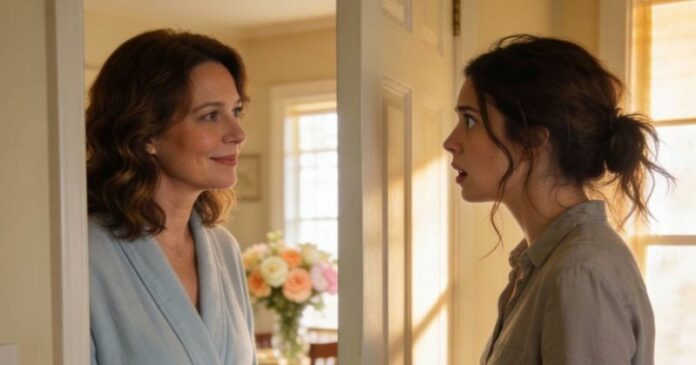
Don Ricardo Alarcón was a very wealthy man who had built his fortune from the ground up. He admired ambition and respected hard work, but above all else, he valued integrity. And lately, he sensed something was off, and it involved his son’s girlfriend, Sofia.
To everyone else, Sofia was a perfect woman. She was graceful, stylish, and confident. Alejandro, Don Ricardo’s only son, was completely smitten with her.
“She loves me, not the money,” Alejandro insisted whenever his father raised concerns.
Don Ricardo had heard similar words many times before, and they all came from men who later lost everything. He didn’t want to confront Sofia directly. He wanted to choose another approach in order to get to the truth. What he wanted to learn was how Sofia acted when no one was watching.
The opportunity came on the night Alejandro and Sofía went to celebrate their engagement at El Dorado, one of the city’s most exclusive restaurants. Don Ricardo arranged something unusual. Don Ricardo disguised in a worn waiter’s uniform and waited at the entrance.
When Sofía arrived in a luxury dress, with the diamonds catching the light, she passed him without a glance. To her, he was invisible.
Inside the restaurant, Don Ricardo waited. When he approached their table to adjust Sofía’s chair, he deliberately stumbled. A few drops of soda splashed onto the corner of her designer handbag. What followed told him everything.
Sofía exploded. She shouted, insulted him, and publicly humiliated him in front of the rest of the guests. He tried to apologize, but that wasn’t enough. Sofia wouldn’t stop insulting him, and if that wasn’t enough, she grabbed a can of Coca-Cola and flung it straight at him.
Alejandro said nothing.
What hurt Don Ricardo more than Sofia’s words was his son’s silence. He didn’t defend him because he hadn’t recognized he was his father. So Alejandro, just like his girlfriend, didn’t stand up for the “waiter” Sofia insulted mercilessly.
The following morning, Don Ricardo called his son to his office and told him the truth about the previous night. He revealed that he was the waiter he and Sofia mistreated.
Alejandro was shocked. He tried to defend his girlfriend, saying she didn’t mean to treat him that way and that she had never treated anyone that way before. But Don Ricardo wouldn’t listen. He learned the truth firsthand, and that was all he needed.
“A person’s true character,” he told his son, “is revealed in how they treat those they believe are beneath them.”
Then came the consequence. Don Ricardo informed Alejandro that his will would be changed. If Alejandro married Sofía, he wouldn’t inherit any of the money or his possession.
When Sofia learned that, she went crazy. She accused Don Ricardo of being manipulative and a bad father.
“I didn’t sign up for that,” she snapped.
For the first time, Alejandro realized his father was right.
Still uncertain, he decided to test what his father had seen. He invited Sofía to visit a local orphanage his family supported. There were no cameras, no luxury, no social status to gain.
Sofía was visibly uncomfortable. When a small child approached her with a handmade paper flower, she brushed him off with open disgust.
That was the moment Alejandro’s doubts disappeared. It didn’t take long before he decided to end the engagement, and Don Ricardo finally found peace. That was the end of the millionaire’s son’s girlfriend.
Please SHARE this article with your family and friends on Facebook.
A discussion started by a Reddit user about the worst physical pain in the universe went viral, with hundreds joining the fray and emotions running high. What surprised a lot of people was that there was a consensus on the answer, which outraged some and left many feeling invalidated.
The response also underscored an inconvenient truth, that pain is not universal and everyone experiences it differently. Even if an online consensus emerges, that doesn’t negate the fact that pain is deeply personal, influenced by the bodies, thresholds, and experiences.
When people talk about pain, the answers are usually predictable. For men, it’s often a kick to the groin; for women, childbirth is usually mentioned. But this discussion took an unexpected turn.
According to many Reddit users, the worst physical pain imaginable wasn’t childbirth at all, but something far less talked about — IUD insertion.
NHSexplains that an IUD (intrauterine device), also called a copper coil, is a small plastic T-shape placed inside the uterus to prevent pregnancy. It does not use hormones but helps stop pregnancy by releasing copper into the womb. Also, IUDs are about 99% effective but not suitable for every woman. After the device is removed, the fertility returns to previous levels right away.
Many of the women who got involved in the online discussion recounted their own IUD insertion experiences, describing intense pain and anger over how little information they were given in advance. Several reported that the process was understated by the doctors and nurses, and they were surprised at how much pain they felt.
Some even argued that stronger pain relief should be standard during the procedure in order to ease the pain and make it more bearable.
“I’ll preface this by saying that I’ve broken my femur, arm, and hand. I’ve broken a molar in half. I sliced my eyeball. I suffered a third degree burn on my hand. I’ve had two reconstructive surgeries on my shoulder. I had 3 holes drilled in my skull and underwent brain surgery,” one user wrote.
“Yes! I’ve broken my ankle to the point only tendons were holding it together, 2 C sections one after hours and hours of labouring, but that IUD is the worst! At one point he was twisting it to get better placement, I thought I was going to barf,” another woman added.
“Same for me. They didn’t give me any warning either, ‘just a pinch’ they said. Yeah, a pinch so bad I kicked the doctor in the face to get her to stop, threw up, and blacked out. I had to drive myself home afterwards, pulling over every couple of minutes to puke from the pain. That went on for days,” a third wrote.
Another comment said, “They’ve known for decades many women are under medicated when getting an IUD, and their complaints of pain are often dismissed. If you’re obese, or a smokier, or a minority, or whatever the trigger may be, you’ll tend to be treated even worse.
“This is why I constantly compliment and write thank-you notes to my good providers – mostly for treating me like a human and listening to my needs.”
What is the worst physical pain you have ever experienced?
Please SHARE this article with your family and friends on Facebook.
If you’ve ever woken up and realized you couldn’t move or speak, even though you were fully conscious, you’ve likely experienced a rather strange and mysterious phenomenon known as sleep paralysis.
Contrary to the common belief, sleep paralysis is actually more common than many believe. However, since it is an experience that feels surreal, many hesitate to talk about it.
My Cleveland Clinicstates that sleep paralysis happens “when your body is in between stages of sleep and wakefulness. An episode is temporary and only lasts for a few seconds to a couple of minutes. It’s a type of parasomnia.”
Although an episode of this phenomenon can cause nervousness and anxiety, leaving those who experienced it scared and puzzled, it is actually harmless.
Some of this episodes are related to sleep disorders, so if they happen often, it would be best to consult a doctor and avoid the emotional stress that comes with them.
According to research, around 30 percent of people experience sleep paralysis at least once during their lifetime.
You can experience it either right before falling asleep or as you’re waking up. Some of the symptoms include: inability to move your arms and legs, inability to speak, sensations of pressure against your chest (suffocation) or moving out of your own body, hallucination, and daytime sleepiness. It can least from a few seconds to up to 20 minutes and is accompanied with feelings of fear, panic, and helplessness.
Sleep paralysis is actually the result of normal biological processes. During REM sleep, which is the stage when most dreaming occurs, our brain switches off our muscles so we don’t physically act out what we see in our dreams. A paralysis episode happens when the mind wakes up before the body does. The outcome is that you’re conscious, but your body is still “asleep.”
This brief mismatch is usually set off by things like high stress, poor sleep, anxiety, irregular schedules, or severe exhaustion. Essentially, anything that disrupts the rhythm and quality of your sleep can act as a trigger. Having said that, this phenomenon can also be a result of inability to adjust between time zones when you are traveling to another country away from from your home, and even sleeping on your back.
In order to avoid it from happening, try getting regular sleep, avoid screen time right before going to bed, try to manage your stress, and create a quiet and comfortable sleeping environment.
In case it still happens, focus on your breathing and try to move just one finger or toe. Bit by bit, your body will loosen up and movement will return.
The thing about sleep paralysis is that it is one of those experiences where biology and belief collide in a powerful way.
Across cultures and centuries, people rarely thought of sleep paralysis as of a neutral bodily glitch. Instead, people tried to interpret it through the system of beliefs they already relied on to make sense of danger, mystery, and things they couldn’t see or explain.
Before modern sleep science became available, this experience was just too intense to be written off as imagination. People would wake up fully aware but frozen in place, struggling to breathe, and feeling like someone or something was present in the room with them. It was then that they turned to their system of beliefs.
In medieval Europe, superstition and religion were simply a huge part of daily life, and this particular phenomenon became wrapped into tales of witches and demons. The feeling of being held down at night and unable to scream was taken as evidence that evil entities were visiting the person during sleep. Stories of the “night hag”—a dark, witch‑like figure that sat on people’s chests as they slept—were common in England, Scandinavia, and other regions of Europe.
Church documents and folklore narratives describe the night hag coming in the night, pressing down her prey with an unseen weight and blowing fear into their ear.
People didn’t think, “Oh, maybe this is my nervous system misfiring.” They thought something truly supernatural had entered their bedroom without warning and that it was there to cause them harm. The night hag wasn’t just a metaphor but a real creature in the shared imagination of the time, a being that explained why good, ordinary people could wake up feeling hunted and powerless.
Unsplash
Travel a little farther south and east, and you see similar experiences told in entirely different terms and it wasn’t because the core experience changed, but because the interpretive lens was shaped by different cultural beliefs.
In the Middle East, where the lines of science were blurred with Islamic cultural tradition and ancient mythology, sleep paralysis was most often blamed on jinn. The jinn are believed to be invisible creatures, made of “smokeless fire” that live parallel to humans, but in the spiritual domain. They can be mischievous, malevolent, or benign according to their species and mood. As averse to jinn as his faith was, the jinn were understood as spirits, and to be roused at night and confronted by a spirit that had taken leave of its senses or was moving between corporeal and incorporeal states was a common experience. This explanation was perfectly reasonable in that cultural context, for people were already convinced that spirits could secretly affect everyday life. For these people living in these times, this was simply a rational explanation.
Unsplash
In Japan, sleep paralysis has long been known as kanashibari, which literally means “to be bound” or “tied up.” People who experienced it would wake up completely aware but unable to move, often feeling a heavy presence pressing down on them. In traditional Japanese belief, this was seen as the work of restless or angry spirits attaching themselves to a person’s body while they slept. It was not just a strange quirk of the body; but a sign that a spirit was there and wanted to cause illness.
These interpretations grew out of a worldview where spirits, ancestors, and the balance between the living and the dead were deeply important. Many stories tie kanashibari to unresolved grudges, skipped rituals, or spiritual imbalances, turning what might otherwise be a confusing or frightening experience into one with clear moral and emotional meaning. People did not just feel trapped in their own bodies, also they felt caught in a spiritual web that demanded attention and respect.
In some rural parts of Italy, especially in Abruzzo, people explained sleep paralysis using the figure of the pandafeche. This creature was said to have a scary face, claws, or other frightening features, and it was believed to sit on a person’s chest at night, especially if they had upset a witch or broken a local rule. The stories are different from village to village, but the idea is the same. People didn’t see the paralysis as random or just in the mind. They believed something real and scary was causing it. Even today, some Italians will joke about the pandafeche when someone feels “held down” while half-asleep, and the story is still passed down as part of local tradition.
Unsplash
It’s somewhat astonishing when you consider what sleep paralysis looks like at different points in history and geography. The phenomenon itself hardly varies. People wake up in the middle of the night fully conscious they are awake, but they can’t move. They have a pressure on their chest as if something is lying on it. They feel a presence in the room. Sometimes they even hear or see things that are, to all appearances, completely real. You just turn on the part of the same whether you’re in Europe hundreds of years ago or living in a modern city today, and you’re fine. What differs is the way people describe it.
Different cultures have different narratives, different names, different significances to the experience. Beliefs don’t merely provide a post-hoc label for what is happening. They literally influence what people think they are seeing, how they think they are feeling, and what they think they are remembering later. The contemporary examples are really fascinating too. Even in cultures that we know about REM sleep and the science around it, these beliefs have not disappeared. They have only evolved. Instead of witches and demons, there are now stories of shadow people at the foot of the bed, intruders in the room, or aliens. Movies and TV and stories online give people images to put themselves in line with what they’re feeling. A teenager watching horror movies late at night might wake up and see a dark shape at the room’s corner.
Conclusion
Centuries ago, someone would have called it a night hag, but the sensation is pretty much identical. This reveals something important about the human mind. The biological portion – how the brain skews consciousness and muscle control – is the same for everyone. But the interpretation of the experience is derived from culture, upbringing, and belief. People who believe in spirits tend to have more vivid and terrifying episodes.
Those who know the science are less frightened, and recall the experience differently. Sleep paralysis isn’t just a quirk of the brain. It expresses the fears, narratives, and social attitudes that we harbor. A momentary malfunction of the brain can snowball into a fully flesh-and-blood experience that feels entirely real and deeply personal.
Please SHARE this article with your family and friends on Facebook.
When our son was born, I told myself I was being “responsible,” just making sure everything in our new life was solid. But beneath that excuse was a quiet insecurity I never admitted — not to my wife, not even to myself. That insecurity grew until I finally demanded a paternity test.
She didn’t yell or break down. She just went still. Her eyes softened in a way I didn’t understand then, and she asked me one simple question: “And what if you’re wrong?”
I answered with a cold certainty I didn’t deserve: “If he isn’t mine, I’m gone.”
I took her silence as proof of guilt rather than the deep hurt it really was. I took the faint, shaky smile on her face as arrogance instead of the pain of watching her husband doubt her most deeply.
When the results came back — wrong results, as I’d later learn — saying he wasn’t mine, I didn’t hesitate. I left.
Lawyers, signatures, arguments that felt final — I walked out of the home we built, convinced I was protecting my pride. I thought I was sparing myself humiliation, but in truth, I was running from trust, responsibility, and love.
Three years later, I ran into an old family friend. As I told him my story, expecting validation, he looked at me with a grief I didn’t understand. “Your wife never cheated,” he said quietly. “That look you thought was guilt — it was heartbreak. And paternity tests aren’t perfect.”
Those words hit harder than anything I’d ever felt. I ordered a second test. And when it confirmed he was my son, the floor beneath me felt like it gave out. Everything I had walked away from… was mine. My family. My child. My wife — who had never betrayed me.
I tried to repair what I’d broken. I wrote letters, made calls, apologized until the words felt empty even to me. But she had rebuilt her world without me — a world where our son was safe, loved, and unburdened by my fear.
The last time I saw him, he was laughing, tiny hand wrapped around hers, running across a park path I once imagined taking him down myself. I watched from a distance, understanding — fully, painfully — that some doors close forever the moment you walk out of them.
Conclusion:
I learned too late that trust is not something you test; it’s something you protect. Fear disguised as logic cost me my family. And while time moves forward, regret stays — quiet, heavy, and honest. One day, I hope my son learns the truth, not to absolve me, but to know that he was never the mistake. I was.
Please SHARE this article with your family and friends on Facebook.
Nearly three decades have passed since a quiet Colorado morning turned into one of the most haunting mysteries in American history. The death of six-year-old JonBenét Ramsey captivated the nation, blending heartbreak, confusion, and relentless media scrutiny. Now, 28 years later, her older brother Burke Ramsey has shared rare reflections on a tragedy that has shaped his entire life.
In December 1996, the Ramsey family’s world was shattered. JonBenét, a lively six-year-old beauty queen from Boulder, Colorado, was reported missing the day after Christmas. A lengthy ransom note demanding $118,000—matching her father’s recent bonus—deepened the mystery. Tragically, JonBenét was later found dead in her family’s basement, transforming a holiday into one of the nation’s most shocking moments.
Friends and family remember JonBenét as vibrant, joyful, and creative, with a love for singing and dancing. Her innocence, captured in countless photographs, became both a symbol of grief and a national fascination, turning private tragedy into public obsession.
The investigation faced immediate challenges. Evidence was mishandled, the home wasn’t secured properly, and early DNA testing lacked today’s precision. Investigators split between two main theories: an outside intruder or someone within the household. The ransom note and unusual monetary demand added to the confusion, while relentless media coverage blurred facts and fueled speculation.
At just nine years old, Burke Ramsey grew up under the unyielding glare of public attention. For decades, he avoided the media, keeping his pain private. In a rare televised appearance on Dr. Phil, Burke recounted the confusion, heartbreak, and scrutiny of those early years. His calm, restrained demeanor reminded viewers that trauma manifests in quiet, often subtle ways.
JonBenét’s parents, John and Patsy, endured years of suspicion and criticism. Patsy passed away in 2006, while John continues advocating for modern forensic analysis to uncover the truth. Advances such as touch DNA, genealogical tracing, and AI-assisted techniques offer hope, though legal and procedural caution has slowed official progress, leaving the case unresolved.
The media’s role in shaping public perception cannot be understated. From documentaries to online debates, JonBenét’s story has been retold countless times. Yet Burke’s interview emphasized the human side of the tragedy: the family’s grief and the importance of remembering JonBenét as a person, not just a case.
Even after 28 years, questions remain unanswered: Who wrote the ransom note? Was there an intruder, or did something happen within the home? While time complicates matters, advances in forensic science and ongoing public interest keep hope alive for resolution.
JonBenét’s legacy also inspires advocacy. The family has championed child protection and victim rights, striving to turn tragedy into purpose. Her story remains a lesson in empathy, the complexities of justice, and the enduring human quest for understanding.
Conclusion
The JonBenét Ramsey case endures as one of America’s most captivating and heartbreaking mysteries. Burke Ramsey’s reflections provide a rare window into a life shaped by trauma and resilience. While definitive answers remain elusive, the family’s determination and scientific advances keep the search for truth alive. JonBenét’s memory persists—not just as a symbol of mystery, but as a reminder of innocence, love, and the enduring human quest for understanding.
Please SHARE this article with your family and friends on Facebook.
When President Donald Trump issued an executive order targeting two former officials, it felt like opening old wounds. Conflicts from the aftermath of the 2020 election, which had never been fully put to rest, became the center of attention yet again.
The executive order targeted Chris Krebs and Miles Taylor, two former senior officials who became lightning rods during Trump’s first term.
Now neither man serves in government, but they are both still deeply enmeshed in questions about election integrity, dissent from within, and the boundaries of executive power.
Krebs, who was head of the Cybersecurity and Infrastructure Security Agency, became a key player in the post-2020 election period when his agency publicly stated that the election infrastructure had functioned securely. His statement that the election was “the most secure in U.S. history” was broadly quoted at the time and accepted by state election officials and many in the press. But for Trump and his followers, the statement became emblematic of what they took to be an establishment reassuring itself too soon during a period of contestation.
Taylor followed a different path into controversy. Namely, while working at the Department of Homeland Security, he anonymously wrote a highly critical opinion piece about the administration. After he later revealed his identity, supporters called his actions principled dissent from within government. Detractors had a different take: they said the anonymous attack from a senior official was a breach of trust.
Trump’s order canceled the men’s security clearances and ordered a review of their conduct. It did not bring new evidence, but it rekindled unresolved debates about responsibility and dissent. Advocates of the decision characterized it as belated but necessary scrutiny, saying the public can only place its trust so far in decisions that helped construct the nation’s narratives in moments of crisis.
“This isn’t punishment,” one former administration official said in defense of the action. “It’s about accountability. Officials who influence public confidence during historic events shouldn’t be beyond review.”
Critics pushed back sharply. Civil service advocates warned that the decision risked sending a chilling message to career officials, particularly those tasked with providing candid assessments that may conflict with political leadership. One former federal employee described the order as “symbolic but powerful,” noting that “you don’t need mass firings to discourage dissent — you just need examples.”
Legal scholars largely agree that presidents have broad authority over security clearances. Still, several noted that how that authority is used can matter as much as whether it is lawful. Even symbolic actions, they said, can affect perceptions of institutional neutrality, especially when disputes appear rooted in long-standing political grievances.
Contributing to the tension are faint echoes of internal analysis and warnings that never fully came to light. Some analysts say that restraint was shown in 2020 so as not to destabilize the environment. Others argue that such forbearance fostered lingering insecurity through the opacity inherent in it. None of these assertions have been definitively proven.
What is clear, however, is that the 2020 election is still shaping political and institutional behavior years later. Measures once broadly accepted as stabilizing are now being re-evaluated through a transformed political prism. For civil servants, the effects are indirect but tangible. Government institutions depend on professionals willing to speak truth to power. If past decisions can later be turned against them, critics say, caution may replace candor.
Supporters argue that independence does not mean immunity. In their view, holding individuals to account for past behavior is a necessary part of democratic accountability, even when it proves uncomfortable.
In the end, the episode underscores a larger issue that remains unresolved: how a democracy manages internal dissent without dissolving into institutional rupture. It does not settle that debate, but it makes clear that the battles of the 2020 era are not behind us.
Please SHARE this article with your family and friends on Facebook.
Princess Diana truly was a very special person who touched the hearts of many with her spontaneous behavior and the love she had for everyone around her, rich or poor, young and old. At the time of her death, her sons, Prince William and Prince Harry, were still very young and the news of the tragic car accident in which their loving mother was killed shook their world.
The moment Princess Diana and Prince Charles got engaged back in 1981, they instantly became one of the most famous and most powerful couples. Many women wanted to be in Diana’s place, not knowing that the relationship and the marriage were doomed from the start, and the future King was to be blamed for that.
Tim Graham Photo Library via Getty Images
People close to the late Princess, among which Diana’s astrologer, Penny Thornton, claim that the problems between Diana and Charles didn’t start when she learned he was having an affair with Camilla, who later became his wife, but way before that.
Shortly after they announced their engagement, Charles and Diana sat in front of the cameras. Charles said he was “delighted and frankly amazed” that Diana wanted a royal life with him and the then-soon-to-be princess noted that Charles was “pretty amazing.” But then, a question followed, and Charles’ answer to it traumatized young Diana. When the reported asked them in they were in love, Diana said yes, and Charles answered, “Whatever ‘in love’ means.”
Jayne Fincher/Princess Diana Archive/Getty Images
“We had this ghastly interview the day we announced our engagement,” Princess Diana said, as quoted in her authorized biography, Diana: In Her Own Words.
“And this ridiculous [reporter] said, ‘Are you in love?’ I thought, what a thick question. So I said, ‘Yes, of course, we are,’ and Charles turned round and said, ‘Whatever love means.’ And that threw me completely. I thought, what a strange answer. It traumatized me.”
While still married to Diana, Charles started an affair with Camilla Parker Bowles, his current wife and Queen Consort. The two fell in love even before he met Diana but after leaving to serve in the Navy, Camilla got engaged to another man.
TIM GRAHAM/Getty Images
When Diana learned of the affair, she confronted Camilla. And then, in 1995, Diana stepped into the spotlight with the infamous BBC interview. “There were three of us in this marriage, so it was a bit crowded,” Diana told interviewer, Martin Bashir, before admitting to having had her own affair.
“It was shocking because this was Diana in her own words and what she was saying was incredibly explosive,” royal expert and author of The New Royals Queen Elizabeth’s Legacy and the future of The Crown, Katie Nicholl, told History.
“It was Diana taking control of the narrative in front of the camera for the very first time.”
What was dubbed “the wedding of the century” ended in a painful separation which eventually led to divorce, after Queen Elizabeth urged her son and her daughter-in-law to officially call their relation quits.
Anwar Hussein/WireImage
When she announced the separation back in 1992, Diana, who held the tiles Her Royal Highness and Princess of Wells, continued to perform her royal duties. However, the divorce wasn’t finalized until 1996, one year prior to Diana’s death, because they couldn’t reach an agreement regarding her titles. She wanted to keep HRH because losing it would mean having to follow strict royal protocols when around her sons, including curtseying to them.
Sadly, in 1997, Diana lost her life after she and her partner Dodi Fayed, the son of Egyptian billionaire Mohamed Al-Fayed, her driver Henri Paul, and her bodyguard Trevor Rees-Jones crashed the Mercedes in the Pont de I’Alma tunnel in Paris while trying to escape the paparazzi.
Tim Graham Photo Library via Getty Images
Now, years after her passing, Princes Diana’s letters showing the true devastation she experienced because of the divorce emerged.
As per The Mirror, 32 letter written by Diana to her friends, Susie and Tarek Kasseem reveal her true feelings.
In one of the letters written on April 28, 1996, she explains that she was forced to cancel a trip to Italy and apologize to her friends because of her mental state.
“I am having a very difficult time, and pressure is serious and coming from all sides. It’s too difficult sometimes to keep one’s head up, and today I am on my knees and just longing for this divorce to go through as the possible cost is tremendous,” Diana wrote.
In another letter written a week later, the late Princess wrote, “As I don’t have a mobile, it is difficult to discuss personal issues as my lines here are constantly recorded and passed on.”
“If I’d known a year ago what I’d experience going through this divorce I never would have consented. It’s desperate and ugly.”
Tim Graham Photo Library via Getty Images
Diana also thanked the couple for letting her spend Christmas with them in 1995, while Harry and William stayed with Charles at Sandringham.
Mimi Connell-Lay, of Lay’s Auctioneers, said that the letters are “frankly astonishing.”
“Susie met Diana at the Royal Brompton Hospital, and it is obvious that they clicked straight away, Diana says as much in one of her letters,” she told the Mirror.
“They had a very strong connection, and what is clear is how much Diana valued their friendship and support and advice at a time of great emotional turmoil for her.
Mark Cuthbert/UK Press via Getty Images
Connell-Lay added, “She wrote a lot about what was going on in her life at the time, especially her divorce, and repeatedly referred to not having the support from the Royal family.”
The letters have now been sold at auction for $169,663.
We are so sorry for everything Princess Diana was forced to go through during her life.
Please SHARE this article with your family and friends on Facebook.
Attraction is never one-size-fits-all. The reality is that while some men are drawn to curves, others tend to favor slim women, and that’s perfectly fine. Slim women have long been admired in certain cultures and social circles, but preferences don’t develop in a vacuum. So who is more likely to prefer slim women, and what influences that attraction?
Younger Men Influenced by Media
Social media has changed how beauty is seen. What once felt normal now often feels edited, filtered, and harder to reach.
All those beauty trends pushed by influencers don’t just affect confidence, they slowly shape what people start to find attractive or likable.
Since younger generations tend to be exposed to social media more than the rest of the people, many of them associate slim women with style, elegance, and attractive. Many celebs, models, and influencers impose the idea that slimness is “modern beauty,” forcing young men to be more attracted to women who fit this image.
Men who live in major cities or move within professional circles such as business, fashion, or entertainment are often exposed to certain beauty expectations. In those environments, being slim is almost always associated with looking put-together, disciplined, and successful. For some of these men, choosing a slim partner simply feels in line with the lifestyle and image they’re used to seeing around them.
Men Highly Focused on Appearance
Ask someone about their taste in women and you’ll usually end up getting a quick answer. However, attraction is more complex than that. It’s shaped by timing, experience, and the nuanced interactions that can’t be just boiled down to a list of boxes to check. But this isn’t true for every men out there. On the contrary, a lot of men are guided simply by appearance when choosing a partner.
While some men tend to engage in meaningful relationships, others only seek short-term involvement. The latter usually choose their dates based on appearance and opt for slim women since slimness may act as an immediate cue of attractiveness.
Please SHARE this article with your family and friends on Facebook.