Looking back, I realize I missed all the red flags. Could I have known things would turn as they did? I guess yes, but I was blindsided by love and convinced myself over and over again that things would turn up for the better, but I just lied to myself.
I was thirty-four weeks pregnant, and that was supposed to be the best period of my life. You know, with all the excitement and the anticipation of welcoming a child. But then one night, right in the middle of the night, my baby started kicking my ribs so hard that I just couldn’t sleep and spent most of the night in the bathroom and trying to get to a position that would be at least a bit comfortable.
The entire time, my husband, Ryan groaned and pulled a pillow over his head, totally annoyed by my existence.
He had been extremely bitter and nasty all the time, whining about the bills and how restless I was. The last time I had tried apologizing to him, he went ballistic and told me to sort things out since he was busy with work and needed to sleep more. I hadn’t even mentioned that my physician had warned me about how high my blood pressure was due to my lack of sleep.
At exactly 3:04 a.m., Ryan suddenly bolted upright, snatched the keys to my car, and tossed them at me. “The car has recliner seats,” he said. “Since you’re on your maternity leave and I’m paying the rent, you can camp out in the car for a couple of weeks, so I can catch some sleep.” Exhausted, humiliated, and gasping for breath, I didn’t even fight him. Instead, I grabbed my pregnancy pillow, walked down three flights of stairs in the suffocating August heat, and curled up in the backseat of my Honda Civic.
That became our “secret nightmare” schedule. Every evening at 10 p.m., I had to go down to the car, and by 6:30 a.m. the next day, he would text me to come upstairs. Not an apology or anything. I kept it all hidden from everyone, even lying to my OB-GYN about it when she desperately asked if there was anything wrong at home. In the meantime, Ryan was just a normal husband in the morning, whistling and making breakfast for himself as though he didn’t force his heavily pregnant wife to sleep at the parking lot.
Things exploded in the early hours of last Friday morning. I noticed some headlights shining through and somebody tapping at my window. It turned out to be my mother-in-law, Dana, who had tried calling Ryan to talk about the baby shower but grew anxious that she could not reach him and had come over to find me crying in the back seat of my car.
I blurted everything out. Dana stiffened up, looking up at the black windows of our apartment in total disbelief of what her son was capable of doing to the woman carrying his child. She asked me to hold tight, rushed somewhere and fifteen minutes later returned dragging something wrapped in brown paper. “It’s time you learned how to parent,” she said, yanking me out of the car.
We marched up those three flights of stairs. When Ryan opened the door, his sleepy smile vanished. Dana made him unwrap the package, which turned out to be a folding camping cot. She flatly told him that he’d be sleeping on it in the hallway from now on, and I was taking the bed.
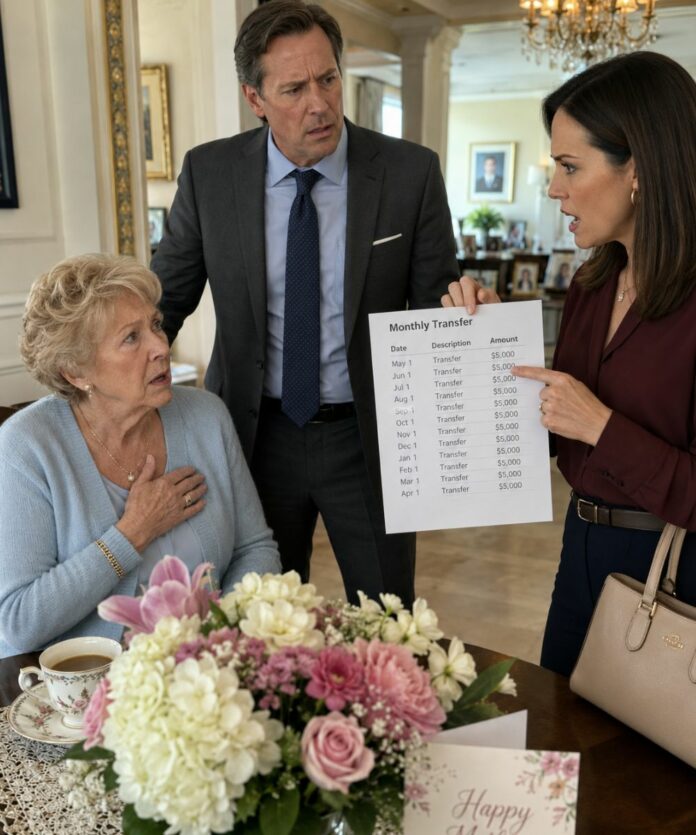
Once Ryan threatened that he could not allow her to run things in his own apartment, Dana revealed that she had actually been sending him money for the past two years to take care of our rent since he did not earn enough; he was just pretending in front of me. She stated that once I slept in the car again, no more money was coming from her side.
Ryan tried to charm his mother, but that didn’t really wok, so he threw a tantrum, just like toddlers do, and honestly, it was embarrassing to even look at him. But Dana ignored him and just threw some sheets on him. I did the same. I just pretended he wasn’t there and walked right past him without saying a single word. I then got in the bed and was glad I could finally get some rest myself.
He lasted three nights on that hallway cot before he finally broke down and gave me a real apology. He even agreed to marriage counseling, which Dana booked for us. Six weeks later, I delivered a healthy baby girl with my incredible mother-in-law holding my hand. And after that, I promised myself I would never apologize for taking up space again.
Please SHARE this article with your family and friends on Facebook.
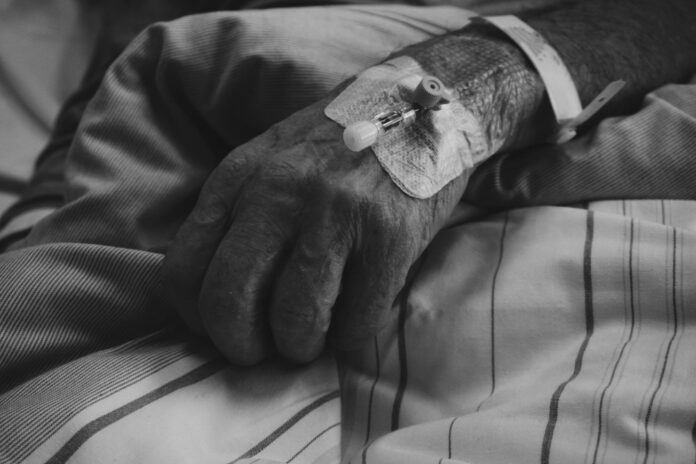
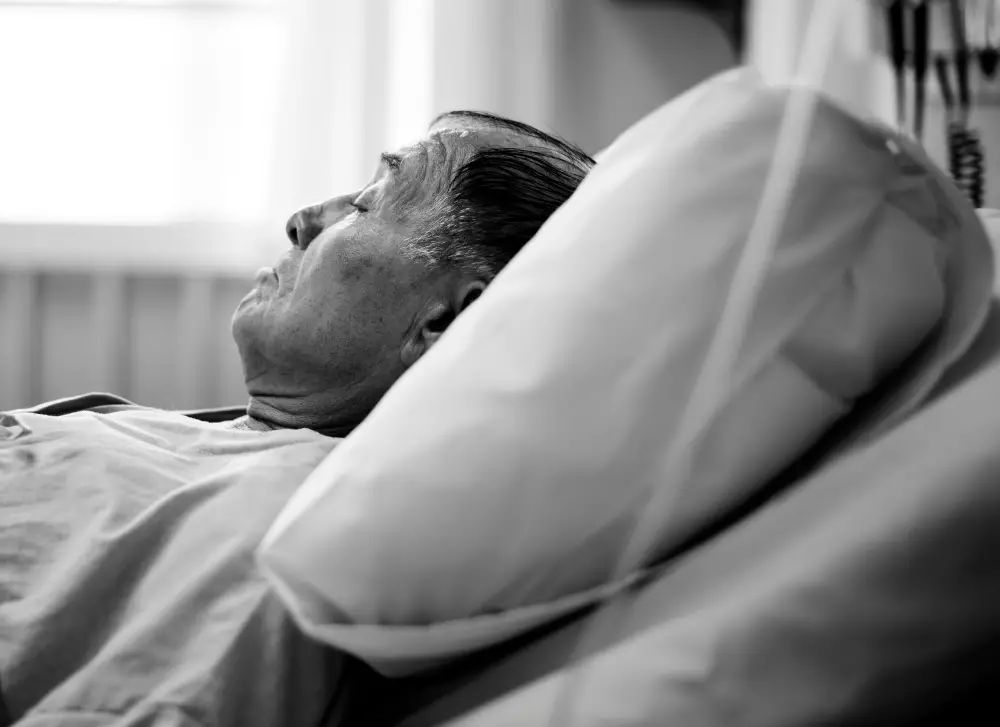
Recognizing when a loved one may be nearing the end of life can be emotionally overwhelming. However, understanding the signs your parent may be nearing the end of life allows you to prepare for the inevitable and provide the care and comfort they need during their final days. Here are three key indicators that suggest it may be time to brace for the worst.
Source: Freepik
1. Frequent Dreams About Deceased Loved Ones
If your parent or an elderly loved one frequently mentions dreams about their deceased relatives, it could be an emotional signal of their longing and connection to those they cared about deeply. While it may seem unsettling, this behavior often reflects their focus on the people they miss and cherish. This is one of the signs your parent may be nearing the end of life that you shouldn’t ignore.
2. Discussions About Their Own Funeral
When an elderly individual starts talking openly about their funeral plans or expressing wishes for after their passing, it can be a clear acknowledgment that they are coming to terms with their mortality. These discussions are a sign they understand their body and situation more deeply than they may communicate directly. Preparing for this moment and honoring their wishes can provide them peace of mind and a sense of control.
3. Sudden Health Improvement After Long-Term Sickness
Source: Freepik
A phenomenon known as terminal lucidity occurs when someone who has been chronically ill or bedridden for a long time suddenly seems to regain energy, appetite, or physical strength. This unexpected recovery may include requests for food or even brief periods of mobility. While it might seem like a positive development, it is often a sign that the end is near. This fleeting improvement is one of the critical signs your parent may be nearing the end of life.
Supporting Your Loved One in Their Final Days
Understanding these signs doesn’t make the process easier but can help you better prepare emotionally and practically. Focus on creating a peaceful environment, spending meaningful time together, and providing them with love and support.
Please SHARE this article with your friends and family on Facebook.
You just got to love how far you are willing to go as a parent, or in my case, as a grieving widower, just to protect a child.
When I stopped by my late wife’s mountain cabin in a middle of a blizzard, all I wanted was to say goodbye to the life we had. Instead, it was a moment my life turned upside down and was never the same.
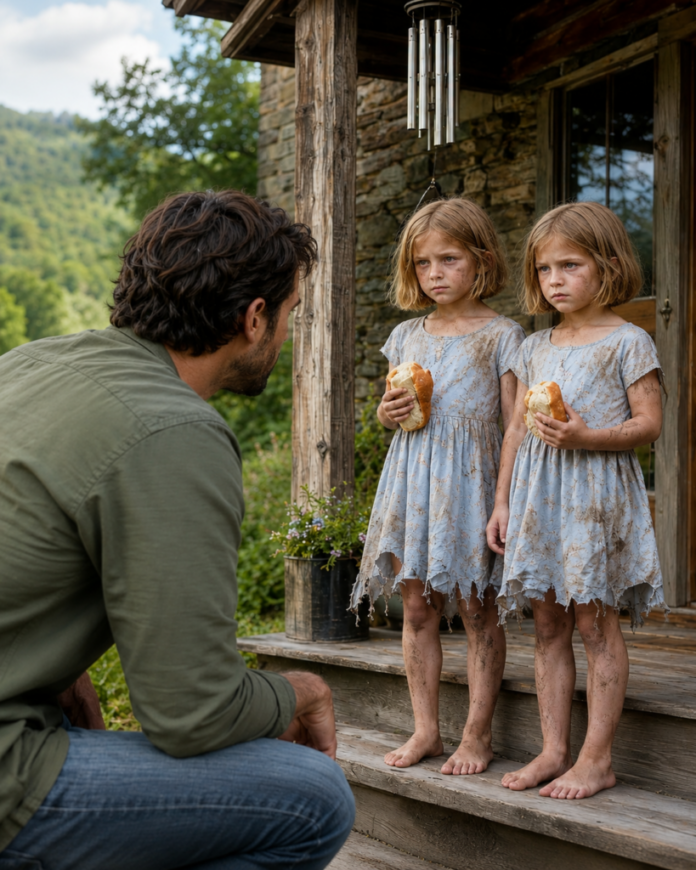
I stopped by the cabin, and the first thing I noticed were two girls looking exactly alike. I figured out they were twins, but what I couldn’t wrap my mind about was why they were there at the porch during that freezing weather.
The first thing I noticed amid the snow was blood and these two kids looking up at me as if I held the key to life or death.
They were both barefoot and refused to answer when I asked them where their shoes were. Apparently, their mother told them not to talk to strangers, and I was okay with that, because they were obviously scared.
Then, out of the blue, one of them asked me if I was Daniel, and I just froze, because no one called me that except for my late wife Mara who passed away eleven months prior to this strange meeting.
I took them inside the cabin, still unaware of what was going on, just to realize that the power was off. The pantry was empty, all the drawers were opened, and there were clothes and things all over the floors. Even the mattresses were dragged in the middle of the room.
“For God’s sake, what happened in here?” I asked.
“Mom told us to look for Aunt Mara’s treasure, sorry for ruining the place,” one of the girls said.
When I asked them about their mother, they told me she had left them there three days prior. I knew their mother, Vanessa, well. What I didn’t know was that she had twin girls, and that was shocking to me.
At Mara’s funeral, Vanessa acted absolutely insane, calling me a paper-pusher and saying that all rights of that mountain property belong to blood family members, not a widower. I didn’t want to argue at that time because Mara asked me on her deathbed not to get into a fight with Vanessa about money. But seeing those girls, I understood that it wasn’t about grief – it was a hunt.
I got a propane heater running, wrapped them in blankets, and called the sheriff. Then I called an old friend, Elena Ruiz, who ran the financial crimes unit for the state attorney general. Before I retired, I used to prosecute people exactly like Vanessa, so I told Elena I needed a forensic team, child services, and total radio silence. While Rose fell asleep on my shoulder, Lily reached into her jacket lining and pulled out a brass key that had been sewn inside. She whispered that Mara told them if the bad people came, they should only give it to the man still wearing her wedding ring.
This was the key to a steel security box that was kept secret in the back of Mara’s old sewing cabinet. There was a letter addressed to me, bank statements, and flash drives that were proof of how Vanessa and her boyfriend had stolen four hundred thousand dollars from the twins’ trust funds when their father passed away. Mara had already made arrangements to file for emergency custody before her illness progressed further. She had restructured her trust to make sure the cabin went to the kids, making me responsible until they were twenty-one years old. It seems that Vanessa did not abandon the twins by accident; she believed that the documents were somewhere in the house, and she wanted to destroy them and use the old will to steal the property.
One of the flash drives contained a voice recording of the two of them talking about how I would be too distracted with crying over Mara to notice anything, and how they would coerce me into signing the deed to sell the cabin and send the twins into state custody.
The following morning, Vanessa showed up in her white SUV with a fur coat on, together with her boyfriend and another crooked lawyer fixer whom I actually knew from my days at the court. She began banging at the door, yelling that I had kidnapped her children. When I told her that they were freezing cold without any food whatsoever, she just raised an eyebrow and said I was overacting. Then she outright told me that she would frame me for the crime of kidnapping unless I gave the house to her then and there.
I tried to look defeated and asked them to give me a day to think it over.
As soon as they left, Elena and two deputies emerged from the pantry, with a recording device. The child protection services took pictures of the bruises on the girls’ wrists and their malnutrition. However, I had to ensure that Vanessa gets booked for all this. I called her and told a lie, claiming that I had discovered a safe containing her deed and letter, and offered to burn it down if she brings me $100,000 in cash. They fell for the trap immediately.
They showed up after midnight, fully confident they were about to get away with it. We sat at the dining table, and I picked up the fake deed they brought. I pointed out that on the exact date Mara supposedly signed it in Boston, the notary listed was actually serving a prison sentence in Nevada. The lawyer’s face went completely white.
When Vanessa snapped at me to destroy the trust amendment, I laid out three copies on the table and told her the safe was just bait—the real document was already logged at the county registry. Right there and then, the deputies walked out of the dark hallway with a warrant.
Everything unraveled immediately. The boyfriend panicked utterly, pointed at Vanessa, and yelled that she was the one who had planned everything, while Vanessa was yelling back that it was he who starved the girls and tied them up. The whole room became deathly quiet, while Elena recorded absolutely everything.
Before sunrise, all three people were under arrest. The investigation revealed a huge chain of fraud acts, while in the end, the court ruled to terminate all rights of Vanessa as a parent. Vanessa ended up with twelve years in jail, her boyfriend with fourteen, and their lawyer lost his license and received six.
And I? I was granted custody on the twins. When I think about that old cabin all I could think of is that I went there to say goodbye to my old life unaware that I’ll find a completely new one.
Please Share This article with your family and friends on Facebook.
It took four rings before Darnell finally answered the phone. However, when he did, he was annoyed and acted as though I interrupted something extremely important. I could hear some noise from the background; loud music and laughter, along with clinking of glasses, like he was in a whole other world than my quiet kitchen, where I just clung to the counter in order to be able to stand on my feet.
It was only a few hours since his mother died. I could still feel that sensation of her slipping out of my hand, that thick, suffocating silence that falls over a home after the person has breathed their last breath.
When I gathered the strength to deliver the news of his mother’s passing, Darnell just said something about being late to an important dinner he couldn’t miss and hung up the phone.
This was a few weeks ago. At the time, I thought that telephone conversation was the absolute lowest point a father could ever reach with a child. I had no clue that my wife, Diane, had been planning something behind my back for the past fifteen years to keep me safe from the people we raised.
The funeral was held on Thursday, and there were hardly any people present there. There was only our next door neighbor, one of her friends, and the postman whom Diane made hot coffee during the chilly winter days. Darnell’s chair remained vacant. Everyone noticed this, but did not say anything about it. Sometimes, people show mercy when they decide to remain quiet.
A few days after that, I found myself rifling through her dressers, trying to keep myself busy. The final box, hidden in the bottom drawer, contained a bundle of letters from her that she had written to. Reading through the letters was a terrible experience as she had chronicled years of abuse from Darnell that I had been trying to ignore – the time he made fun of her cooking or holiday plans, the times when he didn’t call except when he needed money. However, in the final letter that she wrote before her death, she had mentioned Harold, our estate lawyer, and an amount of money that I didn’t know anything about.
I went to Harold’s downtown office and thought there must have been a mistake. We were a humble family, so how could Diane possibly had any money saved. But once at Harold’s, he explained that Diane had inherited a rundown house some years back, restored it, rented it out, and managed to make a real estate portfolio. All put together, she had a trust fund worth nine million dollars.
Apparently, she kept it a secret because she wanted to surprise me for my sixty-seventh birthday and allow me to retire comfortably. But she also explicitly wrote that Darnell shouldn’t get a single cent unless he proved he cared about more than just money.
While I was still sitting in the lawyer’s office, my telephone rang. It was Darnell. Weeks of no contact, and then suddenly his voice becomes so warm, asking how I was doing and offering help to sort out the stuff his mother left behind. Diane knew just how he and his wife Veronica were going to react to it. In one of her letters, she wrote that she had even hired a private detective to check Veronica out because something about her just felt off.
That Saturday, they showed up. They sat in their rented car outside for ten minutes, obviously rehearsing their story line, and then when they came in, they began to take inventory of the living room. Veronica gave me a phony hug, passed me a card of a psychiatrist, dropped hints that my grief was clouding my judgment, and suggested I should move to their condo. I knew exactly what they were up to. I went to the kitchen and called Harold to tell him they had arrived.
A few days later, they returned with a lawyer, psychiatrist, and social worker to perform a psychiatric evaluation, asking me a barrage of questions for two hours straight, all the while Veronica wandered through the rooms touching things as if she owned them.
Once they were done, I told them I needed to place a call, and then on cue, the doorbell rang. In came Harold with the private investigator along with a detective from the financial crimes division. The investigator then began to lay out evidence in the form of documents and photographs on the coffee table, and thus all came tumbling down. It became apparent that Veronica had been married three times previously to men who were rich and elderly, taking all that they possessed while leaving their families completely broke. And then came the audio tape that Diane had recorded of Veronica admitting her plan to put me in a home and sell the house.
Darnell looked as though the floor had just dropped from underneath him. The detective then took Veronica into custody immediately for fraud and exploitation of an elder while she begged for Darnell to help her out.
After everyone left, it was just me and my son sitting in the quiet. He finally broke down, crying about missing the funeral and wondering if his mother hated him. I didn’t sugarcoat it. I told him she forgave him, but that he didn’t deserve it, and that he’d have to spend the rest of his life trying to be worthy of that kind of grace.
Veronica ended up taking a twelve-year plea deal. Darnell went back to Detroit, but I clearly told him he was not going to live with me anymore. He got himself a little place and a steady job. He visits me on Sundays when I call him for dinner. It’s difficult, but he is trying. The last time he came to visit, he had a small basil plant which he put on the windowsill, where Diane used to grow her herbs.
I am living in our old home surrounded by all her things and have no intention of moving anything yet. It dawned on me that not only did Diane save me from being poor, she saved me from being used and manipulated by those who perceived me as being vulnerable. She loved me quietly but fiercely, and her love is protecting me even now that she is gone.
Please SHARE this article with your family and friends on Facebook.
Is longevity just genetics? Why avoiding major diseases may determine how long we live?
When we ponder upon how long and how well we live, the first thing that comes to mind is probably genetics, or the traits we inherit from our parents. It turns out, however, that our DNA is just a part of the story, and this is something backed up by science and plenty of research. According to National Geographic, when it comes to the question of our lifespan, genetics account for roughly 20%. It may be hard to believe for some, but the remaining 80% is determined by our lifestyle, our surrounding, and those seemingly tiny decisions we make every single day.
This means that what we do, and what we decide to avoid, plays a role more important than many of us assume.
Perhaps the best sign of healthy aging is the avoidance of major chronic diseases and conditions.
If we make it into our 60s, 70s, 80s, and even beyond, without experiencing any serious chronic diseases, that says plenty about our body and how its internal systems communicate with each other, how they repair damage, and how they stay balanced.
As per the World Health Organization (WHO), non-communicable diseases (NCDs), such as heart disease, stroke, cancer, diabetes, and respiratory problems like those affecting the lungs, cause about 74% of deaths globally, especially among the elderly.
When we are free from these diseases, it doesn’t only increase our lifespan but it also improves our “healthspan,” which is basically the time we live without being affected by any serious illness.
This is why a number of experts argue that the meaning of true longevity is not just about the number of years lived, but also about the quality of those years.
Heart disease remains the leading cause of deaths globally. According to Harvard Health, the damage happens gradually as the arteries lose their flex and blood pressure rises, often as a result of our daily habits, our diet, and how we cope with managing the stress we experience.
Making it into your 60s and beyond without suffering from heart issues is an indicator of the strength of your body. The healthy heart can be seen as an engine for everything else. It helps deliver oxygen and nutrients throughout the body, keeps your brain healthy, maintains your stamina, and keeps your spirits high. Exercise, good nutrition, and mental balance aren’t just about avoiding diagnosis but also about adding quality into your life.
Type II diabetes is much more than just a “blood sugar issue.” According to Harvard Health, this condition silently damages blood vessels and nerves, which can easily lead to heart disease, kidney failure, vision loss, mental decline, and frequent infections.
Being able to stay diabetes-free in older age is a signal of a healthy metabolism. It means your body is still great at managing energy, fixing damaged tissue, and keeping inflammation in check. All this, consequently, leads to better blood flow, clearer mind, and healthier kidneys. Your day-to-day habits, especially your diet and level of activity, are incredibly powerful predictors of diabetes risk even before any symptoms appear.
A stroke happens due to interruption of blood flow in the brain, or rupture of a blood vessel in the brain. Even when it’s not fatal, the consequences of a stroke can still be devastating. Often, stroke results in the loss of speech, memory, movement, and our independence.
Should you reach old age without suffering a stroke or any serious blockage, it shows that your vascular system is strong, your arteries are flexible, and your blood flow is smooth. The World Health Organization states that such strong circulation not only nourishes and protects the brain but also aids in the healing of wounds and the maintenance of the immune system, both of which are essential for fighting off infections and staying strong in old age.
Unsplash
Cancer
In simple words, cancer happens when our body cells start growing uncontrollably. In such cases, our immune system is the body’s first line of defense. The immune system works constantly, trying to detect abnormal cells in the body and eliminating them before they turn into a bigger issue.
When we reach old age without ever been diagnosed with any form of cancer that’s a strong indicator of a resilient immune system, low levels of chronic inflammation, and effective DNA repair capabilities, all of which is influenced by how we eat, how we sleep, and how we deal with stress. While genetics do play part in the likelihood of developing cancer, our environment and life style choices, such as avoiding smoking and drinking alcohol, are incredibly powerful influence in tipping scales in our favor.
Unsplash
Chronic Lung Disease
Chronic lung diseases such as COPD and asthma affect the breathing, which slowly puts pressure on the heart, the brain, and the immune system. If your breathing isn’t affected in your 60s and beyond, your lungs are doing an awesome job. As explained by the World Health Organization, healthy lungs mean better oxygen supply to every part of the body. This leads to more physical stamina and better chances at recovering from different illnesses. One of the best things you can do for your lungs is to avoid smoking and exposure to air pollution.
Unsplash
What all this means for your body
If you have made it past the age of 60, 70, or 80 without any of these conditions, your body is telling you something incredible; that it’s balanced, strong, and capable of self-healing.
Your internal body parts, including your heart, lungs, brain, digestive system, as well as your immune system, are actually communicating with each other working together in harmony. And that is the main reason why many people who have reached certain age without ever experiencing any of these conditions are very likely to live past the age of 100.
However, this isn’t just down to luck. According to Harvard Health, it’s a result of thousands of small choices we do on a daily basis.
Unsplash
Science backed-up tips for longevity
1. Stay physically active
When you exercise and move your body regularly, you help strengthen your muscles, lungs, heart and bones, thus reduce the risk of heart disease, stroke, diabetes, and even depression and anxiety. Harvard Health recommends that adults perform at least 150 minutes of moderate physical activity each week. Daily physical activity, even a brisk 10-minute walk, can reduce the risk of an early death by 15%, according to The Times.
2. Eat Whole, Nutrient-Rich Foods
A diet rich in fruits, vegetables, whole grains, and lean proteins has long been associated with reduced chronic disease and longevity, as per the Times of India. The Mediterranean and plant-based diets are believed to be the most protective against chronic disease due to their high antioxidant and anti-inflammatory properties. Reducing ultra-processed foods and sugar in the diet helps stabilize blood sugar levels, reduce inflammation, and promote a healthy gut.
3. Prioritize Sleep and Stress Management
Sleep is the time during which the body handles biological repairs. According to research, during the phase of deep sleep, the body gets rid of the toxins, rebalances the hormones, and helps tissue heal. On the other hand, chronic stress speeds up the process of aging.
Some activities people can practice for the sake of boosting their mental well-being, minimizing stress, and even promote longevity are meditation, mindfulness, and volunteering.
Unsplash
4. Avoid Toxic Exposures
We are all well aware that smoking affects our health in a negative way and increases the risk of developing lung diseases, heart diseases, and even some types of cancer. Quitting smoking, limiting alcohol consumption, and reducing exposures to harmful chemicals as much as possible are all factors in maintaining long-term health.
Build Strong Social and Mental Health
It’s in the human nature to socialize with others, and that’s the reason why loneliness and stress are directly linked to a higher risk of chronic diseases and even death. It is very important to be able to keep up with your relationships, to stay mentally active, and to be as involved as possible in your community, because all this can contribute to a longer and more fulfilling life.
*Medical Disclaimer: This article is for informational and educational purposes only and is not intended as medical advice. It should not be used as a substitute for professional diagnosis, treatment, or guidance from a qualified healthcare provider. Always consult your doctor or another licensed medical professional regarding any health concerns or medical conditions.
Please SHARE this article with your family and friends on Facebook.
Every parent out there knows the length to which they are willing to go just to see their kids happy. And I honestly believe that this is even more true for parents hose children have gone through an illness and spent weeks and even months in a hospital.
Well, my daughter had just finished her final round of chemo and wanted to spend a day at the pool without thinking of doctors, hospitals, and syringes. All she wanted was to feel like any other kid out there, so we ended up booking a small resort and hour drive from home. To many, getting to a place like that wasn’t much of a big deal, but to her, it meant the world.
When checking in, the lady at the counter handed us some clips to use for reserving our spots early since the pool area would be crowded. I caught myself apologizing to her whenever my daughter’s goggles dropped on the ground and again when there was a problem with my credit card. This is what a whole year spent in hospitals and making numerous calls to insurance companies will do to you. You end up developing this awful habit of always apologizing to everybody around you, thinking that you are nothing but an inconvenience to others.
The following morning she woke up before sunrise wearing an oversized swimsuit and the biggest smile you have ever seen on someone. And yes, she still had her hospital ID bracelet on, and didn’t force her to take it off since she felt a bit more secure having it.
Next thing, we found ourselves two fabulous seats in the shade of the large umbrella, stayed there for a while, and then went on to grab some smoothies. It probably took less than 15 minutes before we were back.
However, when we got back, we saw a woman wearing this white fancy swimming suit sitting on one of the chairs, and a man sitting right next to her, on my daughter’s chair. What’s more, our towels were thrown near the trash can.
Since it was a very special day for both me and my daughter, I wasn’t in the mood of getting into an argument with any of them. I approached and told them, as politely as I could, that those chairs were ours, but the woman didn’t even look up and just said if you leave, you lose the spot. I then pointed to our room clips on the table, and when she actually bothered to look at us, she saw my daughter’s bald head and her hospital bracelet. Rather than apologizing and feeling bad about stealing our seats, she made an ugly face at me and said that we should find some other place. Those around us who got to hear the conversation was as shocked as I was. In fact, I was so mad I could have exploded, but I did not want to embarrass my little girl in front of everybody.
We ended up sitting in broken chairs at the very back with the direct sunlight shining on us. My daughter was looking so miserable, wondering why couldn’t we have our place. It was heartbreaking not knowing what to tell her since people can sometimes just be mean, but a minute later, one of the resort workers passed by with a giant blue box and winked at me. Then he went straight to that couple and loudly told them they were the special guests of the week, handing them a prize box full of VIP perks, spa vouchers, and fancy dinner reservations.
The woman was thrilled, but then the guy asked for her room number to activate the vouchers. As soon as she gave it, he stopped and said the prizes weren’t actually for her room after all. Then the manager and a lifeguard stepped in. The manager explained that the VIP box was actually for whoever was assigned to those specific chairs. The woman tried to claim we had abandoned them, but the lifeguard called her out, saying we’d only been gone fifteen minutes and he literally watched her throw our towels away. Everyone around the pool was staring while the couple had to pack up their stuff and leave in total embarrassment.
Then, the resort guy handed out a small box to my daughter. There was a plush turtle wearing sunglasses, some coupons for desserts, and a card from the employees wishing her well and encouraging her to keep being brave and welcoming her back to just being a kid. The smoothie guy gave us a wave, and the housekeeper was even in tears. The manager later told me that he noticed that I had apologized to all the employees since the time we checked in, and he wanted to tell me that I hadn’t done anything wrong at all. It really hit me hard because I realized I’d spent a year apologizing to doctors, insurance agents, and strangers, just begging the world to make a little room for my daughter, forgetting along the way that she deserves every right to be there.
We got our chairs back, and we were even given some extra smoothies.
In the afternoon, a woman with a young boy in a medical mask came over to the pool. There was the same fearful and uncertain expression on her face as I once had on mine; the fear of whether she was even allowed in. I looked at her and let her know that we had plenty of space, and dropped an extra towel for her. Soon enough, the kids were showing off their scars as if they were some badge of honor. As I sat in the sunshine, I found out I no longer had to battle the whole world.
Please SHARE this article with your family and friends on Facebook.
Eight months away from home, and I stumble upon what? A sick baby and a terrified wife!
When I walked in, I didn’t actually say anything because I wanted them to think they were still in charge up until police officers, my lawyer, and child services entered the house. By sunrise, both my mother and my sister were in handcuffs, cut out of the family inheritance, and out of the house for good.
But let me start from the start.
The moment I stepped foot in the house, I could hear my son crying. Then there was my mother, “Just leave him. Let him learn his lesson!” What lesson was a baby supposed to learn, I wondered, questioning both my hearing and my sanity.
The place smelled awful and it was so hot I felt like I’d pass out.
Inside the nursery, my wife was on the floor, crying. There were bruises all over her, and she was terrified.
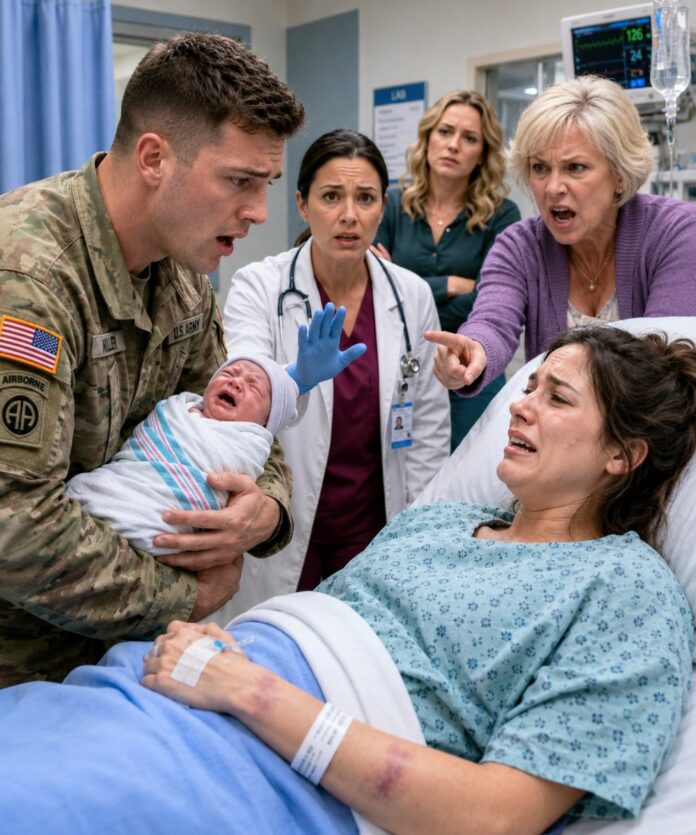
Before I could reach her, my mother, Eleanor, blocked the doorway, literally dressed in my wife’s silk robe. My sister, Audrey, was close behind her, holding a wineglass. All my mother did was cross her arms and say my wife Sophia needed to be disciplined, while Audrey pointed out the child is not their problem.
I looked at Leo and asked how long he had this fever, but both my mother and sister said I was just exaggerating because the child was just right. But then Sophia he told me he wasn’t, and they wouldn’t let her use her phone and call for help.
My mother then said Sophia obviously didn’t know her place and needed to be taught a lesson, thinking I’d take her side.
What my mother wasn’t really aware of was that the house she was staying in was actually mine, not hers, since I bought it through military family trust following my grandfather’s passing.
I also knew the reason why Sophia stopped calling while I was on duty were my mother and sister. But at the time, I didn’t have the strength to get into any arguments with them. I just grabbed my son and left the place.
My mother said I was just making a big deal out of nothing and that the baby was just fine, a bit of high fever wouldn’t harm him.
As I left the place, I could hear car doors slamming in front of the house.
You see, for the past six weeks, I’d been collecting information: bank statements, deleted texts, and video recordings from a supposedly broken nursery camera. Somehow, they forgot I was a soldier and I was trained to plan.
Once my mother and my sister saw the officers, the detectives, my lawyer, and the paramedics, Audrey started yelling like crazy that I shouldn’t have involved the police into what she believed was a “family matter.” But Captain Ruiz reminded her that keeping my wife locked and assaulting her wasn’t really a family matter.
The paramedics ran to attend to Leo who was dehydrated. Sophia begged me not to go anywhere, and I reassured her that I had no intention of doing so while Eleanor continued insisting that they were only trying to teach Sophia responsibility.
My attorney laid a large folder on the table and asked whether teaching her meant beating her. Audrey insisted that no one had ever laid a hand on her but Captain Ruiz raised his hand holding a sealed bag containing the memory card from the nursery camera.
I’d put that camera in before I deployed. It saved footage to an encrypted cloud. Eleanor used to unplug the router for privacy, but she didn’t realize the camera recorded locally to the card and uploaded everything the second the Wi-Fi kicked back on.
Ruiz played the videos on a tablet and the first one was of Eleanor pulling Sophia by her hair because dinner was delayed. The second video was of Audrey assaulting her while the baby cried. Videos were also shown of them locking her up, confiscating her phone, and Eleanor flushing Leo’s medication in the toilet. Eleanor wanted to argue that Sophia was overdosing Leo. But the caseworker accessed the concealed dosage log and found out that Sophia was following doctor’s orders.
I then asked Sophia for how long this abuse had been going on. It turned out it all started the week after I left. They had managed to convince her that I gave them full control over her showing her text messages I allegedly sent.
My mother said I was destroying the family, but where people who forged signatures, stole money from the family trust fund and abused my wife really a family? I wouldn’t say so.
In fact, my grandfather, the person who raised me while my mother was away for five long years without telling a single soul where she was, once told me that you only protect family that protects you. And neither my mother nor my sister ever stood for me.
My mother still couldn’t comprehend the extend of the damage she and my sister had done. She even had the audacity to ask me if I was choosing “that woman” over her and my sister.
The officers took both my mother and sister out for further questioning while my lawyer handed them eviction notices. As they were led out, my mother said she was willing to forgive me if I dropped the charges, and I couldn’t help but laugh at her words. She seemed totally delusional.
Then came the final blow. My lawyer pulled out the trust documents. Because of the abuse and the forged checks, their inheritance was frozen.
Audrey freaked out; she had given up her entire life for those $38,000 she had stolen from the family trust and a chance to abuse my wife. Eleanor spat at me saying that I had planned all of this. I just replied with, “No, you planned all of it, I have just documented all of it.”
By morning, they were arrested for the whole long list of felonies. Seeing the video proof, they both pleaded guilty. The court deprived them of their inheritances forever and gave the money to Leo’s education and Sophia’s treatment. They had nothing left, nothing except their prison cells, their poverty, and their ruined family.
I resigned from active service to join a local one and spend more time with my wife and son. Sophia started seeing a therapist and founded a nonprofit organization which helped military spouses recognize the signs of abuse.
Please SHARE this article with your family and friends on Facebook.
For a long time, I believed that the news of my five-year-old daughter’s sudden passing was the absolute rock bottom in my life. But I was wrong.
Some would question what can be worse than losing a child, because honestly, nothing is. But once you learn the whole story, you’ll understand what I am talking about.
Around a week after Grace’s funeral, while I was still questioning reality and wondered if I’ll ever be able to move on from the tragedy, I was sitting on the floor, crying my eyes out, when I took Grace’s favorite pink sweater. I took it in my arms and then I noticed something falling from the sleeve. It was a flash drive and a note that said my husband was lying to me. That came as a shock to me, because why would my husband lie to me when we were both in the same mess of losing a child. Was someone playing games on me during the roughest period of my life or there was more to the story of how my daughter died?
The entire ordeal started on a regular Thursday when Grace experienced high fever that forced us to take her to the hospital. Next thing I knew, she was hooked up on one of those huge machines. I became paranoid because no one really told me what was wrong with her. As the nurses and doctors went in and out of her room, I reminded each and every one of them that Grace was severely allergic to penicillin. “Please have it on the chart,” I’d say, and they all assured me that they had it covered.
This entire time, my husband, Daniel, acted weird. He just stayed at the end of the bed, totally detached from reality. Every now and then, he’d step outside the room to take one of his “work calls.”
By Friday, they had to move her to ICU. Saturday came around, and before I knew it, all the alarms were going off and everyone was rushing into the room. A nurse went to check her chart, drew a red circle around her allergies, and told me I did the right thing bringing it up. Then, they made me leave the room. “She needs space,” they said, but she was only five years old, scared out of her wits. And then, she was gone.
One week after we laid her to rest, the hospital gave us a call to come and pick up the plastic bag containing her possessions. Daniel immediately got on his feet and begged me to let him do it, but something wasn’t quite right about him begging like that. It didn’t feel right, and so I said no.
Once I arrived at the hospital, Hannah, the nurse at the reception desk, gave me the bag. She didn’t say anything, but the fear she had in her eyes was screaming at me even though she wasn’t speaking a word. As she placed the bag in my hands, she moved very close to the counter and told me, “Check out the video when you’re alone.”
The following night, I waited until all the lights went out in our house, and Daniel was fast asleep. I locked myself in Grace’s room and started checking everything inside the bag to find that drive in her sweater. Once I had put the drive into my computer, the scene that appeared on my screen literally destroyed my entire world.
It was an image taken from the ICU the morning of her death. Grace was weak, but she was conscious and upright. The video displayed the image of a nurse who was trying hard to prevent Dr. Patel from giving Grace a particular drug. She was literally showing him something on the chart and trying to remove his hands, but all in vain because he ignored her and injected the drug directly into Grace’s IV. Her body went into shock immediately. Her monitors spiked and alarms went off, and then the flat-line happened. They had injected her with penicillin.
As awful as it was, it wasn’t the worst thing that happened. The video continued playing, and the next scene was in a private meeting room at the hospital later that same day. In the video, I could see the hospital administration gathered around a table as they figured out a way to change the records to make sure her death was considered “a medical complication,” so they wouldn’t be sued. Then the door opened, and Daniel walked into the room.
They told him everything that went wrong, and yet, he didn’t start yelling or contact the police. They offered him an extremely large sum of money as compensation, in return for complete silence and an NDA. Without any further hesitation, my husband signed all the documents and took the money. I actually had to sit there in the darkness, listening to my own husband’s voice saying, “She doesn’t need to know the details.” And he was talking about me.
Not even a single tear escaped from my eyes nor did I scream out loud. That strange and detached autopilot mode took control of my whole body. For the next four hours, I copied everything and anything. I backed up the video to three hard drives, stored it on the cloud, and sent it to secure email addresses.
The very first thing in the morning, I found Nurse Hannah who verified everything and admitted how she had jeopardized her entire career by sneaking out that video since she could not bear to live with the guilt of covering up the death of a little girl. She gave me her word that she would be my witness in court. Immediately afterwards, I went to the bank and investigated the financial records and found out entirely new bank accounts of which I was unaware at all and under the full control of Daniel, who had made huge wire transfers just days after Grace’s death.
However, when I finally confronted him, just seeing the terror-stricken look in his eyes told me everything I needed to know. He attempted to deny what he did at first, stuttering incoherently, but after I showed him the tape and threatened to report him, he broke down entirely and confessed to accepting the hush money. And yes, he even said he did it to protect me from learning the truth because I was too fragile for it. All the while, I kept recording our conversation on my phone without his knowledge.
The next day, I presented all evidence to a lawyer, and together, we filed a huge malpractice lawsuit. In response, the hospital’s legal counsel immediately retaliated, sending me numerous threatening messages, forcing me to give back the video, and trying to scare me into submission. But the pressure became completely unbearable for Daniel; he packed his bags and disappeared from the house in the middle of the night without saying a single word to anyone.
Today, I’m alone in this battle. Depositions are being scheduled, and the hospital is using any tactic possible to remove this video from the legal records. However, I won’t stop, no matter how ruthless and devastating this will be for me. Because if they succeed in destroying this video and hiding their crime, the truth of what they have done to my baby daughter will be buried along with her. And I’ll never let that happen.
Please SHARE this article with your family and friends on Facebook.