

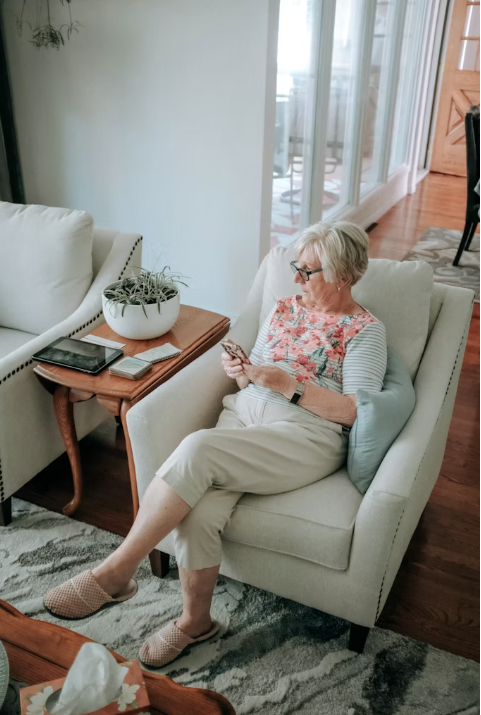
When you are 73 and living alone it’s easy for people to make assumptions. Most people believe I’m lonely, desperate, and miserable, but the truth is nowhere near to what they assume about what my life looks like.
Many of my friends who either still have their spouse by their side or live with their adult children are convinced that my days consist of some sort of depressing silence, empty rooms, no one to look forward to, and isolation.
They see being alone at this stage of life as a tragedy or at least a game of waiting. But in my case, it is definitely the exact opposite. I am single, and to tell you the truth, I have never felt happier.
There is always this confusion between being alone and being lonely. These two things have nothing to do with each other at all. To be alone is a very physical thing; it simply means that no one else shares the same physical space with you. Loneliness, on the other hand, is an emotion. I’m sure everyone out there has been in a crowded place surrounded by people talking, yet has felt completely empty and invisible from within. On the flip side, you can live completely by yourself in a quiet house and feel entirely fulfilled, connected, and whole.

Of course, learning to appreciate myself took some time. In those initial months when I began to live alone, silence was oppressive and uncomfortable. It was too quiet, unfamiliar, and a bit scary all at the same time, as I had to face my own thoughts with no distractions at all. But as time passed, I discovered a wonderful truth: peace is where silence is. And when I began to embrace silence rather than run away from it, everything changed. Silence became a place of comfort rather than a desert of loneliness.
As research in environmental psychology and mental health indicates, our surroundings and how we spend our time within them have an enormous impact on our emotional resilience. In order to turn solitude into an advantage, I created a lifestyle that revolves around four main points.
Building a daily routine with purpose
Probably one of the greatest pitfalls individuals encounter while living alone is lacking a daily structure. It is easy to fall into a routine of waking up at random times, eating whenever, and letting the hours blur together without much intention. This is not what I wanted for myself. Instead, I decided to create a straightforward, daily schedule: a morning walk to soak in the sun, an hour of dedicated reading, light housework as a way to respect my living space, and dedicated time to reflect. It does not take much effort to maintain, but structuring the day in advance makes the mind feel secure and grounded.
Staying mentally and emotionally active
Loneliness has a weird way of creeping in the second your brain stops being active. If you spend the whole day just melting into a screen, you start to feel yourself shrinking. To fight that, I make sure I’m actually using my brain. I pick up books that challenge me, dive into topics I know nothing about, and honestly question my own experiences. Your mind needs a workout and something to get excited about, just like your body does.
Focusing on connection, not quantity
I don’t have a massive social circle anymore, and honestly, I don’t even need one. I’ve completely shifted my focus from how many friends I have to how deep those friendships actually go. I crave real, late-night-style conversations and authentic bonds, not just superficial small talk. For me, even just checking in every now and then with the people who truly get me is enough to keep my cup full. True connection isn’t about the number of contacts in your phone. In fact, even organizations like the National Institute on Aging have found that when it comes to keeping our brains sharp and our bodies healthy as we age, it’s the quality of our relationships that matters, not the quantity.

Finding joy in simple things
This was probably one of the most prominent personal paradigm shifts in my case. I stopped looking forward to some big events, vacation days or other important things, which would give me a reason to be happy. Rather, I began cherishing small micro-moments in the day: the silence of the new morning, the warm feeling of having a really good cup of hot coffee, the calmness of taking a walk around the neighborhood or reading a page from an excellent book. These were my whole world since I realized that happiness does not always have to be full of fuss.
My experience
Once you stop being scared of going through life alone and change the way you see things, living alone becomes a blessing. It is where you get to be completely free; you can decide when to eat, sleep, or decorate the way you like. Living alone gives you peace of mind, continuous self-realization, and absolute emotional freedom. You understand that you do not need anyone else to make your day or set your mood.
Eventually, becoming comfortable in one’s home has nothing to do with age; it has everything to do with a person’s mindset. Loneliness is not so much about the environment but rather how people deal with it. You do not necessarily need to wait until you are 73 years old to grasp this idea; you can do so today.


For most of my life, I fell into the trap of thinking that to be happy, I constantly needed to be surrounded by people, noise, and validation—just to keep the terrifying quiet at bay. I used to think being busy meant being alive, but I couldn’t have been more wrong. Real happiness comes from the inside, and it’s all about the relationship you have with yourself. Once you realize that, loneliness completely loses its power. There’s a beautiful shift that happens: you can never truly be alone if you’re a good friend to yourself.
Please SHARE this article with your family and friends on Facebook.
Bored Daddy
Love and Peace