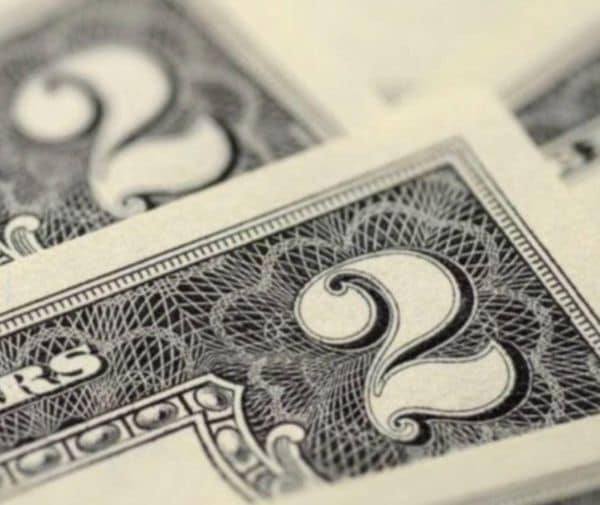
Got $2 bills? You might be surprised by their value!

- Advertisement -

The $2 bill was first introduced in 1862 during the Civil War to ease coin shortages. At the beginning, it featured Alexander Hamilton before switching to Thomas Jefferson. This bill has a fascinating history in American currency.

Throughout the years, the $2 bill wasn’t accepted by the public because they often associated it to bad luck. Its unpopularity continued into the 20th century, with Americans avoiding to use it for their daily transactions, and sticking to the $1 and $5 bills instead.

The U.S. government made an attempt to revive the $2 bill as part of the nation’s Bicentennial celebration back in 1976 by introducing a special edition featuring the signing of the Declaration of Independence on its reverse.
However, this design became popular with the collectors and further deepened the conception that the bill was only valuable as a collectible. This made many people hoard $2 bills, which further limited their circulation.

Despite the fact that it’s not used often in everyday life, the modern $2 bill isn’t particularly rare or valuable. Most $2 bills printed after 1976 are only worth face value unless they have distinctive features like star notes or errors such as double print.

Those $2 bills that can be worth more were printed between 1953 and 1963. The pre-1928 large-size notes can also be of greater value, with the rarest examples selling for hundreds of dollars depending on their condition.
- Advertisement -

One of the reasons why the $2 bill was never truly accepted by the public was practical. Namely, cash registers that are designed without a designated slot for the denomination made it inconvenient for retailers to handle.

This, along with people’s preference for multiples of 1 and 5, contributed to the bill’s decline in popularity.

According to the Federal Reserve, about 1.2 billion 2-dollar bills are in current circulation. And although this might seem like a huge number, if we make a comparison to the 11.7 billion 1-dollar bills in circulation, the difference is obvious.

Even today, the $2 bill is wrapped around enigma because of its rare use, making it a conversation starter for those who stumble upon it.

Please SHARE this article with your family and friends on Facebook.

Bored Daddy

- Advertisement -

Love and Peace

- Advertisement -
- Advertisement -
- Advertisement -

The $2 bill was first introduced in 1862 during the Civil War to ease coin shortages. At the beginning, it featured Alexander Hamilton before switching to Thomas Jefferson. This bill has a fascinating history in American currency.

Throughout the years, the $2 bill wasn’t accepted by the public because they often associated it to bad luck. Its unpopularity continued into the 20th century, with Americans avoiding to use it for their daily transactions, and sticking to the $1 and $5 bills instead.

The U.S. government made an attempt to revive the $2 bill as part of the nation’s Bicentennial celebration back in 1976 by introducing a special edition featuring the signing of the Declaration of Independence on its reverse.

However, this design became popular with the collectors and further deepened the conception that the bill was only valuable as a collectible. This made many people hoard $2 bills, which further limited their circulation.

- Advertisement -

Despite the fact that it’s not used often in everyday life, the modern $2 bill isn’t particularly rare or valuable. Most $2 bills printed after 1976 are only worth face value unless they have distinctive features like star notes or errors such as double print.

Those $2 bills that can be worth more were printed between 1953 and 1963. The pre-1928 large-size notes can also be of greater value, with the rarest examples selling for hundreds of dollars depending on their condition.

One of the reasons why the $2 bill was never truly accepted by the public was practical. Namely, cash registers that are designed without a designated slot for the denomination made it inconvenient for retailers to handle.

This, along with people’s preference for multiples of 1 and 5, contributed to the bill’s decline in popularity.

According to the Federal Reserve, about 1.2 billion 2-dollar bills are in current circulation. And although this might seem like a huge number, if we make a comparison to the 11.7 billion 1-dollar bills in circulation, the difference is obvious.

Even today, the $2 bill is wrapped around enigma because of its rare use, making it a conversation starter for those who stumble upon it.

Please SHARE this article with your family and friends on Facebook.

Bored Daddy

Love and Peace

- Advertisement -
Monica Pop
Monica Pop
Monica Pop is a senior writer for Bored Daddy magazine covering the latest trending and popular articles across the United States and around the world.

More from author

Related posts

Advertisment

Latest posts

A year after my divorce my ex MIL told me her son did the right thing leaving me

Every divorce is painful in its own way, and mine wasn't an exception. Around a year following my separation with my ex-husband, I found...

My husband let his secretary ride in the front seat of my car and called me sensitive—so I sold his house, took his car,...

When people ask me at what point did I realize my marriage was over, I don't really overshare. But I knew exactly what that...

Donald Trump’s niece Mary claims he’s in a ‘downward spiral’ and reveals what he’s ‘terrified’ from

That Mary Trump isn't fond of her uncle, President Donald Trump, isn't anything new. In fact, it looks like she's using every chance she...

Want to stay up to date with the latest news?

We would love to hear from you! Please fill in your details and we will stay in touch. It's that simple!