

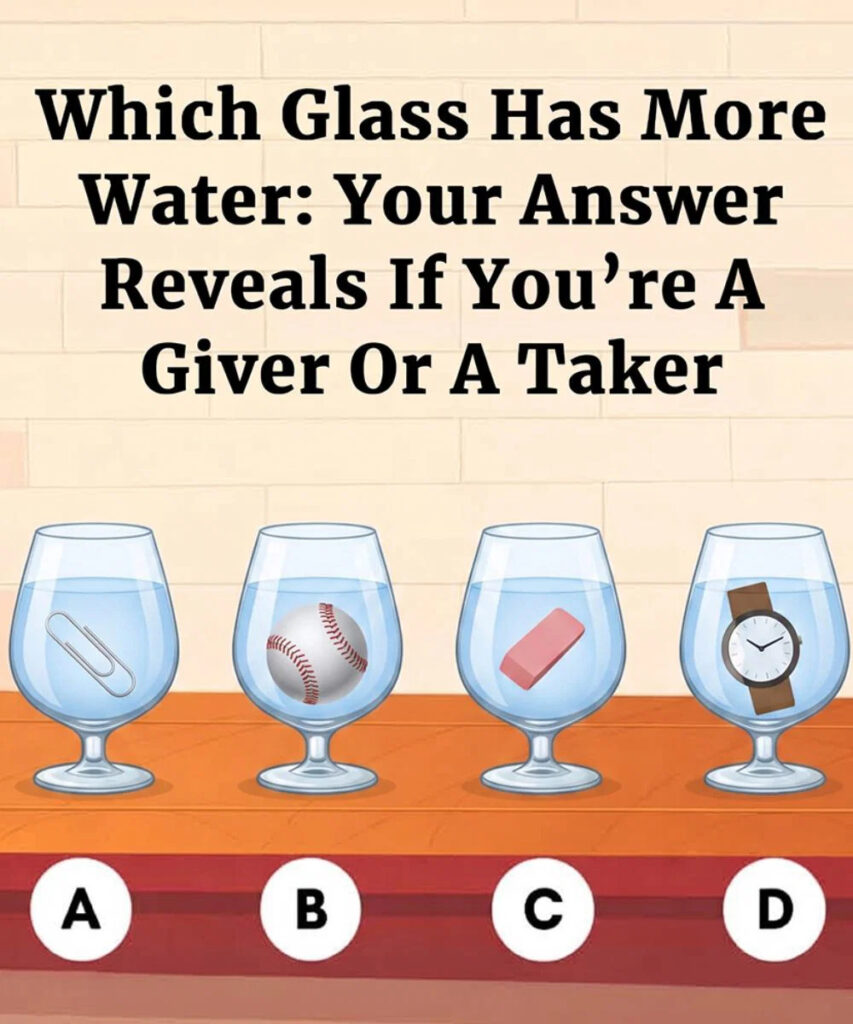
At first glance, this puzzle seems incredibly simple, just like most puzzles out there. There are four glasses labeled A, B, C, and D, all filled with water to nearly the exact same level. Inside each glass, however, sits a completely different everyday object. Your challenge is to decide which glass truly contains the most actual water.
Most of us give their answer right away, relying on our initial instincts. But after giving it some thought, we will soon discover that this is no game of guessing whatsoever.
It’s fun how puzzles like this one often lead to lively debates regarding personality and thought processes. Although the decision you make may have no scientific basis for defining who you are, it does have in describing how you think and how you interpret the things you see around you.
Looking closely at the glasses
Each glass contains a distinctly different object:
Glass A contains a paperclip
Glass B contains a baseball
Glass C contains an eraser
Glass D contains a wristwatch
Initially, most people concentrate solely on the apparent water level. Given that the four glasses seem to be equally filled to the brim, it becomes increasingly challenging to spot the critical clue in front of them.
The trick behind this puzzle is based on an elementary law of physics known as displacement.
When any object is submerged in water, it displaces water by occupying space. The larger the object, the more space it takes up inside the glass. Consequently, this means less water remains in that particular glass.
Therefore, even if two glasses appear to contain the same amount externally, the one with the smallest object actually contains the greatest amount of water.
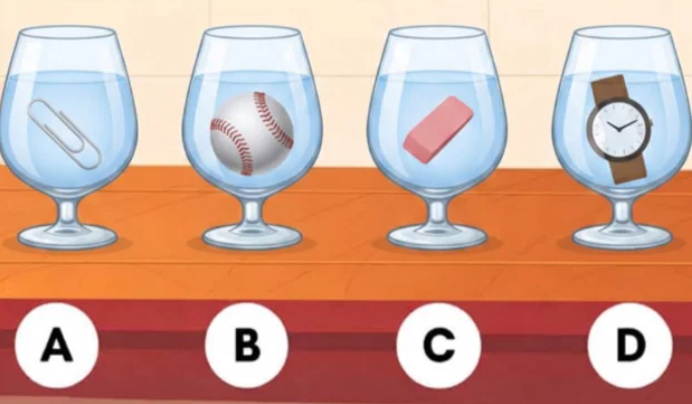
The correct answer is Glass A.
The paper clip is undoubtedly the smallest object amongst all four objects. This explains why it causes the minimum amount of displacement of water. Since the paper clip takes up the minimum physical space in the glass, there would be enough space left for water to flow around the object to attain the high water level.
On the other hand, the baseball placed in Glass B takes up a large amount of space. There is not enough space left for the water to fill the gap. The rubber eraser and the metal wristwatch also displace significantly more water than the tiny paperclip.
This is why Glass A technically contains the most water, even though all the glasses may appear completely similar at first glance.
Why so many people get it wrong
The thing that makes this puzzle so fascinating is not the complexity of the science behind it. On the contrary, the idea itself is pretty straightforward when you take your time and think about it. The problem is purely perceptual in nature.
It is natural for the human mind to make fast and efficient visual judgments while navigating through life. Seeing four glasses with water filling them to the same level automatically implies equal amounts of liquid contained within each of the glasses. Most people concentrate on the level of water rather than the displacement caused by the objects hidden inside.
This is precisely the reason why riddles such as these are spreading fast online. It shows how intriguing the gap between perception and reality can be. At times, the tiniest detail makes all the difference.
What your choice might say about you
While there is only one answer that fits this riddle from a logical standpoint, it gets even more interesting when considering the various ways in which you might interpret your choice in terms of personality traits.
If you chose glass A
If your choice was the paper clip, then you likely have an amazing eye for details and find yourself preferring a more methodical thought process instead of jumping to conclusions. You may be one of those people who need to break down the situation before coming to an answer. In other words, instead of just looking at the surface level, you see past it and into the reasoning behind it all.
If you chose glass B
In case the baseball grabbed your interest, you tend to use intuition and instinctive judgments rather than over-analyses of your visual observations. You tend to act according to your instincts and have confidence in yourself while taking swift actions. You might not always consider all possibilities before acting and, therefore, fail to notice small details.
If you chose glass C
The choice of the eraser could point towards a balance between being a logical and creative thinker. This indicates that you have the capacity to think logically while also incorporating some form of imagination, and you normally weigh different options before coming up with a definite conclusion. Being a flexible thinker, you often adapt easily to new information and are perfectly willing to change your perspective if proven wrong. People like this are usually thoughtful and open-minded.
If you chose glass D
By choosing the watch, you are likely to have a greater attraction towards symbolism, emotion, and abstract reasoning. Instead of concentrating on the tangible dimensions or the objective facts and figures, your focus may naturally shift towards the significance, importance, and interpretation of things. You may place a higher importance on experiences and feelings compared to logical reasoning.
Why people love visual puzzles
Puzzles are extremely popular now due to their simplicity, interactivity, and the great pleasure people feel while solving them. Visual puzzles encourage people to engage immediately. Unlike complex equations and lengthy tests that require time and effort, puzzles take only seconds to understand, which makes them highly suitable for social media.
However, what makes them truly memorable has more to do with psychology than anything else. These visual puzzles remind people that our minds do not always interpret things accurately because they often work based on assumptions.
In everyday life, this happens more often than we realize:
- People judge complex situations too quickly based on a headline.
- They trust appearances without looking deeper into a person’s character.
- They react emotionally before analyzing the actual facts.
Puzzles like this gently challenge those automatic cognitive habits and force us to pause.
The bigger lesson behind the puzzle
Ultimately, the most intriguing thing about this puzzle is not whether or not you were right in your initial attempt. Rather, it’s the reasoning process behind your conclusion.
Did you stop to think about what was going on?
Did you rely solely on your gut feeling?
Did you consider the objects’ function within the glasses?
The puzzle ultimately becomes a small reflection of how people approach problems in general. At times, the reality is not always immediately evident. At times, the solution lies in the minutiae that others overlook. And finally, at times, those who take enough time to observe become the ones who get to see the bigger picture.
So the next question is, “Did you choose glass A right away?”
Please SHARE this article with your family and friends on Facebook.
Bored Daddy
Love and Peace