

When you think about it, it’s rather interesting how some families work, or better said how the fall apart when money is on the line.
All my life, my brothers saw me as the black sheep because I opted for a life that did not revolve around pursuing a corporate position and saving every dime I made. When our father got ill, they remained distant and indifferent to his condition while I left everything behind in order to take care of him. They believed that since I did not put up a struggle in claiming my share of the pot, it meant that I was incapable of doing anything at all. But people like Grant and Owen always underestimate the quiet ones, never realizing that you don’t have to shout to be paying attention.
They picked our father’s funeral to break me for good. Standing by his sleek walnut coffin, Grant puffed up to me, his breath reeking of expensive bourbon. He insulted the ill-fitting black dress I wore—borrowed from my neighbor, Mrs. Alvarez, because it was all I could afford after six months of unpaid leave to care for Dad. Grant whispered that Dad had left everything to them—the company, the houses, the money—and that I was walking away with nothing. Next to him, Owen smiled and suggested I find myself a receptionist job at the funeral parlor. They expected tears. They got none. Instead, I placed a single red rose by Dad’s coffin, looked them in the eye, and asked how they could possibly believe that—especially since Dad had called me just three hours before he died.
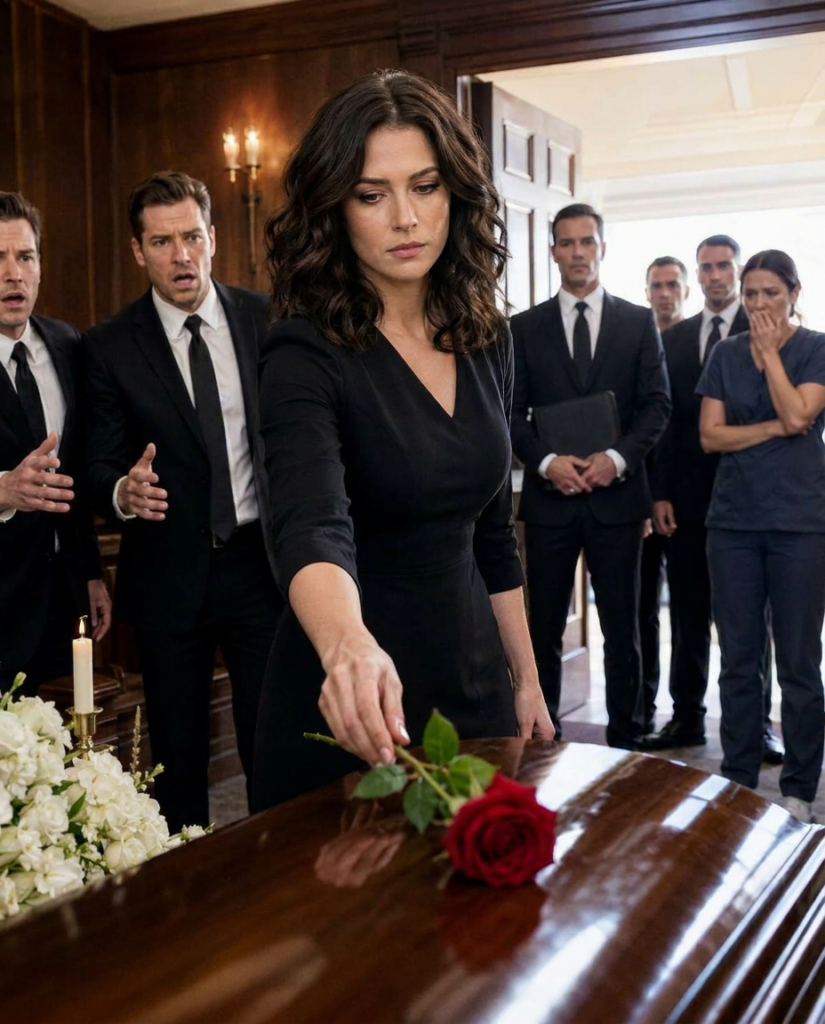
Grant attempted to brush it off by saying that Dad was only delirious, but the smile disappeared from his face when the funeral director shut the door of the chapel after us. At the rear of the chapel stood Dad’s lawyer, Miriam, together with two detectives and Celeste, the private nurse hired by my brothers.
They always considered me the broke daughter, totally ignoring the reason why state regulators had once called me the best forensic accountant in the field. While they spent the week shopping for new cars and new offices, I spent it hunting for signatures, prescriptions, and an illegal trail. When Dad called me before he died, he wasn’t confused at all; his voice was faint but steady, giving me a precise warning that Grant and Owen were pressuring him to sign documents and altering his medications. Thanks to a security app I use for work, I had the entire conversation recorded.

When confronted by the detectives, the nurse finally crumbled and spilled everything. She said that Owen had held Dad’s wrist down in order to make him sign a new will, and after Dad said that he was going to call me, they drugged him. When she left, Owen took things one step further and changed out the syringe for a lethal dose, leaving his prints on the syringe’s cap that he then threw in the garbage.
Grant tried to talk himself out of it with the forged letter, but Miriam put an end to that very quickly. Some months ago, Dad had quietly put the whole business, the house, and the account into a family trust. The provisions of the trust made it clear that Grant and Owen would be completely disinherited should they take advantage of or abuse him in any way. Miriam looked directly at my brothers and informed them that I was now in charge.
The room exploded. Grant dove for the paperwork while Owen bolted for the side exit, but both ended up slammed against the wall and cuffed right beside Dad’s coffin. Just before the police escorted them out, the funeral director blocked the doorway, stepped to the altar, and brought down a projection screen. Dad’s face filled the frame, a video he had recorded weeks ago. Tears welled in his eyes as his recorded voice echoed through the chapel: I had given up my life so that he could live, while his sons only showed their faces when they needed a signature. He left the company entirely to me, he said, because I was the only one who understood that people weren’t resources to exploit.


The legal consequences took a few months to play out, but they were absolute. Owen was sentenced to twenty-two years for second-degree murder, and Grant received twelve for fraud and conspiracy; both lost every dime they had stolen. I never visited them in prison. Instead, I focused on assuming control of the company and safeguarding our people’s future, transferring a fifth of the business directly into an employee-owned pension fund. I also sold Dad’s mansion, using the proceeds to establish a scholarship foundation for full-time caregivers of elderly parents.
Nearly a year and a half later, I visited my dad’s grave alone—still wearing that same borrowed black dress, though I had finally tailored it to fit me perfectly. As I placed a single red rose on the grass, I remembered how my brothers had predicted I would walk away with nothing. In a way, they were right; no inheritance could ever replace my father. But as I walked away from the cemetery, I knew I carried something far more valuable: my dad’s truth, his unwavering belief in me, and my dignity completely intact.
Please SHARE this article with your family and friends on Facebook.
Bored Daddy
Love and Peace